
Shakespeare in India, Can the ‘Shrew’ be Tamed?
The problems arising from translation, interpretation, and performance of the Shakespeare play in early India.

Shakespeare has been widespread in India for more than two-hundred years and is embedded in their cultural fabric. Throughout its popularity, it has dealt with social, political and literary implications in both colonial and post-colonial India. There are however, problems arising from translation, interpretation and performance of the Shakespeare play in early India. In particular with the play Taming of the Shrew. This particular play goes against women’s role in society in India but could they overcome it and make it acceptable to their Eastern audience?
To begin to understand the function of Shakespeare in India, we need to consider the motivation behind its interpretation. Sisir Kumar Das, a poet, playwright, translator, comparatist and a prolific scholar of Indian literature explains that primarily, William Shakespeare was considered to be a very highly regarded literary expert among English learned Indians. Therefore, translations of his plays were used to introduce his works to the general Indian reader. This in turn decreased the gap within society and also enhanced creative writing within India. There were also social implications in bringing Shakespeare to the broader Indian society with reference to caste, convention, tradition, gender, freedom and change. (Trivedi et.al, 2004, 48–50)
However, what cannot be argued, is that Shakespeare was also an important component of the British colonial mission. Used to propel a sense of British authority, it could be said that the British Empire believed they could make the Indian population more ‘British’. Conversely, this gave India the tools necessary to translate Shakespeare, giving them a sense of power and the belief that they could construct an Empire of their own. What is more likely is, India embraced a Shakespeare of their own and through adaptation and interpretation found a way of exploring his texts through their own theatre practises. (Mason, 2004, 639–643)
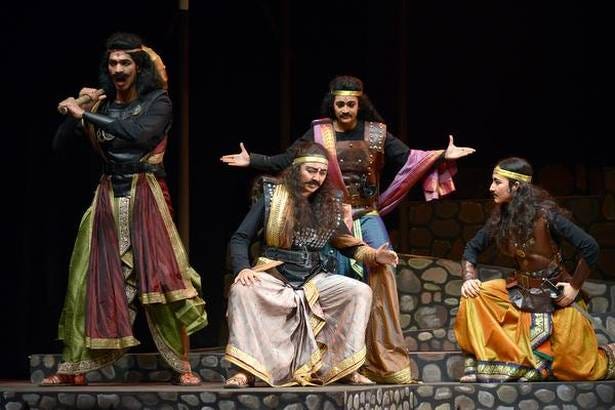
Shakespeare was at first commonly resisted but admired, however was very popular within the ‘Parsi’ theatre. First arising around 1853 and influenced by British travelling companies, Parsi theatre soon developed in to a touring company which not only crossed colonial but imperial India as well as South East Asia. Using the local languages of Urdu, Hindi and Gujarati it used melodrama and elaborate stage effects to entice its audience. (Hansen, 2003, [online]) However, Parsi theatre was often criticised by dramatists, as there was a common anxiety to keep to an Indian ideal and suit the cultural taste.
In November in 1852 the first staged version of a Shakespeare play in an Indian language appeared in Surat. Nathari Firangiz Thekani Avi was presented in the language of Gujarati probably for the Parsi theatre and roughly translated means ‘A bad European woman brought to sense’, or its Shakespeare equivalent The Taming of the Shrew. Contextually ‘Kate’ (Katherine) the main female character in the play, undermines the role of women not only in Indian society but also within the Elizabethan culture it was written in:
At face value the play proposes that desirable women are quiet and submissive, whereas women with spirit must be ‘tamed’ through a combination of physical and mental abuse. Necessary tools may include starvation, sense deprivation and the kind of distortion of ‘reality’ that is practised in totalitarian regimes.
Bate and Rasmussen, 2007, 526
As much as the Indian male would find amusement in watching a female be tamed, the character goes entirely against the female Indian stereotype, where the definitive ‘dharma’ (sacred law relating to karma and reincarnation) for a woman is to marry.
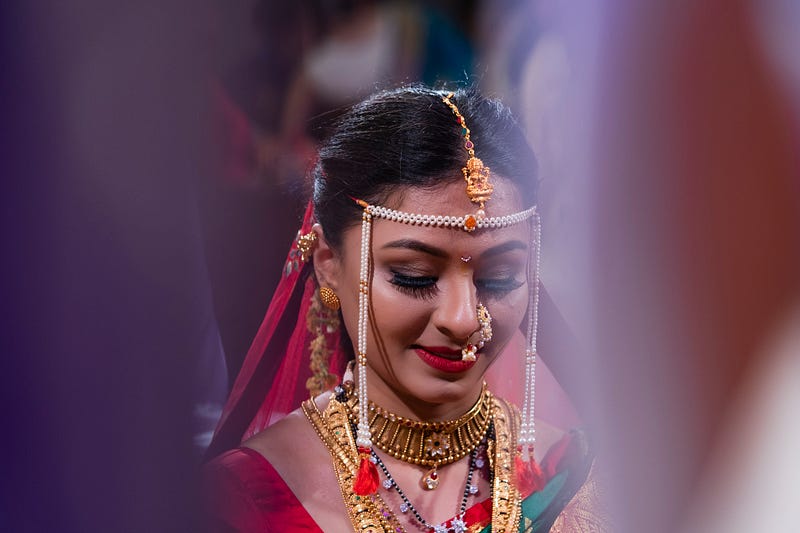
So why was it was important to make clear that Kate was a ‘Firangi’ (European) and not an Indian woman? India is by and large patriarchal and therefore lacks equality between the genders. The best life option to a woman of India especially in the North where independence is rare, is to marry, become a good wife and bear many sons. These customs are tied up within folklore and fairytale and the only difference in a woman’s freedom are caste, education and the number of years spent in work. (King, 1993, 389–390)
It is therefore easy to see why many Indian scholars of the time had particular difficulty in not only translating the word ‘shrew’ but also contextualising the play to Indian circumstances. In the earlier versions, violent equivalents were used such as ‘Chandi Mardan’ meaning grinding a vicious woman! Chandi refers to the Goddess Durga, who is the angry, armed warrior and wife of Shiva who defeated a demon that threatened the Gods. Later less brutal words were used for example the Hindi word ‘Parivartana’ denoting transformation. (Durga, 2004, [online])
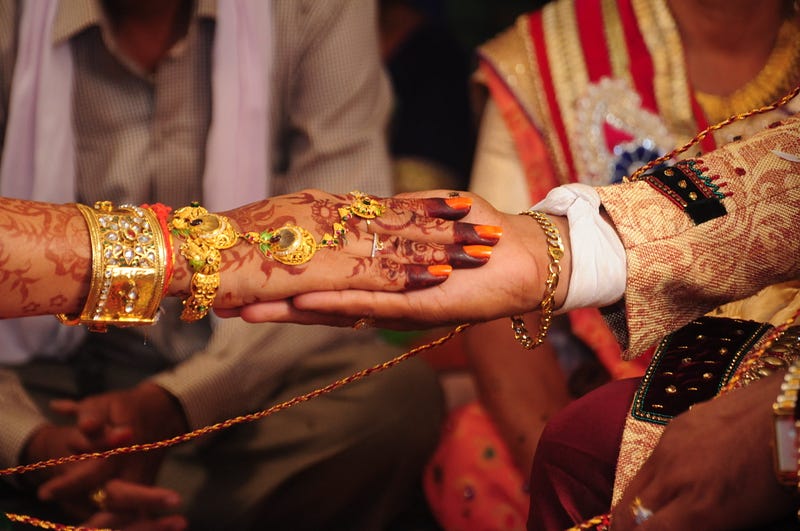
On the other hand The Taming of the Shrew does deal with the Indian tradition of arranged marriage. “Katherine does not refuse to marry Petruchio but the marriage is arranged before the two have met and without Kate’s consent or participation.” (RSC, 2008, [online])
The statistics for arranged marriage in India has been quoted as high as ninety-five percent and are considered along with size of dowry to be of prime importance. However, there are variations from the North to South of India.
In the North primarily among Hindu girls, marriage is arranged to a man in a distant village and family ties are cut. Perhaps this could be best demonstrated in the play when after their wedding ‘Petruccio’ forces Kate to his country house to tame her, cutting her off from those around her. Girls in the South tend to have more autonomy and marriage is arranged within a closer family network. That said there are also differences between the Muslim and Hindu community:
In India, for example, the general impression is that Muslim women are more likely than Hindu women to be denied work opportunities outside the home, a secular education, control over economic resources, recourse in case of abandonment or divorce, and choice in reproductive behaviour.
Jejeebhoy and Sathar, 2001, 690
This reiterates the complexity of translation, interpretation and performance of the play for the Indian audience and shows, that it would differ greatly throughout the different regions of the country as well as the religions. So each production based on a Shakespeare play must consider the cultural implications and practises of the area.
Although one of the first plays to be performed in India, my own research shows that not a great deal more has been written on Indian versions of Taming of the Shrew, perhaps this is due to the complex gender and cultural issues it invokes for the Indian audience.
What is true, is the Parsi Theatre opened up the possibility for Shakespeare in Indian theatre in many languages even if their adaptations had little to do with the original plays. Even though there was a decline during the growth of cinema and the Indian Freedom Movement, in the popularity of Shakespeare in India, this was short-lived and soon experimentation of the Bard within many Indian theatre forms became popular once again. The study of Shakespeare within Indian academic study has never ceased and through its translation, interpretation and performance, has been fundamental in the early advancement of contemporary Indian Theatre.
Article written by Drama Llama | Educator | Writer | Academic | Consultant