
Shadows and Spies: Mossad’s Ulysses Project
As i was browsing X (twitter previously), i stumbled upon a very peculiar report on one of the Mossad’s projects in the Middle East, according to the commentators, the article was deleted multiple times, i ll share with you an excerpt of the article i found (it says that the full story can be found in Friday’s Yedioth Ahronoth ‘7 Days’ magazine), i ll also write a summary, just in case the article is blocked..
The Article:
Summary..
Exposed: Mossad Agents Married Palestinians in 1950s to Maintain Cover
Operatives of Mossad’s Ulysses Project created false personas, wed Palestinians, started families — while secretly gathering intelligence for Israel
Among the operatives of Caesarea, the Mossad Special Operations Division, Uri Yisrael holds a remarkable distinction: He maintained a covert identity for an unprecedented 15-year period.
Yisrael, along with another operative known only as “Isaac” (whose real identity remains classified), participated in the Ulysses Project — a classified Israeli intelligence operation conducted during the 1950s and 1960s.
These agents infiltrated Arab communities by assuming Palestinian identities, establishing businesses, marrying local Palestinians, and raising families. They were instrumental in gathering early intelligence about Fatah’s formation and participated in initial operations targeting Yasser Arafat.
Uri Yisrael’s Palestinian-born son, now 50 and residing overseas, remains unaware of his father’s true identity as an Israeli Mossad operative. He’s also oblivious to the existence of his half-brother, Shai Yisrael, a practicing attorney born to Uri and his Jewish wife.
The operation originated in 1950 when Isser Harel, Mossad’s director at the time, established the Ulysses unit.
Its mission was to embed agents within Palestinian refugee populations across the West Bank and neighboring nations. The recruits were primarily Jewish immigrants from Arab countries, who joined after Harel and his team convinced them of the operation’s critical importance to national security.
The mission was unrelentingly harsh. The recruits, some barely out of their teens, underwent a complete severance from their families and were relocated to concealed apartments in Jaffa for an intensive eighteen-month training period. Their rigorous preparation included mastering cover identities, immersing themselves in Islamic studies, and receiving extensive training in espionage and sabotage techniques.
“Those were incredibly challenging times,” recalled unit commander Sami Moria. “When delivering their letters to families, I faced heart-wrenching moments. One mother would repeatedly plead, ‘Please, just let me glimpse my son, even for a moment, from across the street — I just need to know he’s alive.’
From the initial group, only nine candidates successfully completed the demanding training program and were subsequently integrated into the Arab-Israeli community. Their mission objectives included monitoring potential insurgency, maintaining readiness for possible enemy occupation, and establishing connections within Palestinian diaspora communities and Arab nations.
The verification process was rigorous and methodically planned. In one notable test, two recruits were deliberately dressed in tattered clothing and presented themselves as Palestinian refugees who had crossed into Umm al-Fahm from Jordan. They entered an Arab café and ordered coffee while Moriya and Shin Bet personnel monitored from a distance, knowing the establishment was frequented by Israeli police informants. Within thirty minutes, the area was swarming with eight police vehicles. The officers forcefully apprehended the supposed “infiltrators.”
The majority of Ulysses operatives concluded their missions in 1959, but two were transferred to Mossad service and maintained their Arab identities. With their handlers’ approval, they married, raised families, and sustained their cover as Palestinian nationalists.
In early 1964, these two agents provided crucial intelligence about an emerging Palestinian organization. Its leadership included two individuals then unfamiliar to Israeli intelligence — Khalil al-Wazir, known as “Abu Jihad,” and Yasser Arafat, operating under the alias “Abu Amar.”
Uri Yisrael, operating under the pseudonym Abed al-Hader, went so far as to provide the meeting space where Fatah’s leadership gathered to strategize their plans for Palestine’s establishment. The Mossad’s surveillance unit captured every conversation through listening devices embedded within the apartment’s walls.
In June 1964, Rafi Eitan, who headed Mossad’s European operations, approached the organization’s director with a bold proposition. He requested authorization for Caesarea to infiltrate the apartment and eliminate all occupants.
In his written communication to Meir Amit, the Mossad director at the time, Eitan emphasized: “We have unprecedented access to the target. The operation would be straightforward. We must eliminate this threat while it remains manageable.”
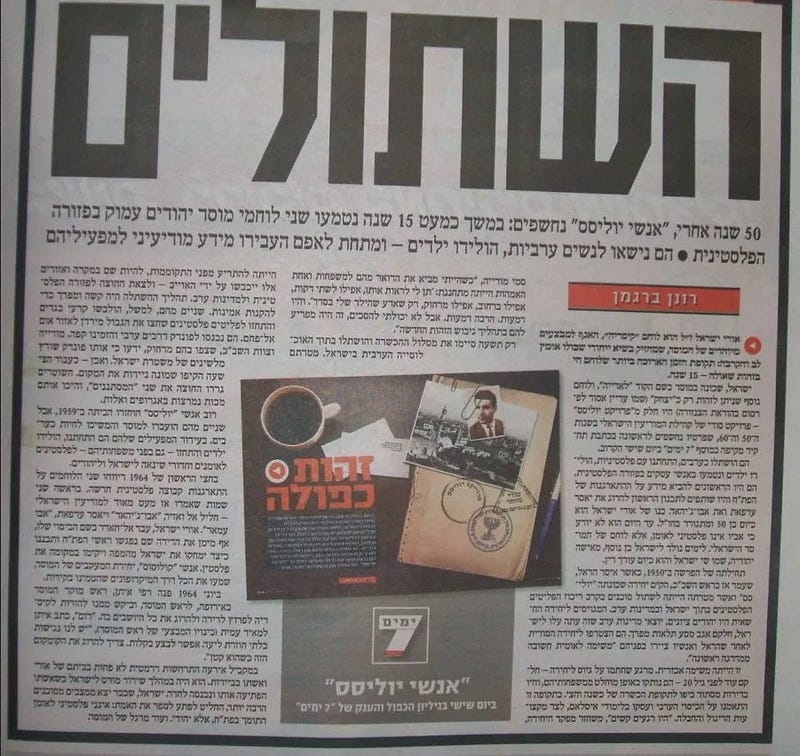
Apparently, the excerpt does not say the full story, it says that the full story can be found in the magazine.
However, we got a perfect idea as to how Mossad operates in the Middle East, frightening to say the least!!