
Shadow Work: Uncovering The Wounded Self
Two exercises to help you recall childhood memories.

Ahh, shadow work.
Where does one even begin?
One of the critical aspects of working with the shadow, a.k.a. the wounded self is to uncover the source of these hidden, darker parts of ourselves.
We need to investigate:
- Where did these feelings come from?
- What happened to me as a child?
- What did I experience to cause me to reject and deny these parts of myself?
Essentially we need to do a deep dive into our childhood.
Since we are deeply shaped by our childhood experiences, remembering painful or traumatic memories is vital if we want to avoid repeating them in our adult life.
Below are two of the most effective exercises to recall memories and feelings from childhood and are powerful to do when working with the shadow.
1. Drawing and Reflecting on Your Childhood Home
Think back to your childhood home. If you lived in multiple places, start with the one that sticks out in your memory the most.
First, call to mind the front of your house or apartment building.
Sketch or draw a picture of what the outside looked like. For context, jot down the years you lived there, and the ages you were at the bottom of the drawing.
Next, choose a room inside.
- Reflect on the room for a few minutes in a conscious waking state with your eyes open. Recall the objects, furniture, windows, doors, and the entire layout of the space.
- On a new sheet of paper, draw a sketch of the room based on your recollections.
- Meditation: With these memories fresh in your mind, close your eyes and visualize the room and let the memories and insights flow naturally.
Lastly, write down your insights and answer these prompts:
- What initially comes to mind when you think of this room?
- What usually took place in this room on a daily basis?
- What are the good memories you have in this room?
- What are the bad memories you have in this room?
- How do you feel about this room in general?
Be as detailed and descriptive as possible. If you find yourself going down a rabbit hole, good. Keep going. I have found the deeper you go the more you will uncover and it will lead you to prompt your own questions.
Repeat this process for every room in your house.
Take your time.
It’s best to do this exercise over time. Avoid trying to go through every room all in one sitting. Give the memories time to come back to your consciousness.
What has worked for me when I did this exercise is to set aside 1 hour a week to go through and flush out the memories for one room.
Also, keep in mind the drawings can be as basic, or as elaborate, as you feel like making them. This isn’t about the quality of your drawings. It’s about reconnecting with the environment you spent most of your time in as a child so you can kickstart your memory.
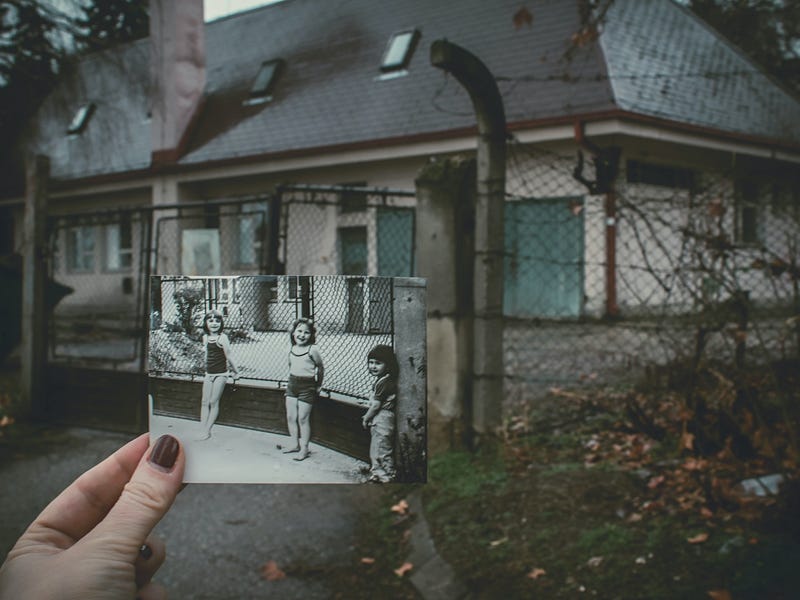
2. Gazing at a Childhood Photo
This exercise is a spin-off of a technique I learned from the TMS Pain Recovery Program for generating self-compassion by connecting with your inner child.
Start, by finding a photo of yourself from childhood.
Choose one from a time that most resonates with you. Don’t overthink the photo, just go with one that feels right.
Find a quiet place and begin to gaze at this younger version of yourself.
Imagine yourself as this child.
Visualize yourself feeling vulnerable, when you were being treated harshly, or when you were in some sort of emotional pain and needed to be comforted.
Notice what feelings come up.
Care for this inner child.
Think about how the present-day adult version of you would care for that child in the situation you imagined.
- What would you say to him or her?
- How would you comfort him or her?
- Imagine telling this child things like:
I will hug and love you every day. Everything’s going to be okay. I will take care of you and protect you.
As you look at your younger self in the photo, remind yourself that this child is with you all the time. You can connect with this child every day and take care of him or her.
Repeat this process with another childhood photo from a different time and see what arises.
What strategies or tools do you use to help recall painful childhood memories? Let me know in the comments.
👉 You are a conscious creator! Join my weekly newsletter on everything self-development and spiritual growth.


