
Shackleton’s Ill-Fated Ship ‘Endurance’ has Been Found 107 Years Later
It is resting deep in the Antarctic waters, virtually intact, and it will be left untouched.
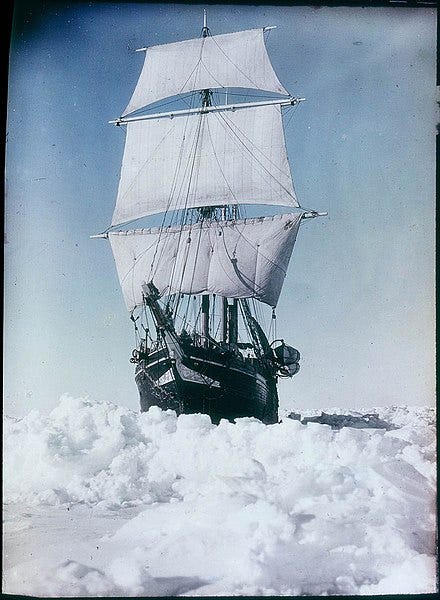
The Imperial Trans-Antarctic Expedition, the last expedition of the Heroic Age of Antarctic Exploration. An introduction full of romance, excitement, and adventure to one of Sir Ernest Shackleton’s missions to try to reach the South Pole.
The Irish-Anglo explorer pushed the limits of Antarctic exploration. Ever active, his passion for exploration and call to reaching the South Pole had been once again roused after Norwegian explorer Roald Amundsen’s party succeeded in the task on 14 December 1911.
PREPARATIONS
Preparations for the new adventure were detailed and articulated, between finding financial support, careful studying and planning of the journey, and finding the right crew. Also, two ships, which were purchased in February 1914, Aurora and Polaris. He renamed Polaris to Endurance, after his family motto “By endurance we conquer.”
Endurance was a barquentine, a three-masted sailing vessel designed and built by a specialized shipbuilding and engineering firm headquartered in Norway. The design did consider the dangers of the ship being stuck in ice, but the risk of being stuck long-term had not been deemed relevant. First, it had originally been intended as an ice-capable steam yacht use (i.e.: as a luxurious means of Arctic transportation for leisure passengers), not for prolonged time in icy waters. Second, in the sixteen years prior to Shackleton’s latest journey, only one vessel had been crushed by ice. The Endurance was insured, with no more major thoughts given to this aspect.
SETTING SAIL
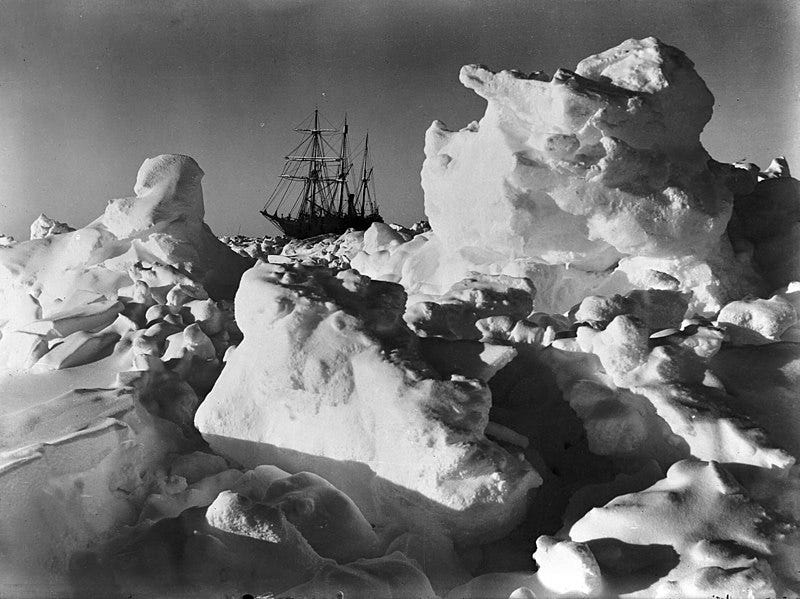
In summer 1914 the ship had been refitted, supplied, and manned. On 6 August 1914, the Imperial Trans-Antarctic Expedition officially began, setting sail from Plymouth, England to Buenos Aires, Argentina. On 5 November 1914 they then arrived at the whaling station of Grytviken in South Georgia, where they departed on 5 December 1914 for the Waddell Sea, Antarctica.
Two days later, the expedition met the first hurdle, as progress slowed to a crawl after meeting the polar ice pack. Conditions never improved. A strong gale forced them to stop for several days and started compressing the ice. That ice would never relent and would mark the beginning of the end of the expedition — and the Endurance. By 24 January the ship was icebound, surrounded by a white layer of ice in every direction as far as the eye could see. By February 24 1915 the ship essentially became a fixed station, although the packed ice kept drifting, and not even in the desired direction.
From 2 May 1915, the beginning of the polar winter and perpetual darkness, the Endurance would be at the mercy of the elements. Battered, moved, lifted, bent, swept, rarely released from the ice just to be bashed at again. The structure proved exceptional as expected, with permanent but only superficial warping. Alas, it was only time before major damage would be sustained since the ice pack gave no signs of relenting.
This happened at the end of October 1915. On the 24th, slammed by a large mass of ice, the stern post was torn away and the bow planking was stoved in, causing flooding which was eventually halted after 28 hours of continuous work. Nevertheless, the fate of the ship was marked. Shackleton ordered any useful equipment, besides the supplies, to be unloaded.
THE END
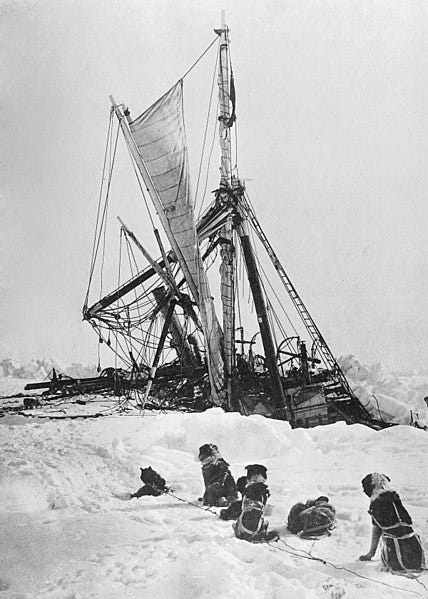
The Endurance, colors flying by Shackleton’s order, was slowly but steadily being crushed, dragged down, and overtaken by ice and snow. By 8 November the upper deck was still level with the top layer of the ice while all the interiors were filled with ice. The masts were still standing, and were eventually felled by yet another pressure wave on 13 November, moments that have been recorded on film.
The icy coffin closed on 21 November 1915 in the span of a minute. A pressure wave lifted the wreck as the ice closed in together. When it passed and the ice briefly separated, the wreck sank, and the ice immediately closed over it, erasing the Endurance from sight for a long time.
SEARCH MISSIONS
With the new millennium there have been a few attempts to find, or to begin a search expedition, the wreck of the Endurance. In 2001 and 2003 for example. Wreck hunter David Mearns returned in 2010 sponsored by the National Geographic Society. In 2018–19, another unsuccessful attempt even with the use of unmanned vehicles, lost to the ice. The centuries passed, yet the ice can be just as unforgiving.
The Endurance22 expedition was announced by the Falklands Maritime Heritage Trust in July 2021. It would begin the search in 2022 and it would use unmanned vehicles.
DISCOVERY
On March 5, 2022, the wreck of the Endurance was found at last. Laying silently 1.86 miles (3 kilometers) under the sea and just 4 miles south of his recorded sinking location. It was in great condition. The extremely cold water and little sediment depositions had kept it basically in the same conditions as when it had sunk almost 107 years prior.
The name was fully visible on the stern: Endurance, in gold-painted letters. Planks, rope, and other items littered the deck, basically a sight of a really messy ship as if it had been on land. But this one was surrounded by black icy cold waters, which were very still and with little marine life or sediment.
As per the original search expedition’s plans, the wreck had been photographed and recorded extensively, including with a thorough ultra-high-definition 3d scan, but left untouched and undisturbed.
The wreck is still there, now a protected historic site and monument under the Antarctic Treaty System. The ship has lived up to its name, in its own way.


