
Sex, Satire, and Unabashed Jewishness: Pouring One Out for Broad City

The fifth and final season of Broad City is kicking off.
As a Hulu subscriber who doesn’t own a TV, this means I’m going to have to wait a while to actually see the series finale. And the finality of a lot of things is hitting me: I’ll be 35 next year, it’s 2019 and a new decade will be upon us in tandem, and Broad City, like many good things, has reached the end of the line. It’s the end of an era and I want to write about it in real time as future Rachel painfully avoids the tweets about the final episodes in the next few months.
I could needle on with that old cliche rooted in truth about how the end of something you adored leads to a new beginning. And practically speaking, I conjecture that the real-life Abbi and Ilana are ready to move onto other things which I’ll happily support. I sure as hell have changed and evolved from 2014 to 2019 as a person and a creator. But as a New York Jew of a Certain Age, I felt the need to pen this essay on how much this show meant to us.
In my little retrospective on Cosmo Kramer a while back, I touched upon how Seinfeld was not only a pretty revolutionary comedy for the time but Larry David feared that networks wouldn’t want to pick it up because it was “too Jewish”. While there’s some jokes and a few long story arcs that provide some bonus hilarity to people who were raised Jewish, I don’t think you need to be highly familiar with Jewish traditions and tropes to get what’s happening. When I caught various episodes in my childhood then watched it again as an adult, I felt “at home” in a sense but didn’t feel the burning sense of identity and “This was for us!” that I felt watching Broad City which didn’t debut until I was 29.
When I started college shortly after 9/11, the show that virtually every woman my age watched was Sex and the City.
It was adapted from a book of the same name, based on creator Candace Bushnell’s anthropological observations of Manhattan’s insular high society and the glitterati on the fringes of it who lunched, soiréed, and hung their Manolos in some of the most chi-chi neighborhoods in the world. Then the show changed directions and focused more on the main cast’s relationships and continuous story arcs, opposed to the more open-and-shut episodes in the first two seasons that more closely resembled the source material.
And well, for the average viewer, the show was pure fantasy.
There’s already tons of thinkpieces about how unrealistic Carrie Bradshaw’s lifestyle was even after accounting for old school rent control, not to mention how nonsensical it was that she was pretty damn prudish and queerphobic for a sex columnist. (And $4/word writing jobs at Vogue? Cue dagger eyes from every freelance writer in the room.) Ditto for the fact that the show centered around four wealthy white women and gave pretty much no screen time to actors of color, and more or less still enforced a very patriarchal and heteronormative worldview. After all, the incredible lifestyles, adventures, and careers these women have still take a backseat to the relationships they pursue and drowning your sorrows in overpriced cocktails and designer handbags is promoted as the cure-all for heartbreak.
But despite valid criticisms of the show, Sex and the City undoubtedly played a revolutionary role in how women discuss sex and relationships with their friends and in general.
It sparked conversations and in-jokes, and was an early-aughts primetime staple for those nights in by yourself or with your girlfriends. And we all knew at least one Charlotte York holding out for marriage and 2.3 kids in this ever-worsening hellscape, and more of us identified with — or wanted to be — Samantha Jones than we cared to admit.
Then 2008 happened.
The economy came crashing down and my generation’s once-bright prospects and hopes were quickly buried deep underneath mountainous debris. Some never emerged from the wreckage as i-bankers snickered with the loot they ran off with as the new administration defied our hopes and never bothered to punish them. Sex and the City had been off the air for four years by the time it got a theatrical release, but we were too busy graduating to a decimated job market and trying to survive to really get much enjoyment out of seeing Carrie Bradshaw try on wedding dresses and take her girlfriends to a five-star resort in Mexico. Both of which cost as much as our undergraduate degrees that were now rendered more worthless than a Crazy Eddie gift card but chained many of us to a lifetime of debt servitude no less.
When it was apparent that the Great Recession wasn’t going to be magically fixed by hope and change, TV executives realized that Millennials were going to be the largest and most diverse generation in American history. For Millennial women in particular, we were tired of fantastical and “aspirational” parables of single life with your girlfriends in the liveliest (and subsequently, most prohibitively expensive) parts of Manhattan or LA with “rent control” flimsily written in. We wanted jokes about being unable to afford dollar pizza because of student loans, outrageous rents, and pitiful wages that didn’t align with our education levels. Stories about the existential panic we were — and many cases, still ARE — feeling with respect to careers, romance, the difficulties of forming and keeping friendships in the age of social media and massive economic instability, climate change, and the ascent of global fascism. Demands were made for portrayals of the joys and utter agony of dating in the age of social media and dating apps, and what goes down at the real parties go far from the places where cosmos are $20 a pop.
Even today as most of us are in or edging into the same age bracket as the ladies on Sex and the City, we knew we’d never be able to relate to these characters. How the hell did four professional women in their thirties get together that often unless they practically lived next door to each other, even BEFORE Cuomo’s MTA and Uber made two-mile treks require several days advance planning and a sherpa?
So, our fevered discussions on social media and XO Jane were heard. We wanted “realer” stories about friendship, life in the big city, and sex that had a blend of drama and hilarity and we got them — or at least whatever the executives thought would resonate with an audience hungrier for more relatable stories. 2 Broke Girls and Girls came into existence then Broad City followed suit.
Broad City was soon branded another “realistic” show for 20-somethings but it was so much more.
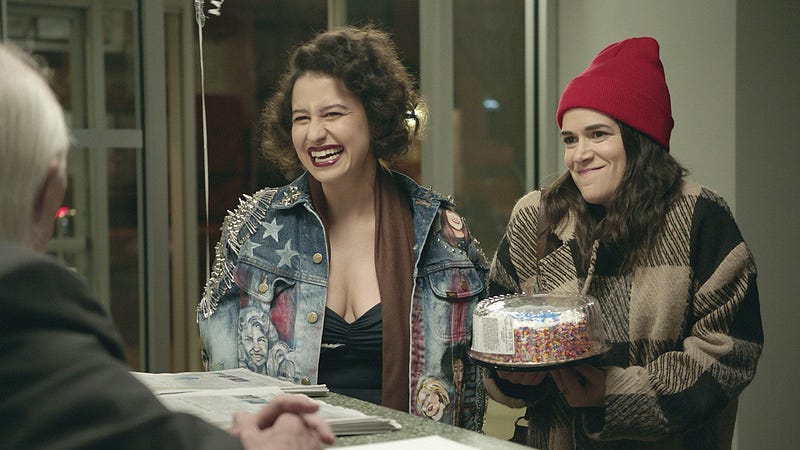
Unlike its predecessors, Broad City sprang from a YouTube series that Abbi Jacobson and Ilana Glazer independently produced together after the two met at an Upright Citizens Brigade class. Books and original TV shows aren’t dying anytime soon but the fact that the show originated on YouTube hits home: the line between traditional media and the Internet gets blurrier by the day, but to certain subsets of people and entire generations the Internet still has zero credibility as a medium.
There’s Twitch streamers you might not have heard of with viewerships that exceed many primetime TV shows while other content creators would have what’s considered a significant online footprint yet aren’t seeing financial gain from it. Making a living off YouTube and countless other online means, or using it to get discovered, has also totally changed since the duo started making videos in 2009.
At a 92Y talk I attended spotlighting Broad City alum D’Arcy Carden who’s now one of the most sought-after actresses, she was accompanied by Jacobson and Glazer who revealed that the web series and TV show took off because all of their UCB classmates made a point to lift each other up, thus their class in particular resulted in a host of highly successful talent. Carden also told a story that elicited gasps from the packed room about how she had to physically take her UCB check to the office and the person behind the desk was Donald Glover. A stunning amount of extras and minor characters on Broad City were various people that they knew from UCB classes and clubs! Forget everything about discoverability algorithms and public relations: there’s so much to be said for finding your tribe and elevating each other.
So sure, the TV versions of Abbi and Ilana worked shitty Craigslist gigs when they hustled to get themselves out of financial binds, and had bouts of unemployment. They lived with roommates in Brooklyn and Queens, got disastrous Groupon haircuts, and their only outings to fancy clubs and restaurants were of the gate-crashing variety. It made Abbi and Ilana far more relatable than 20 and 30 something characters of yore, and a better fit for post-recession viewers expecting a little more realism.
But it’s the ORIGINS of the show that strike on an equally visceral level as a lot of the actual episodes themselves which I’m about to deep-dive into. There’s much to be said about the unprecedented opportunities in media that we have nowadays that’s tempered out by the difficulties in growing an audience or getting that big break.
The humble origins as an independent YouTube series aside, Broad City completely subverted many of the fears and tropes present in TV series I previously discussed. Sex and the City wasn’t afraid to get in your face about sex and discuss the often stupid decisions grown adults make in relationships, but Broad City showed actual rifts, conflicts, and fears in friendships and romances alike peppered with the de jure liberation of women engaging in intensely gross physical comedy. Larry David feared that Seinfeld would be too Jewish for mainstream audiences, but Broad City blatantly wore its Jewishness on its sleeve and in a manner that literally made me feel something in my chest when I watched certain episodes.
The above GIF is from “Knockoffs” in the second season and what I’ll primarily focus on, as other episodes could have entire essays devoted to them but this hits home the most. It’s so rich in symbolism in addition to locations and scenes that have major personal significance to me.
So if you haven’t seen it, Abbi and Ilana each have their own plots where the former has accidentally acted on her crush on the hot neighbor and is about to hook up with him the first time and the latter is attending her grandmother’s shiva after joining her mother on her quest to stockpile counterfeit Coach bags in Chinatown. (Turns out there’s a whole-ass resource for what’s involved with sitting shiva so I linked that if you’re more interested in learning about Jewish mourning rituals.)
I was instantly teleported back to the past even though this episode helped me live in the now.
A few years before I was born, my grandparents left the Bronx for Southbridge Towers. It was one of the most coveted Mitchell-Lama cooperatives in lower Manhattan even though the Two Bridges area of the seventies was pretty far-flung from the artisanal ice cream shops and designer baby boutiques lining the South Street Seaport today. After decades of dealing with landlords who wouldn’t rent to Jews then priced or redlined out of areas they could’ve bought in to raise their family, they were finally going to own something as retirees after being waitlisted for 17 years.
It was the teachers, artists, and retired City workers like my grandma who transformed the Two Bridges region and the area surrounding the South Street Seaport from blight ignored by the City into real communities. Communities that slowly seeped out and withered away over the years with their life force extinguished by rapacious foreign real estate developers who turned the mayor and City Council into docile lapdogs. They encouraged developers to take advantage of the Mitchell-Lama loopholes and goad existing complexes to renovate and privatize if they could get board approval, then Southbridge Towers’ heart stopped beating upon its privatization in 2015.
Chinatown was just a stone’s throw away and I have so many fond memories of walking along Mott Street with my grandparents or my dad, and feeling like I suddenly entered a different country. We’d go back to the apartment that was only inhabited as of the height of disco but felt like the set of Yentl. It served as a portal into another time and place: pictures and drawings dating back to the Pale of Settlement adjoined my grandparents’ wedding portraits taken during WWII. Tchotchkes that were smuggled out of the Old World lined the picture window overlooking Beekman Street, the wall dotted with pictures of my family and my grandparents’ anniversary trip to Vegas that was a be-all end-all for them. It was a time warp that often heightened the feeling I was living in the past, but it was a comforting past opposed to the endless smothering loop I normally felt and would struggle to escape from for decades.
My grandfather died when I was in third grade and I remember sitting shiva in that same apartment for just one day. Having grown up seeing virtually no representation of Jewishness in mainstream media, it floored me at 30 to not only see a whole episode centered around a shiva but that it also mirrored my experience of sitting shiva in Southbridge Towers. We weren’t an incredibly observant family so I don’t recall whether the mirrors were covered, but we sat on the shiva boxes the rabbi gave us. Then the event mostly consisted of my extended family complaining about Mayor Dinkins and traffic on the LIE while we ate traditional shiva fare (bagels, deli spreads, and opening fruit baskets, I remember the endless arrival of fruit baskets when my mother died a couple years later.) This was in between telling funny stories about my grandfather’s antics, my great-uncle’s favorite being how he always wanted a monkey and even had a chance to get one through a guy he knew on Coney Island until my grandmother said “It’s me or the monkey.”
Jewish mourning rituals have this duality no matter how observant you are. Funerals and the actual burial are done ASAP. Shiva is observed anywhere from one to seven days but honoring the deceased is further drawn out with Yahrzeit observance and the unveiling ceremony one year later on the Hebrew calendar.
While Broad City is told through a largely secular lens that centers culture more than religion, a sentiment an increasing number of Millennial Jews in America apparently identify with, I found myself thinking about this duality in how this particular episode hits home with me. It wasn’t solely seeing some interpretation of my childhood memories broadcast on TV that was so core-shaking.
That episode was an expression of Jewish duality itself. The main idea of sitting shiva is that loved ones take some time to focus on grieving instead of being consumed by what else is happening around them, even things that make them happy like going to the movies or concerts. But “Knockoffs” is anything but focused! Initially, Abbi is hyperfocused on finally sleeping with Jeremy until she warps his shinjo in the dishwasher. There’s the madness with Bobbi Wexler and her counterfeit bag obsession (by the way, every Reform family within 60 miles of NYC has that batshit mom or tante just like her.) This frenetic burst of change takes place in just 22 minutes.
There’s much ambiguity in Reform Judaism as to whether there’s an afterlife and what happens after we die. But it’s safe to say that Grandma Esther, a woman who lived a full life with no regrets, sent some of her light to Abbi in her moment of doubt. It’s not even that Abbi bluntly says she was inspired by Grandma Esther’s adventurous streak when she attends the shiva: she’s taken aback at Jeremy’s request to peg him, but decides to go through with it while caught in the moment. And while I died laughing at the scene where Ilana’s parents reveal they went to a swingers’ party and didn’t have sex with anyone but stayed because the food was great, followed by Bobbi congratulating Abbi on trying new things, something about it just felt so much like home that I never felt with any other TV show I’d ever seen.
Abbi wanted to sleep with Jeremy so for so long and it was a drawn-out process until she finally called him under the influence after getting her wisdom teeth removed. Having made major moves towards what I want in life after being high on anesthesia, this too hits home to the point I could feel it crashing on the shores of the Bronx River.
But while Abbi deliberated for so long to make a move on him just to have the ensuing mishap go down so fast? Attraction can be like that but so can numerous other things in life.
Sometimes we sit shiva for that dream job we didn’t get, that partner who rejected us, the childhood we didn’t get to have. Mourning for what we missed or was never ours in the first place can become an all-consuming thing if we’re not careful: Ilana is absolutely right when she tells Abbi that her crush on Jeremy was holding her back because it made her act differently and possibly miss out on other men, who could’ve just been fun diversions or perhaps the kind of partner Abbi has been seeking all this time. She lives in Jeremy’s ephemeral dream realm oh so fleetingly that hurtling back into reality stings so much more: I think that strap-on getting stuck in the door on the way out of his apartment is unintentionally symbolic.
Namely in that we need to move forward and focus on how to make “what should be” into “what is”. There’s nothing wrong with having a yahrzeit and remembering what what we would and wouldn’t do again, but time marches on.
This episode is beautiful in its chaoticness and perhaps unintentional portrayal of the duality in Jewish mourning rituals and ambiguity in how our culture and faith deal with death. With those faded pictures of my grandparents in Vegas still fresh in my mind, I think of how it wasn’t just Southbridge Towers I didn’t get to say goodbye to. The life that they had simply can’t exist in this economy and world anymore unless you’re incredibly wealthy. I too had a be-all end-all Vegas trip that was living a dream I had for so long, and can easily jump on a plane thanks to financial, career, and infrastructure ease that didn’t exist when they were my age. I can’t say I’d trade it in for what they had. But I think of that solidarity they had with their neighbors and the solidarity Abbi and Ilana spoke of at the 92Y talk and what was clearly evident in the show.
New York is a city that can tell infinite stories through every medium as it’s a living breathing force every denizen takes in and materializes differently. It changes with time and technology like anywhere else does but there’s some changes we don’t want. All of the family I came back to this city for have been dead and gone for some time. The New York shown in Broad City is still drastically different than the New York I grew up in, and even what I live in present-day southeast Bronx. Some of it comes down to personal preference like eschewing a traditional job, refusing to partake in dating apps, traveling frequently, and so on. But this city is not just in my blood, it’s a city that can simultaneously mourn for centuries yet move forward faster than a text message.
Broad City wasn’t only about girls being unafraid to say and do gross things and reduce their stigmatization, or addressing the harsher parts of keeping or cutting off friendships and hitting a turning point in your mid-late twenties. It was a love letter to New York that wasn’t afraid to harp on it when needed.
In an age where Donald Trump is president and companies post shiny billboards that normalize selling bodily fluids to pay for rent and tuition, it feels like satire is truly dead. And there was no time to even put it in the ground let alone sit shiva for it.
But satire thrived during Broad City’s run, where Abbi’s sojourn to North Brother Island for a package mastered the art of taking a minute task and transforming it into this epic battle-torn journey. And revisiting Grandma Esther as the Wexler family cleans out her apartment in “America’s droopy dick”? I wouldn’t be surprised if guns DID come with new apartments there.
For a show that put satire front and center in a world growing ever-stranger and more hyperbolic by the day, it also made us fall in love with the characters’ friendships and the incredibly real dynamic that they had. Abbi and Ilana both question where they’ll be in the future and they handle seeing old friends in both disastrous and realistic fashions. They take on the type of growing pains that still happen in our mid-late twenties like realizing we weren’t the best people and maybe even still got work to do.
I’ll happily support the epic creative endeavors to come from Abbi and Ilana even though I’m sad the end of an era has come. The show did so much for realistic portrayals of how women talk to one another, hope amidst existential crises, and unabashed Jewishness for those of us who didn’t get to grow up seeing that.
And I can’t think of a better way to end this essay than with this.


