7 Strategic Lessons That Helped Me Get Over 500% Growth in My Third Month on Medium
Time-tested strategic tips that work outside Medium, now applied to Medium journey; don’t decide to write, decide to be a writer.
The Preview
After reading the umpteenth article on how you should write every day to be successful on Medium, I feel compelled to write this. The “write every day” advice can never work for someone like me with young kids and both myself and my wife in full-time jobs. You don’t need to quit your day job and you can still be exceptionally successful in your side hustle. There are countless examples of success stories (if only, you look around). You just need to make sure that you are strategic in your journey. In this post, I will share my top seven strategies that have, so far, worked for me and they will work for you too if you can get the essence and start on your own journey. The strategies that I am about to tell you about are not unique to Medium. They work in other domains of life too and while I am new to Medium, I have seen it working in my life exceedingly well outside Medium.
My Medium Credentials
Let me begin with a summary of my brief journey on Medium. I have been on Medium for 100 days having written only 10 articles (yes 10, it’s not a typo) in this short period. That’s one article every 10 days. This frequency of writing is significantly lower compared to what is suggested by the “experts” I have read from on Medium. However, these 10 articles have amassed me over 22,000 views, $314.97 in total and I have gained over 100 followers on the platform. My earnings in the current month have now crossed $100 for the first time and stand at $222.39 at the time of writing. Looking at the previous records of Medium partner earners, the majority of Medium writers earn less than $100 per month and the percentage of writers who earn more than $100 any month has never exceeded 10%. If the previous pattern still holds true for February 2021, then I have now comfortably climbed to be amongst the top 10% of writers based on monthly earnings. This should be quite good for someone who has never publicly blogged before and had no idea of what Medium was, a little over 3 months ago.
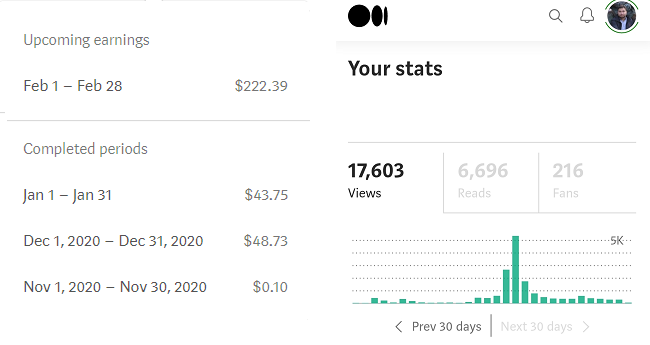
But I did not reach this point by fluke. And my stats are not driven by a single article. I have now 4 articles that have crossed 1,000 views. And when I started, I had no clue about the things I know now. My first two articles performed poorly, are self-published, did not get into any publication and have the least views. And my 10th article is the most viewed so far. At every step of my brief journey, I have focused on learning. After every article I wrote, I questioned what I learnt and how can I apply that to my next article.
“Write An Article Everyday” Is Bad Advice for Beginners
The last thing you want in your new side hustle is burnout. Getting successful in such creative endeavours (be it writing or any other content creation) requires consistent effort over long periods of time. Consistency is the key and a great analogy I have found is to relate it to the difference between running for a sprint and a marathon. Being successful in Medium writing is like running for a marathon. If you try to speed up too fast, too soon, you may get exhausted and burn out before ever reaching the finish line. If you could write every day, by all means, go for it. Write every day! But such advice can never work for someone like me with several commitments outside Medium. Also, there is a more fundamental problem with setting a goal of trying to publish every day. Such advice nudges you to focus on the wrong thing. Let me explain…
Beginners Should Focus on Processes, Not Goals
Writing one article every day is a goal. But allocating one hour before lunch every day, to sit and write, is a process (that can help you reach that goal). Your output is causally linked to a process, not a goal. A goal is something connected to a future that you aspire to reach. The process is connected to the present, the actual moments where you can take actions to help you get closer to your goal. You can only do something right now about the present… not the future…not the past. Focussing on processes rather than goals helps you focus on the present rather than dream about a future goalpost. Improving what you do now, what actions you take now, are what will help you reach your goal. If you have good habits and a good system of how you spend your present, your odds of reaching your goals will be higher.
Let me give you a simple example in the context of writing for Medium. Suppose I have a habit of checking my phone and being on social media every night after kids fall asleep and I end up spending more than an hour doing this, every night (or most nights). If I now wish to write on Medium, and I have a goal-oriented approach, I will try to muscle myself through at different times during the day or night, trying to reach my goal. And if the target is too high, I will eventually frustrate myself and probably give up, (and believe me, that this is impossible). Instead, if I am more focussed on improving my processes, I would pay close attention to how much time I spend on social media, what are the trigger points that lead me to mindlessly spend my time, and how can I avoid those triggers, and use that time for writing on Medium instead. I won’t have the needless pressure of reaching an arbitrary number and can fully focus on my processes (the outcomes would naturally follow, as a by-product). James Clear, in his book on Atomic Habits, has dealt with this idea extensively, and he made a wonderful point where he said that both winners and losers have the same goals.
If goals alone could determine success, then the losers wouldn’t be losers after all.
The tips I am going to tell you in this post are inspired by this philosophy of focussing on the processes, (at least in the beginning), rather than goals. Goals have their own place too, but they come later. A beginner first needs to get several habits tweaked, to make writing on Medium a successful journey. As you read further, you will realise that you likely have enough time during your 24 hours (even if you have a full-time job and young family), and a small portion of that can be dedicated to your side hustle.
Strategic Tip 1: Decide that You Are a Writer
This may sound subtle but I can’t stress the importance of this point. Don’t decide to write, but make the decision that you are now a writer. Attempting to write regularly for Medium will require a behaviour change. Borrowing the idea from James Clear in Atomic Habits, behaviour changes can come at three levels: outcomes (outer-most), processes, and identity (inner-most). You can use any of the three layers to help you drive your behaviour change. However, a behaviour change driven by identity, has much higher odds of success.
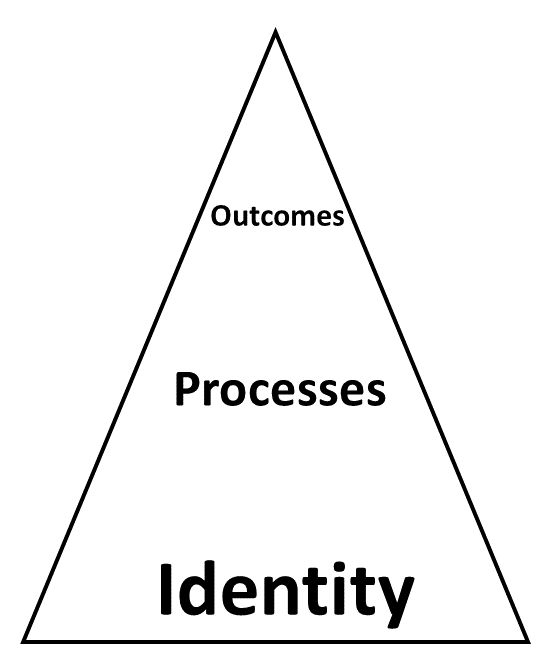
In the context of writing on Medium, an outcome-driven approach would be to try to write because you are seeking the outcome of writing. An identity-based approach would make you change your belief of who you are, (a writer). An outcome-based approach helps you focus on what you want to achieve but an identity-based approach helps you focus on what you want to become.
In my own journey, I started considering myself a writer after having published only two articles (pretty audacious, I know!). Those two articles are self-published and did not make it into any publication. However, after I shifted my belief that I am a writer, I naturally started focussing on improving my craft. This is because we humans are naturally inclined to take actions that align with our sense of identity. And once you believe that you are a writer (and not just writing to try it out), all the ensuing actions that can help you improve your craft will become easy. Your own curiosity and urge will spur you into action and seek avenues where you can hone your craft. There are tons of resources freely available in Medium and outside Medium (such as youtube), where you can learn and improve.
Change your belief of who you are. You are a writer (your level may not be where you want it to be, but that will come with learning. For now, you need to self-identify yourself as a writer and the rest will follow).
Strategic Tip 2: Make Small Adjustments To Your Lifestyle
My second tip is inspired by Napoleon Hill’s famous book, “Think and Grow Rich”. In the six step formula for converting a deep desire into practical steps, Hill states:
Determine exactly what you intend to give in return for the money you desire. There is no such thing as “something for nothing”
If you want to be a successful writer on Medium, you have to give something in return. The odds of success happening by chance to anyone, are practically zero. You have to set out a plan, and work towards it by sacrificing some of your time. But here is the part that I love. You don’t have to sacrifice anything important. There is a lot of time that could be utilized to help you become a successful writer (if only you decide to).
Lack of time is the most common reason I have heard, for people saying that they can’t write. You see, writing does not start from the moment you sit in front of a laptop to type. You can use your time during your daily chores to get some writing done. An article that you have written is nothing but a collection of ideas written coherently to convey a message. Our brains are constantly churning ideas, during shower, during commute, during the time when we stand in a queue in a grocery store. If you do decide to become a writer, you have a lot of time that you would have spent doing nothing anyway. All you need to sacrifice is a bit of that time and think about ideas. And perhaps an hour somewhere in your daily routine where you can put them on a paper/computer.
In my own routine, I have been trying to get up one hour earlier than I used to. This means getting up at 6 am and having one hour of writing time to myself before everyone else is up. I use this one hour to do the actual writing. However, I use some of the opportunities I get throughout the day to gather ideas. There is a lot more time during the day where ideas can strike (the shower time, the pick/drop school times, waiting in the queue at the grocery store, holding your child to put them to sleep). According to a recent study published in Nature Communications, we humans, on average, have over 6,000 thoughts every day. This is a lot of raw content and you only need to latch onto a subset of these to produce your content. However, you can only begin to make use of those ideas if you have made a decision to write. Otherwise, they are just that, ideas that nobody ever hears…
You have ample time during the day, a part of which can be dedicated to focussed thoughts to help with writing. There is a sacrifice required because success will not come by chance. However, the sacrifice required is much less than you may think.
Strategic Tip 3: Have Faith & Embrace Failures
Don’t expect success in your side hustle to be a walk in the park. This will not be an easy journey, emotionally. It will, instead, be a psychological rollercoaster. You may work hard on an article and expect a lot of views but it may still end up getting a meager response. The one thing that you don’t want, is to stop just because your motivation wavered, or you did not get the reception you expected, or perhaps your article was not accepted in a publication. Build resilience as you go along. Don’t take anything personally. If you don’t get the reception you expect, assume that it is due to your own writing (even if in rare cases, this is not true). This is because it will help you critically evaluate your work and will help you improve.
Understand this from the onset: Your motivation will waver at some point. You will experience heartbreak at some point. But when that happens, the worst thing you can do is to quit. Don’t quit! That is the time to pick yourself up and learn, and upskill. Successfully navigating through those moments is what separates the average from the excellent. You need to have unwavering faith in your ability to learn and upskill. And you only have to look at your former self to compare how much progress you have made. When you look at others who are way more successful than you, then only do so for inspiration and learning lessons. But don’t let anyone who is way ahead of you in the game, scare you. They are just ahead of you in the journey. But remember, everyone reached the summit a single step at a time. Look behind at your former self to see how much progress you have made, and look towards the more successful people at the summit, for inspiration. But don’t get scared by them. They did not fly to that point. They took a journey, over a period of time, one step at a time. And you can do that too!
I pitched my second article to one of the largest publication on Medium after finding out about “publications”. And they rejected it with an automated message telling me that I can try in a few months. It did hurt and I could have stopped then. But I did not. In fact, I tried to understand what went wrong and why my article was not accepted. It then forced me to raise my standards. I then wrote my next article in 2 weeks pitching it to them again. That article was not only accepted but it was chosen as one of the Editor’s Picks and featured in their dedicated column.
Have faith in your abilities; look at those ahead of you only for inspiration and only compare yourself with your own former self as a testimony of your abilities; apparent failures provide you with opportunities to learn, and upskill. Be resilient and make use of those opportunities.
Strategic Tip 4: Get Your Motivation on Steroids
Attempting to improve your skills as a writer is not just so that you can be successful on Medium. Writing is the most important skill that will seriously improve your odds of success in your life, even outside Medium. Writing helps you improve your communication skills, one of the most sought-after soft-skill in today’s job market. Your brain is constantly churning random thoughts but it is only when you attempt to put them on paper, you begin the serious effort to organize them in a coherent whole. Writing helps you think clearly.
Writing also helps you learn more about whatever topic you are writing about. You can passively read about a topic and learn about it. But when you have to write on the topic, you are not reading passively anymore. This is because you have to make sure that what you write is a coherent story and you can only do a good job if you, yourself, really understand the topic.
Think of all the benefits of improving your writing ability. You will become a better thinker, communicator and learner. These benefits go beyond success on Medium. Learn and reflect on these benefits to get your motivation of writing on Medium on steroids!
Strategic Tip 5: Build a Healthy Routine
Timing isn’t everything but it’s a big thing (Daniel Pink, Author of “When”)
Our energy levels, and mental ability, are not a constant and they rise and fall according to a biological clock (the circadian rhythm). You need to understand your rhythm and build your routine and set priorities accordingly. Most of us have peak hours in the morning , followed by a trough in the afternoon, and a rebound, (last few hours before sleep).
In the past, I used to check news, and social media first thing in the morning. I have recently, instead, made sure that I keep my head clear in the mornings, and make the most of my one hour before kids are up. In my day job, I try to have all scheduled meetings, (that I am able to move) in the afternoon to allow my mornings to be as free as possible to do actual work.
This is a journey, not a one-time stunt you can pull off. Therefore, you must build a routine that works for you taking your circadian rhythms into account. The worst thing you can do to yourself is to spend your most productive time in trivial activities.
Strategic Tip 6: Feed Your Mind
Writing is a creative endeavour. You are “creating” content. But where does creativity come from? Is it new ideas that never had any existence and came into being in someone’s mind? No, not at all. According to the Stanford neuroscientist and author, Professor David Eagleman:
Human creativity doesn’t emerge out of the thin air: it depends on remodeling what we’ve learned and experienced. Generation after generation, we chisel away at the cliffside of history for the raw materials of tomorrow.
If you want to be creative and produce content, you need to be a consumer first. You need to have a large reservoir of ideas, and thought patterns that resides in your subconscious mind. And when you sit to write, snippets of those ideas will filter through your own life experience to produce “original” content. Successful writers are avid readers. Become an avid reader of quality material. Thanks to the options we now have, you can even listen to audio books (even for free) during exercise, during commute etc. Over time, your reservoir of ideas in your subconscious brain will accumulate and soon enough, it will show up in your own writings.
Feed your brain with quality content to accumulate a reservoir of ideas. Existing ideas filtered through your unique experiences is what will lead to something original. If you are struggling to be creative, you likely aren’t adequately feeding your brain.
Strategic Tip 7: Get on Your Journey
Do you know why we selectively remember certain things, but forget many things that happen in our daily lives? It’s to do with emotional connections. The more emotions any experience evokes, the more it registers in the brain. You can spend months reading all the advice on Medium about writing and then think that you are improving. However, this is passive consumption and no matter how engaging any content you read is, unless you start your own journey, it will not get internalized. You may, by now, have read tips and advice from several “experts” on the dos and don’ts of writing on Medium but they will not internalize as much as when you write that one article yourself, hit publish, and then experience the results (in terms of views, stats etc.). Also, everyone has unique strengths and weaknesses and people can only tell you what worked for them. It is possible that a different strategy may work for you. But you can only know this if you try it out yourself. Therefore, my last and most important tip is: start your journey from today.
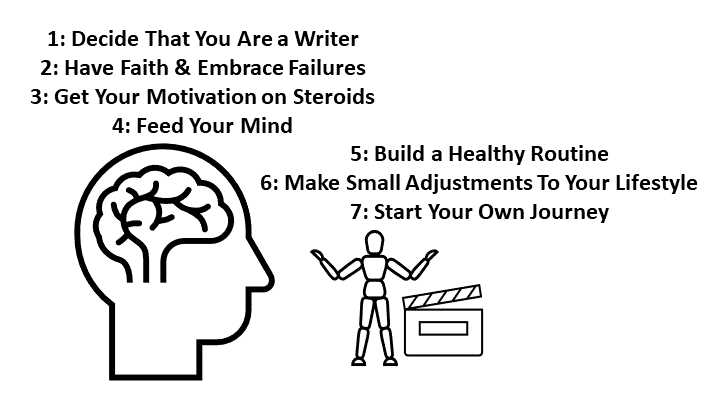
In summary, start with the decision that you are a writer (1), find time for this endeavour by making small adjustments to your routine (2), have faith and embrace failures (3), get motivated (4), build a healthy routine (5), feed your mind (6), and get the ball rolling (7).