
Seven Gates
I drag the burden of my estimated weight — minus my soul, seven stones boulted into seven grains of untouched intimations, of a muffled voice that cries in the hours of my dreams—
My soul a pitted drupelet that breaks through the membrane that encircles my world, hidden, and yet my nous offends me, it forms overlapping puffs as that of an endangered cloudberry that makes the the canopy of its drooping leaves, the only sky it dares itself to ponder.
And yet, at times the one ignores the other, as this day the soul cannot escape the call nor the pull of gravity — and my soul speaks with the letters I put down on this page, their thoughts a luxury, away from the company of my overburdened station.
I take a seat by the ebbing light of the seashore, the waves my solitary companions, crystal waves that break around the rise of the evening light — gently it rises as though touched by the many faces of an unknown god, rising around me and Panoptes, the eyes of Argus, hang as a chandelier from the sky lighting away the last remnants of the sitting wind. His eyes the folds of ever watchful ears…
The string of the phantom wailing of Eftambatousa* (Seven Doors) pulls me, this night, across the surface of the waters.
I break the the the surface of the void into the waiting arms of a choir, the cathedral of the sea, an amaranthine prayer on the crimson line of my lips.
2 kilometers away, I sway as an eel through the caverns of my voice, dragging my soul through the blue tears of the sea, with all strength left on the stairs of my sinew.
I break the surface, drowning on a breath of raining air, the chandelier above twinkles with sound, I hear its unveiling wonder and see the forbidden colours of the smile on my pain.
The windows of my eyes wet with hollow tears — I see the climbing chaos on the torn lining of the universe
I raise my lashes before I raise my eyes.
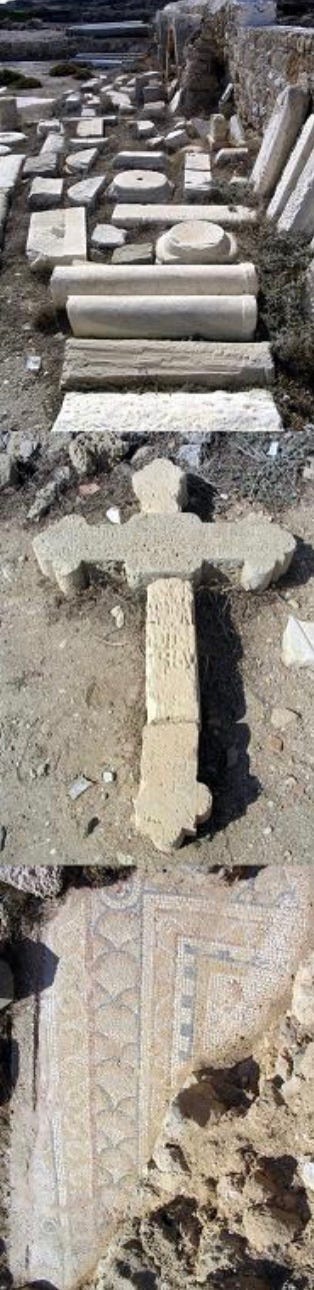
Maratho, was the original home of my ancestors the Spoites. Eftambatousa (Seven Doors or Seven Gates) are the ruins of a Byzantine Naos that was built by the sea for worship, it lies across from the shore of Agios Nikoloas, Spoa. The cathedral had seven doors that the people used to exit into the tunneled caves below it for safety from pirate raids.
On one such raid some of the inhabitants of Maratho, were burnt alive, and others were taken into slavery, they were found out because of a child that lagged behind in the chaos to reach safety. Their charred remains still lie there. A memorial is held for their souls every year on August 15th, the Annunciation of the Theotokos, who the Naos was commemorated to.
When Eftambatousa, was raided by Ottoman Pirates. The bell was plundered because it was used to notify the inhabitants of Eftambotousa that pirates were spotted offshore. Also for its size and precious metals.
The Loutra (baths), that were used to cleanse before prayer, the mosaic floors and Doric pillars on the site belong to a much older — the previous Ancient Greek Naos of Potideon (Poseidon) — still lies there centuries later. Protected by the Archeological Society of Greece.
Because the position of the town was in the route of pirate ships the people moved to higher ground for safety and protection from raids, to where my village is today, in the embrace of The Bounaro (The Mount)
Legend has it, that the wailing of Eftambatousa is heard by a special few. She is said to be heard crying because she wants to be returned home…
Copyright © 2021. R Tsambounieri.


