
Setting the “Portrait of a Lady” on Fire
Is being alone the only way to be free?
I was always intrigued by movies that depict forbidden love stories. Is a forbidden fruit desired more because it’s not allowed? In some countries or communities, a movie about lesbians might be viewed as immoral, but Portrait of a Lady on Fire is just another love story.
The plot of Portrait de La Jeune Fille en Feu is set three centuries ago in Brittany, France. Director and writer Céline Sciamma won the Best Screenplay at Cannes in 2019 for this, her third feature film selected for screening at the prestigious festival. Sciamma’s earlier films Water Lilies, Tomboy, and Girlhood formed a coming-of-age trilogy. Adèle Haenel, the leading actress who played Héloïse, also starred in Water Lilies. Noémie Merlant was the other female lead and scored the biggest breakout role of her acting career, playing Marianne.
“It was very moving,” I told my friend Brian after watching. He felt the same, describing it as pure romance and saying it got to the heart of what falling in love feels like. I was deeply engaged throughout the two hours, enjoying the beautifully crafted conversations and the adventurous scenes at the cape and the cliff.
“It was very moving,” I told my friend Brian after watching. He felt the same, describing it as pure romance and saying it got to the heart of what falling in love feels like.
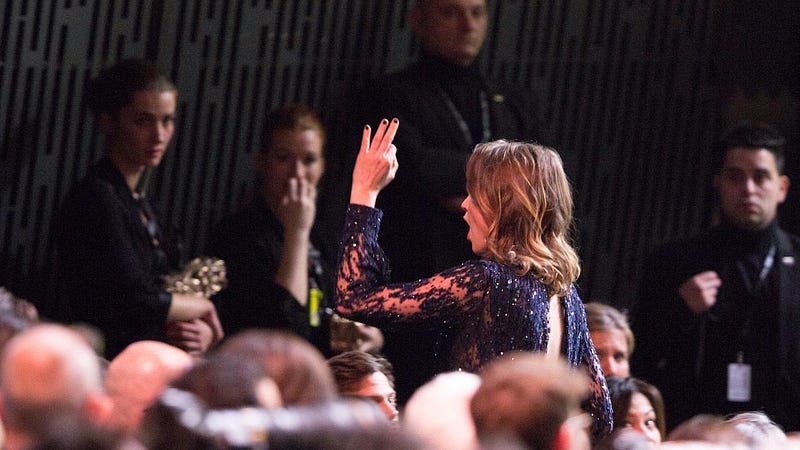
I had a near-zero impression of Adèle Haenel before watching the French film. The only recollection of the name was her dramatic departure from the Cesar Awards in 2020 when Roman Polanski was awarded Best Director. The camera caught her back as she protested the academy acknowledging Polanski, who fled to France from the United States after being charged for raping a teenager in 1977.
I saw her back again in the movie, and it grabbed my attention. The scene where she is followed from behind by Noémie Merlant, who plays a painter hired to make a portrait of Héloïse to send to the man her mother is forcing her to marry, was riveting. The one-shot sprint from the house to the side of the cliff, with Marianne chasing, took my breath away. As she reached the edge, I finally saw who she was when her face was revealed. The director is famously known in the industry for her minimalism. Here she has resourcefully filmed a first encounter that despite being set in the 18th century, could still make 21st-century audiences gasp for air.
It’s hard to tell that both leading women met for the first time at the scene of their first shoot. Most film reviewers have described their chemistry as electric, but I would go further to say they seem to interact effortlessly, and viewers forget that they are performing. Perhaps the film has bored many with its lack of conversation and abundant space for the duo to fill that gap with their unspoken connection. Nevertheless, the few words that left their lips worked wonderfully.
“When you first asked me if I have loved before, I knew at that moment that I was (in love with you).”
One of the most-talked-about points in the two-hour movie is the female gaze. The term was part of the feminist movement in the 70’s but seems to have faded away, being reduced to a buzzword as #MeToo swept across the world like some relentless storm. It’s a term used to oppose the male gaze, in which women are objectified and treated like something the viewer could consume, hence losing their humanity and point of existence. Perhaps because Héloïse and Marianne are able to see each other completely as who they are, their scenes are presented as forthright self embodiment, rather than superficial infatuation.
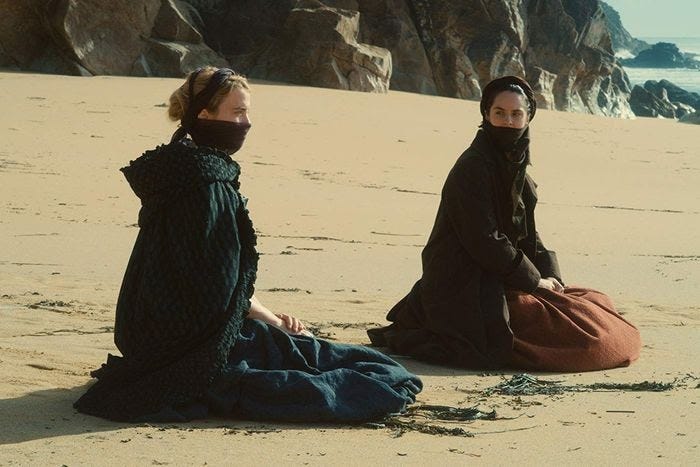
Given that the director and actors are all women, it’s not surprising that they were able to find a humanizing way to gaze at each other and the perfect distance to express intimacy. Their shawls were used in a clever way to intensify their stares and longing for each other. At one point in the film, I was concerned it could turn out to be another Blue is the Warmest Color, which focused the limelight on the sexual encounters for the pleasure of non-queer viewers. But it eventually didn’t disappoint with a series of delicate, subtle yet provoking scenes. Some sequences made me think “wow” or “aha” or “so this is what it is.” One of them is the bonfire take, where the theme song finally plays out, and their relationship is on fire.
Some sequences made me think “wow” or “aha” or “so this is what it is.”
The elements in the movie were so rich that they referenced Sartre, Nietzsche, and the fateful myth of Orpheus and Eurydice as a metaphor to describe their deep affection for each other. In the original story, Orpheus went to the underworld to rescue Eurydice, who had died, from the realm of Hades. Hades promised to let Eurydice return with Orpheus, but with the condition that Eurydice would follow Orpheus and he was not allowed to look back to make sure she was there. But of course, he looked back, causing his wife to fall back to the land of the dead. This story was first read out loud in a scene, with Héloïse questioning how readers are sure that Eurydice didn’t call out, causing Orpheus to turn his head and end it. When Marianne was about to leave after completing the painting, it seemed Héloïse used the same sword to cut Marianne loose.
The movie also illustrated once-taboo practices such as having an abortion, portrayed in the most innocent but painful way. It causes the audience to sympathize with a servant, and worry how long it will last, as she has the procedure while her two toddlers look on. The scene is thematically related to how women were not (and some are still not) able to choose their own destinies. Héloïse was to be married to the man from Milan who would receive her portrait. The story of her earlier living as a nun was left mostly untold, but it suggested that she rebelled against her mother and tried running away from the arranged marriage before giving in. What I appreciate most about the screenwriting is the movie does not portray two women in a relationship as wrong. It is a complete love story that was short-lived but did not need further judgment.
The scene is thematically related to how women were not (and some are still not) able to choose their own destinies.
I love how intentionally the scriptwriter answered her questions in the film at long last. What is freedom? How do you know if you’re free? Are you free only if you are alone? As the audience, we spent two hours on the journey with Héloïse and Marianne. In the end, to the music of Antonio Vivaldi’s Summer in G minor, we know they will always remember their love story, even though they are destined to live apart. And we know exactly how we want to remember the lady on fire. Her angst, her yearning for a life less ordinary, and perhaps for someone to share the thunder and lightning, were compressed into the music and came crashing into me.
Freedom is what we do with what is done to us. — Jean-Paul Sartre
The writer is a southeast Asian who loves whimsical ideas and believes in radical optimism.
For more stories of interest to women and other disempowered groups, follow Fourth Wave.


