
Setting Fire to Uzbek Scarves
A yellow plastic lighter’s search for the perfect fabric souvenir
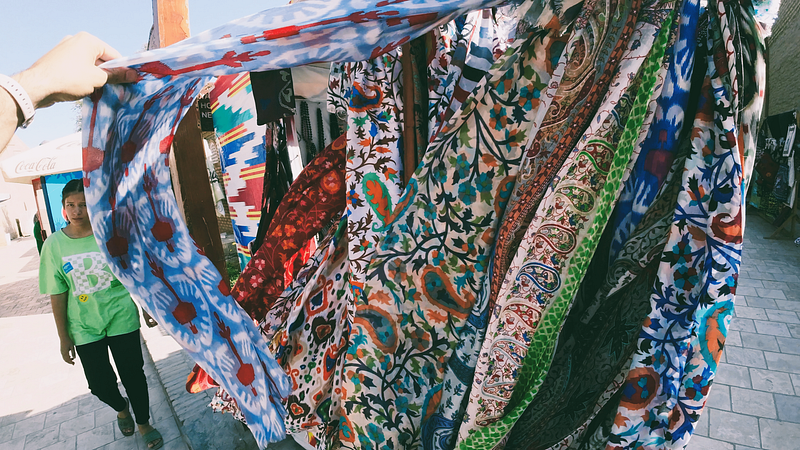
“You should pick out a thread and set it on fire. Just to make sure it’s real.” He said to a couple of tourists, also roaming the fabric bazaar in Khiva, a city of approximately 93,000 people in south-central Uzbekistan. Before the traveler could respond, my partner pulled out a lighter from his jeans pocket and handed it to the lady, who was still holding on to a scarf from the rack. The lady stared at the yellow plastic lighter, frozen, stunned…
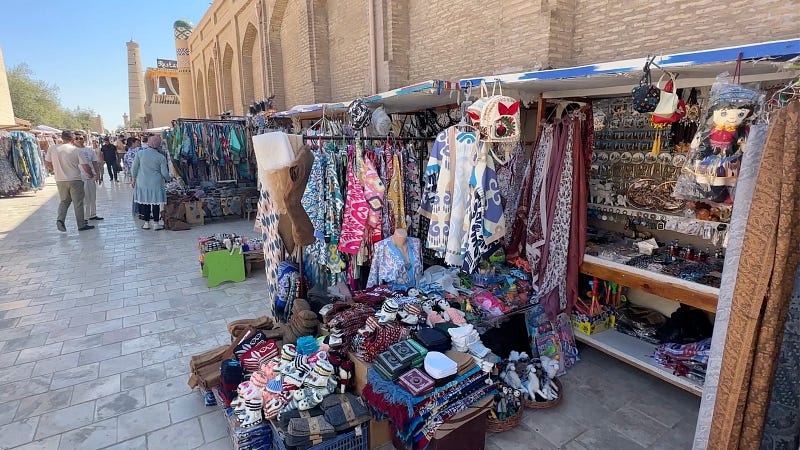
By this point, my partner had become a seasoned traveler in this doubly landlocked country (meaning that all neighboring countries are also landlocked — one of the only two doubly landlocked countries existing on the planet, together with Liechtenstein). A bazaar was nothing to be afraid of, nothing that could confuse him any longer. On the road, he developed tricks to win them over and the yellow plastic lighter was just a tool.
Witnessing the exchange, the saleswoman, a girl working in the store, came forward. My partner turned towards her and with his conversational Russian, which allowed him to comfortably backpack throughout the country, asked: “Can we burn it?”. The girl looked puzzled. An eyebrow arching towards the sky. She turned around and, with a quizzing look, consulted an older woman clearly managing the store. The older woman locked eyes with the yellow plastic lighter, paused, then nodded solemnly…
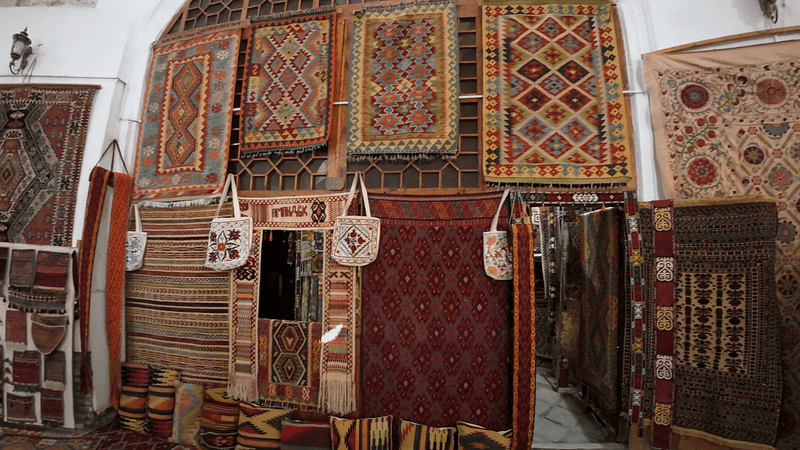
My partner had left for Uzbekistan thinking he wouldn’t encounter many tourists. Roaming the crowded alleys of bazaars, he couldn’t have been more wrong. In 2022 alone, Uzbekistan welcomed approximately 5.2 million tourists. The majority came from neighboring ex-Soviet countries, but there was also a surprisingly high number of Europeans, especially Italians. Yet, few Americans. To be honest, he was disappointed, but at least he now had someone with whom to share his newly acquired street smarts.
He boldly grabbed the scarf from the rack and carefully fondled a loose thread between index and thumb. With a bold stroke, he alighted the fire on his other hand. Slowly, he burnt the thread. The fabric turned black and melted. A plastic smell seared in the air. His nose twitched, annoyed. He looked at the pair of tourists and proclaimed: “It is polyester”. With unexpected agility, the older saleswoman stood up from her plastic chair and stepped forward. “What are you? A fabric expert?”, she challenged.

In all honesty, he was not an expert in fabric before leaving for Uzbekistan, but he sure became one while searching the entire country for the perfect souvenir. The real silk scarf. That was the one thing he had to find along the famed Silk Road that, for over 1,500 years, paved the 4,000-mile route connecting Europe to China until the mid-15th century. The name however could be misleading because much more was transported on this ancient trade route besides the lucrative silk, including spices, tea, and rich gems.
My partner’s trick was more than simple and it can be applied by anyone who is not a real fabric expert. It only requires a certain boldness of spirit and audacity to go up to a seller asking them for permission to set their property on fire. Besides this, one only needs a good nose to follow this easy rule: if you burn polyester, it smells like plastic; if you burn cotton, it smells like paper; and if you burn silk, it smells like hair. Easy, yes?
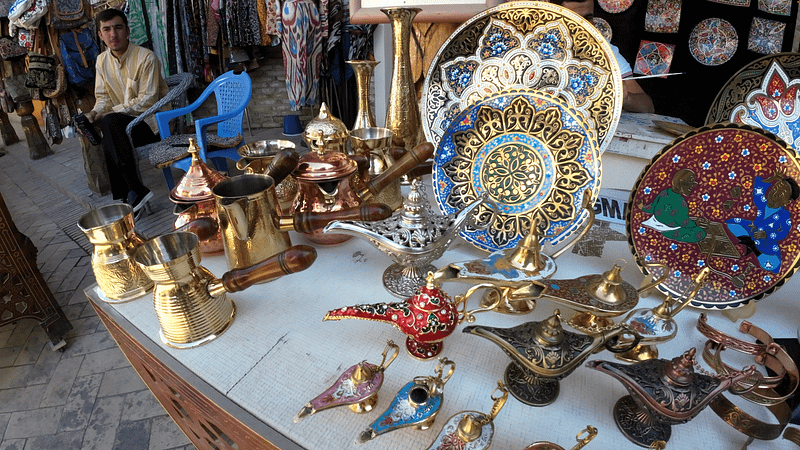
Truth be told, silk scarfs were not hard to find in Uzbekistan, and in fact, I now have so many, I can combine every color in a palette, cover every season, and fit every style, from formal to casual and everything in between. But that yellow plastic lighter made the search infinitely easier.
That pair of tourists did not end up buying the scarf, deterred by the warning that it was only unromanticized polyester. Whether they truly believed it or not, the doubt was enough to move on to another stall in the bazaar. The worry that my partner could accidentally set the entire market on fire was superseded only by the fear that he was going to get beaten up on a street corner by the huge, rough family members of these two women who lost a sale because of his stupid lighter.
Thankfully, that did not happen, and every other time he used the yellow plastic lighter, the smell always oscillated between hair and paper. A reassurance of organic material.
As a result, the suitcase that came back from Uzbekistan was full of fabric. Scarves, in cotton, silk, and cashmere, thin, heavy, mid-season, colorful, monochrome, light, dark, or patchy. We have them all. Gifts for mothers, sisters, girlfriends. So many were bought that we now have spare for whoever might be in need of a present. But this is not all that came back from Uzbekistan. Nested in between scarves were knives, so many knives, Damascus steel, carved handles, decorated blades. Knives from Chust, the small town in far eastern Uzbekistan most famous for their blacksmiths. But the search for the perfect knife would merit its own story…
Thanks to you for making it this far and to Globetrotters for giving us the opportunity to reflect on the purchases we make while traveling! This story is part of the October Monthly Challenge to write about souvenirs.
So much great writing came out of this challenge and here are a couple of the stories from other travel writers that stuck with me:
Ellen Eastwood makes a great case for souvenir minimalism! This is a great way to keep memories close by while avoiding cluttering the house:
Souvenirs are magic. Gargoyles are magic and Erie Astin collected quite a few in Oxford. They look incredible!