
Servant Leader: The Mentor Test
How Michigan Athletic Director Joe Roberson changed our lives
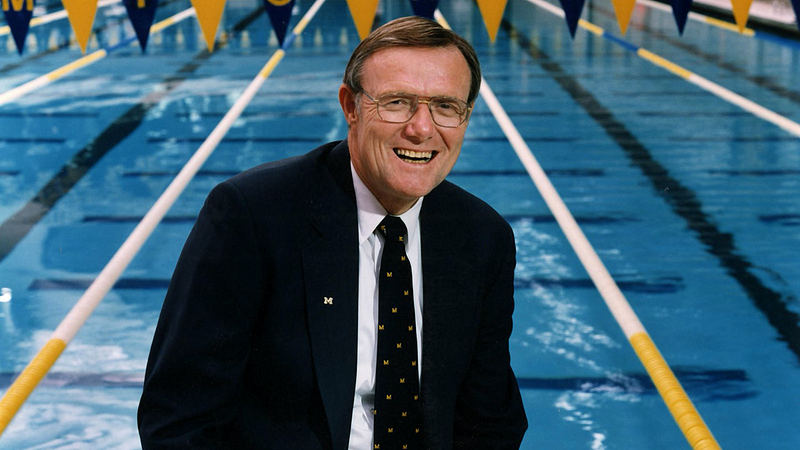
Before I could marry my wife, we needed to go to lunch at the Gandy Dancer, Ann Arbor’s classiest restaurant, to get the blessings of her mentor.
Former Michigan Athletic Director Joe Roberson, who died January 13, perfectly illustrated the phrase “larger than life.’’ He was a giant, both physically and intellectually. Leader and Best?
- The former baseball player played for the Brooklyn Dodgers, working with legends like Jackie Robinson, Sparky Andersen and Chuck Conners aka “The Rifleman.’’ But how many leave pro baseball to earn a PhD?
- When the University of Michigan, his alma mater, gave him a development job, he wound up running the first successful billion dollar campaign. Billion with a “B.’’
- When President James Duderstadt, another living legend, asked him to run athletics, he helped his school win national championships in hockey, swimming and diving.
- In the biggest of big sports, football, he made the incredibly difficult choices that made Michigan a national champion: firing Gary Moeller, replacing him with Lloyd Carr.
- When my wife is asked about Michigan students from Joe’s era, she remembers Tom Brady, now widely known as the only quarterback to play in nine Super Bowls, winning six. Another student she remembers from those days, a grad student Joe hired named Warde Manuel, who is now Michigan’s athletic director.
On Saturday, we drove through a blizzard so his family, my wife and current University of Michigan Athletic Director Warde Manuel could share his story, each offering another piece of the puzzle.
He liked his meetings short and to the point, telling his daughter if she did have a memorial service, it shouldn’t last more than 30 minutes. They honored him in 28 minutes.
When she considered a “narrow path,’’ like being a Salvation Army officer, he also told her “You have to be very careful not to confuse choosing a narrow path with making a narrow minded decision. If you choose the narrow path, I am with you.”
“I stand before you because of him,” Manuel said. “I stand before you because, over the years, I’ve had the ability to reach out to him and get his guidance. In his words, in his wisdom, his directness… He was truly a servant leader.
Manuel recalled Roberson “was direct, would almost sometimes come off as callous… He was smart and he took it all in and he’d re-think and continue to think, believed in doing things the right way, that winning at all costs wasn’t the measure of success. It was about who you were and how you went about winning and driving success in life and for me, that lives on. He was a leader who believed in people. He loved students. He loved the athlete part but he loved the student part even more.”
Manuel now sits in the big man’s old office, and “I have a picture of him. I love him even more now because in many ways, I believe, he can see us… A person who loved the success of others… He taught me how to lead.”
“Joe Roberson wasn’t the AD in the chair when we won the national championship in football but Joe Roberson was the reason we won that national championship. I told him that. He didn’t want to hear it. He gave credit to others. He made the tough decisions. The super majority of his decisions were absolutely, positively the best decisions for the University of Michigan.”
My wife Debbie remembered the time a maintenance man at a rival university helped him, how “Joe took the time to find out who his boss was so he could send the man’s supervisor a gracious note to make sure he got credit for going the extra mile…On my last week at the University, a woman I never met before arrived at our office for a meeting. We started chatting and she mentioned she started working at the University as an intern in the early 80s. Then she said she still fondly remembered a Joe Roberson. She had no idea I worked for him and I hadn’t even brought up his name! It’s common for us to forget people we met decades ago but the one name that stood out to this visitor was Joe Roberson. They say you’re not really gone as long as someone still remembers.”
He did many big things but he was also incredibly proud to be a kid who grew up in Flint, Michigan, the birthplace of Buick and GM (though most of the world’s Buick’s are today in China).
Flint was a boom town then completely humbled, one of the most battered cities in America so a big chunk of humility was at his core. With many of the auto jobs gone, the U-M Flint (where he was once interim chancellor) became the big anchor of that shrunken city and he would do whatever he could for Flint, making his home in nearby Grand Blanc (never the main elite U-M home of Ann Arbor), accepting any request Flint made of his time.
He would often recite this poem, The Bridge Builder by Will Allen Dromgoole. He quoted it in his speeches and it speaks to the way he lived his life:
An old man going a lone highway Came at the evening, cold and gray, To a chasm, vast, and deep and wide, Through which was flowing a sullen tide.
The old man crossed in the twilight dim; The sullen stream had no fear for him; But he turned, when safe on the other side, And built a bridge to span the tide.
“Old man,” said a fellow pilgrim, near, “You are wasting strength with building here; Your journey will end with the ending day; You never again will pass this way; You’ve crossed the chasm, deep and wide- Why build you this bridge at the evening tide?”
The builder lifted his old gray head: “Good friend, in the path I have come,” he said, “There followeth after me today, A youth, whose feet must pass this way.
This chasm, that has been naught to me, To that fair-haired youth may a pitfall be. He, too, must cross in the twilight dim; Good friend, I am building this bridge for him.”


