September
An end and a beginning
There’s a slant to the light that signals the return of school with new uniforms, new shoes and fresh haircuts. And afternoons that still wear vestiges of summer.
Properly speaking, autumn doesn’t start until September 21st; technically it’s still summer. But just the word September is enough to seal autumn in our brains. Besides, England rarely gets Indian summers.
Early September is a liminal time that doesn’t last long, a week, perhaps two, before autumn proper sets in with the rain and grey of late September. But for a week or two, for school children, the collecting of conkers coincides with ice cream, and peeling off of cardigans and blazers.
The month casts a solemnity. Now we enter the tunnel to Remembrance, to the shortest day, to Christmas. Death, decay, dying, a slow descent starts with September. Even the local Indian restaurant sends a flyer to ‘Extend the summer with something tasty,’ as if there’s a collective bracing for the coming dark days.
Lumpy white clouds fill a pale blue sky. The Japanese anemone have lost their petals, are now nubs on stalks, tipped yellow. The fuchsia is pretty, the Chinese red, the ballerina pink, the pink emerging from fat white lanterns.
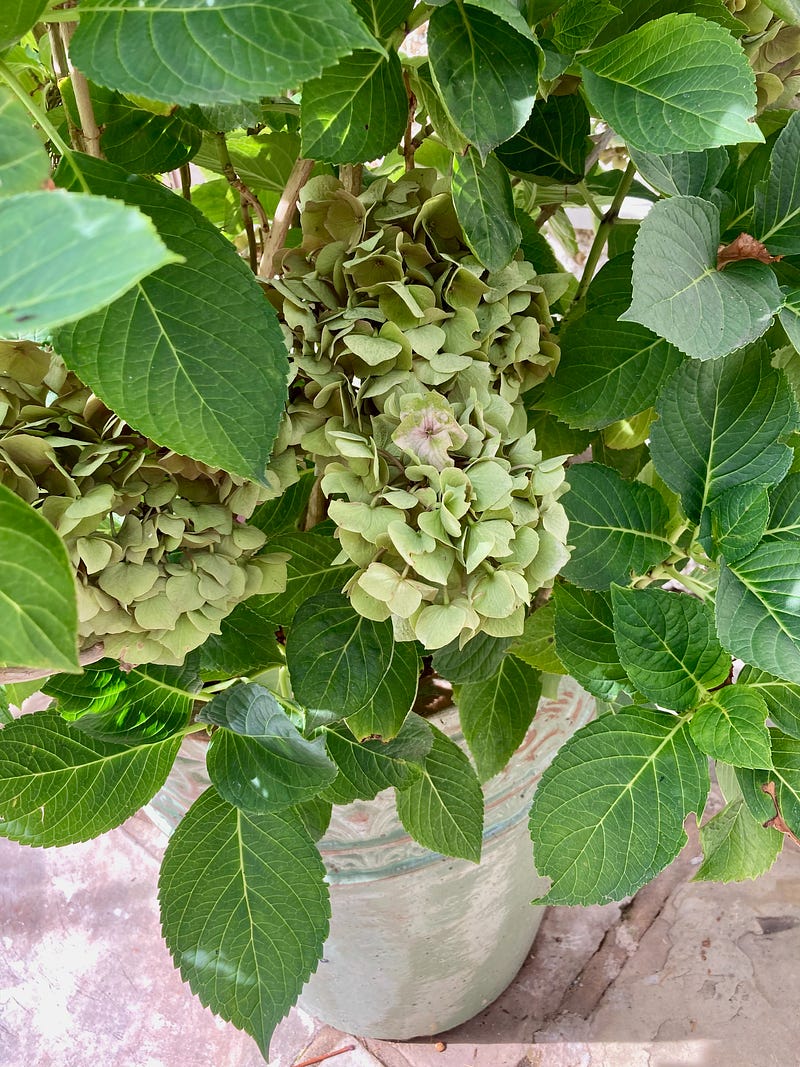
Perovskia still waves its silver and purple, but the hydrangeas have suffered through the summer drought, their petals are washed out or crisped brown. So too the phlox, gorgeously peppery but crushed and dried.
Unlike the roses. The red-orange rose I transplanted to the hydrangea bed last year is happy and flourishing with no sympathy for the hydrangeas. One poor hydrangea never got started. Only produced leaves, ribbed dark green on light green. And the pink hydrangeas are green. Either the remorseless sun has bleached the petals or the plant has reduced its pink to economise. Annabelle merely flashed its raspberry blooms in July before sinking into earthy green.
It’s as if the roses taunt the hydrangeas as they dash the rockery with red. I can’t help feeling that this exposes the true character of a rose; soft, supple velvet it may be, but cruel and harsh too; its medieval barbs are its soul.
Annabelle has become more about size and structure, architecture, form, rather than raspberry. It is wily, more rose-like, flashing its perfection, allotting it, not dallying, lest we take it for granted, neglect its worth.
The cotoneaster is loading daily with red berries, and its leaves, small and waxy and dark green, will give way to the red bounty. Now I see why Christmas’ colours are red and green.
Rose hips shine on the climbing rose. Honesty, long since papered and dried, clamps its flat kidney-shaped seeds between its dry windows. Nothing dents the silver carpet of stachys or lamb’s ear as it is so aptly known. The only plants that have survived the west border are the silver leafed: artemisia along with the stachys, and some sedum. Coco the cat has dug up most of the sedum but a posy remains and its blush rose is a delight beneath the eucalyptus.
The agapanthus struggled, but then they need confinement, they need to jostle, cheek by jowl; with so many of their neighbours swooning in the heat, they had too much space and they wallowed, like humans with too little to do.
Already, virtuously, I have clipped all the Lavender into neat everygreen domes. Unlike the two rhododendrons which are parched, their leaves dangling. The new one is a brown ball that may not make it to next year.
I cut mint and eucalyptus and a purple phlox panicle and, as an indulgence, an Annabelle bloom and three fronds off the curry plant to make a posy, to bring the gentle fading colours of the garden into the house.
I receive ten red valerian seedlings through the post. Need to pot them up and keep in the conservatory for 2–3 weeks. Valerian ought to be a safe gardening bet; I calculate the odds of new plants surviving are well below fifty percent, but Valerian flourishes on the meanest of local verges.
Out walking the horse chestnuts are almost bare. Only brown leaves dangle amid the bright, tight green conkers. Cow parsley is brown, fossilised in shape; I almost like it more than in spring when it’s frothy and airy and white and light green.
On an evening stroll, the sky a clear blue, the sun low and concentrated, a sound comes, familiar, loud, annoying. The sound of a lawn mower and the faint smell of grass; it’s an act that has been absent this past summer. The scent of grass returns like a relative back from their voyages; a relative your thought you loved, but now you are not sure.
On a morning run, after a storm, the road is filled with green leaves, not just crisp brown leaves, but green and waxy and speckled brown and variegated, blown down by the night’s fury. Running past a gardener’s truck packed with cuttings, the scent of rosemary and liquorice is strong, a pleasing, if perculiar cocktail. Some late juicy roses’ scent is exposed by the damp.
One morning I wake to the air filled with rain, the sky sinking with rain. The heron flies over the pond, a great stone grey ornament sweeping his wings, a warning, swiftly followed by the rain, white and heavy, leaping off the marble table as if burning. Rain pings and tingles over its own constant hush. Quickly the garden greens again and those days of sun are mere anecdote.
Rain gurgles again down the drainpipe, a carefree splash and tumble, liquid acrobat, juggling and dropping, drinking, swallowing, quenching greedily, as if even a drainpipe must make up for months of dust. I’ve forgotten how powerful is the sound of rain, fat tips hitting the earth and the roof of the conservatory, the constant fizzle of the rain’s plumes.
We had a morning of heavy rain last week and the poor parched grass responded with clumps of bright new grass. Now, the grass is sending up more tufts of green, fleur-de-lys of green, tips of spears, as if the grass is fighting back, has been biding its time.
There’s always a resolve, come September, that we shall not turn the boiler on. It’s an easy resolve on the first of the month, but becomes hard, rigid, perverse by the middle of the month and this month will be no different. Already there is a nip in the house, the thermometer dipping below the constant twenties of summer. But a greater chill comes…
The Queen has died. So momentous, it pierces everything. She has been our backdrop, like the towering cedar tree — quiet, stable, strong—whose magnificence would perhaps be only fully appreciated if suddenly its regal shade was gone, leaving grass and plant exposed and blinking in the new harsh unfamiliar light.
September is more of a beginning than January when sober study recommences after the frivolities of summer.
And this September, with our great loss, feels like the end. Till we remember that with all ends comes beginnings…