
Sept 1993: Björk On Debut — “I Didn’t Give A Fuck About Styles, I Was Just Interested In Songs”
This City Life cover feature coincided with Björk’s gig at Manchester Academy promoting her first album, Debut.
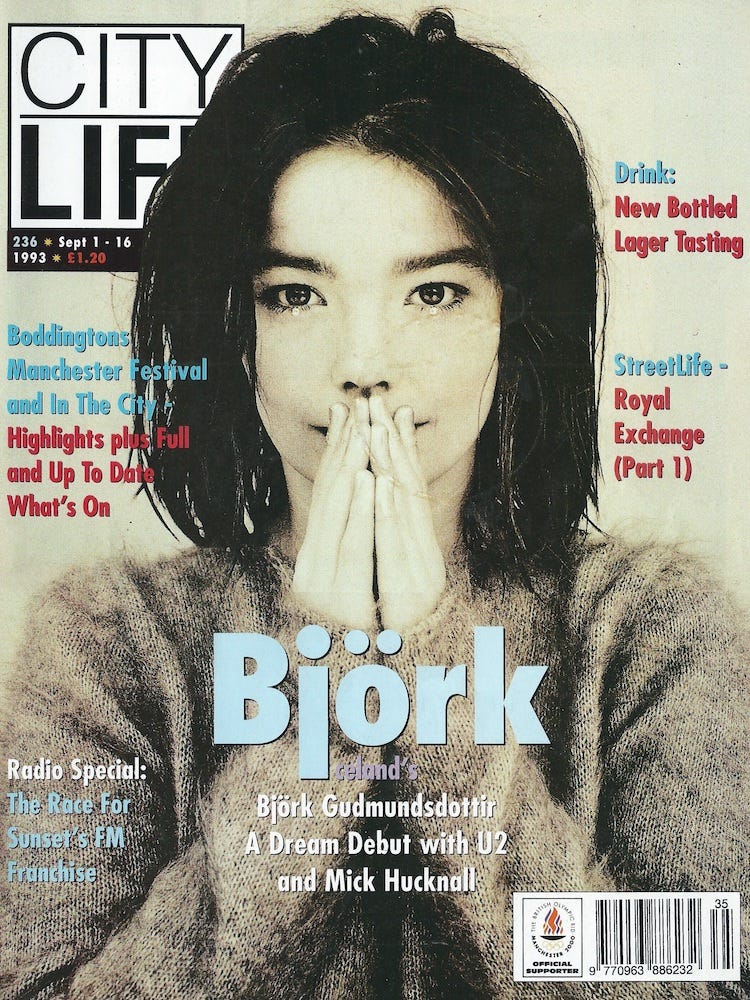
She was, of course, a joy to talk to, a bundle of attitude, energy and beautiful eccentricity.
I loved Debut and had been a fan of The Sugarcubes, so I was probably a bit star struck when I spoke to Björk.
I’m pretty sure that’s apparent in the following article, but I think the excitement that surrounded her at the time was justified — Debut really did stand out as something special, the product of a singular creative vision.
An aside: Björk’s gig was part of In The City, the international music convention founded by the late, great and much-missed Tony Wilson.
Björk: “This is the first time that I decided to do something only for myself, not to please anyone”
There was a time when there was pop music and there were songs and you either loved or loathed them. In 1993, things are more complicated, pop music more fragmented, a confused mass of categories and prejudices, neatly compartmentalised, ready and waiting to conform to whatever cliche you subscribe to.
Occasionally, along comes an exception, music whose clarity comes from its eclectic thirst for perfection, its open-minded pursuit of excellence which cuts across musical ghettos. This year’s model is former Sugarcubes’ singer Björk Gudmundsdottir, with her album Debut. And everyone is surprised.
“It just happened,” says Björk in her bizarre Cockney-meets-Icelandic accent. “I was not doing this album with someone in mind. What I’ve done in the past is served a lot of causes, fought a lot of fights… this is the first time that I decided to do something only for myself, not to please anyone, and last of all the critics in foreign countries.”
But the critics have been bowled over by Debut, predicting album of the year accolades with shocked wonder. No-one expected something quite this good from the quirky Icelander, whose former band never really lived up to the excellence of their early singles. Yet despite its title, Debut is not the first time Björk has released music under her own name. She has been making music in her native Iceland since the age of 11 (she’s now 27), and describes her time with the Sugarcubes as merely “an exception, a detail”.
So what is it that makes Debut so special? It’s not simply the collision of musical styles, the fact that it is just as informed by ’90s club culture as it is by the last 50 years of jazz. It’s not just the way strings sit next to tablas, brass arrangements next to an ambient-house back-beat, the Jimmy Van Heusen/Johnny Burke classic ‘Like Someone In Love’ next to a thumping house track recorded in the Milk Bar toilets. In fact, on first listen, you don’t really notice any of these rarities. And that’s the point: the songs take precedence, the musical arrangements acting as the most efficient way to convey them.
“The thing with all the different musicians on the LP is not that I was consciously using all the stars in the world, it was more the other way round,” explains Björk. “I didn’t give a fuck about the styles, I was just interested in the songs and focused completely on them. A song could be anything it wanted, it didn’t matter what style… if a song needed a certain feel or a certain sound or a certain person, I would try to give the song that, you know?”
The result is a feast of superb musicianship: tabla player Talvin Singh, LA harpist Corki Hale, brass players Oliver Lake — a big name in the New Jersey avant garde jazz scene — and Britain’s Gary Barnacle, and the backing vocals of Jhelisa Anderson (Shamen et al), all of which add to the pristine quality of the record. Oh, and it just happens to be produced by Nellee Hooper, the man partly responsible for that Soul Il Soul sound.
“When I started off, I didn’t plan to have a producer, but I just got to know Nellee as a friend,” says Björk in her typically unpretentious manner. Other people might tempt top producers with offers of large fees and declarations of their artistic worth; Björk makes friends.
“It was a bit of a musical love affair really, and if he had been a guitarist then there would have been a guitar on every song. He just has enough of an open mind to go with me on this little trip. I had this sort of map in my hand which was the songs, and he just went for it.”
This relaxed, instinctive approach is the key to Björk’s way of working. She began Debut as a last stab, a kind of gift to the world after years of what she describes as laziness: holed up in Iceland, writing film soundtracks and music for the theatre, recording an album of jazz standards, and popping over to Manchester to record a couple of tracks for 808 State’s ex:el album (establishing a long-standing friendship and musical relationship with Graham Massey). She also had her son to look after, who is now seven.
“I thought I was just going to do it once and go back to Iceland and be a happy housewife,” she says without any hint of irony.
As the praise continues to flow, with U2 asking her to support them on selected Zooropa dates and Mick Hucknall phoning to ask if he could remix one of her songs (he has, the new single ‘Venus As A Boy’), the idea of Björk doing a Sinead O’Connor and retreating back to base seems particularly bizarre. Thankfully, it’s not going to happen — Björk’s gone and got hooked on fulfilling her personal vision of what pop music should be like. Since January she’s been resident in London’s Little Venice with her boyfriend and son. She looks set to be a permanent fixture for some time to come.
“It’s a privilege to be able to make your dreams come true, to put all those things in your head and turn them into fact,” she says with a certain childish wonder. “I feel very lucky.”
If Björk makes music which you can’t help falling in love with, it’s because it communicates her own love affair with pop. She describes making music as “a basic need”, a mission to produce the perfect song, an obsession. Lyrically she cuts across the spectrum of human emotions, observing the strange attributes of human behaviour, the fragility of personality, the simplistic pleasures of life, the buzz of sensuality. She comes across as a grown woman who remembers what it is like to be a child.
And of course there’s her distinctive voice. A strange contradiction of a voice, fragile yet determined, worldly yet childlike, crazily on the edge yet somehow soothing. “We are so lucky to have Björk’s voice,” says Nellee Hooper. “She’s the Billie Holiday of the ’90s and beyond,” believes Mick Hucknall.
“Sometimes you just have to jump off a cliff, I suppose,” says Björk, talking about the need to take risks in life, to follow the heart rather than the head. The next cliff for Björk to jump off is presenting her music live. She’s drafted in seven musicians, including Talvin Singh, Iranian keyboardist Leila Arab, a violinist and a flautist. It will be something special, well crafted yet open to spontaneity. Just like her music.
“There’s nothing better in life than finding a song which sympathises with all your emotions and your hunger,” enthuses Björk. “It seems that only a song can do that, nothing else can. And either you hear it or you’ve got to stand up and make it yourself.”
Originally published City Life 236, September 1993