
“Sell” or “Sale”? Another Difficult English Vowel Pair: Short-e vs. Long-A
Do you ever mix up the words “sell” and “sale”? Or how about “taste” and “test”?

This vowel pair — Long-A as in “sale” and Short-e as in “sell” — is a pair that is frequently difficult for non-native speakers of English.
Check Yourself — A Little Experiment!
Here are two sentences that you can use to do a little test:
They had to test the food. They had to taste the food.
Have a native speaker of English — a friend, neighbor, or coworker — listen to you say one of these two sentences. Can they clearly and easily identify which one you said? Or, if you say both sentences, can they hear the difference, or do they think they sound the same?
And do you think they sound the same?
If you are not sure how to pronounce these well, or if you think they sound the same, that is because they are kind of similar. However, if you read the article on Long-E vs. Short-i , then you might already have an idea about the difference between these two vowel sounds.
The Similarity
There is actually a very good reason why many learners of English confuse these two vowel sounds. The reason is that Long-A and Short-e are both pronounced in almost the same place in the mouth — in the front part of the mouth, at a medium level of tongue height.
However native speakers of English hear them as two completely different sounds.
The Difference
There are two basic differences that distinguish them. The important factor that many English learners do not know about is tongue tension. For Long-A the tongue is tense, but for Short-e the tongue is not tense, the tongue needs to be fully relaxed. In addition to tongue tension, the other difference is that Long-Vowels have tongue movement, but Short-vowels do not.
How to Make Them
1- Long-Vowel Tongue Movement
English Long-Vowels have 2 parts. This explains the name “Long”. If we look at typical IPA symbols for English Long-A (/ei/ or /eI/), they show us the two parts. (By the way, “long” does not mean a longer amount of time for English! It is not /e:/)
The secret trick for learning to sound more like a native speaker, is to move your tongue for Long-Vowels. The tongue should always start from the main sound and finish by sliding toward the off-glide sound. Try this with a few words, such as: say / name / plain / make
2- Short-vowel Tongue Movement
The other secret trick for English vowels is that for Short-vowels the tongue must be relaxed! Linguists call these “lax” vowels, but many languages do not have lax vowels, and this is often why English vowels can seem difficult.
How-to, Step-by-step…
- First, start by saying the sound of Long-A: “A”.
- Then, keep your tongue in the starting place — hold it there, but relax it: “A” > “e”.
- If this seems hard to do, focus on relaxing your whole tongue, all the way back (and even make sure that your neck is relaxed).
- Then, try a few words with Short-e, making sure that your whole tongue is relaxed for the vowel sound: ten / left / went / bed
The Short-e sound is the one that tends to be more difficult, so it does require some practice. Long-A is not usually difficult, but it will always sound nicer and much more natural if you train yourself to always move your tongue with the off-glide to finish it.
Word Pairs
What may seem like a small difference between these two vowel sounds can actually be a big difference in meaning. Here are some examples:
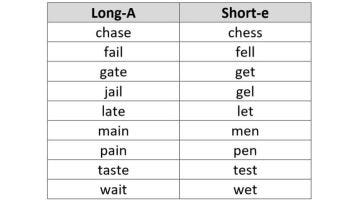
Some of these words could cause some funny mix-ups…
- Do you use hair gel? Be careful with Short-e for “gel” so that you don’t say “hair jail”!
- If you want to borrow somebody’s “pen”, don’t ask to use their “pain”!
Even if a word with Short-e does not have a similar word with Long-A, it can still be harder for others to understand you if your tongue is not relaxed for Short-e. It may take a bit of practice to train your tongue to be relaxed for Short-vowels, but this is something that can make a big impact on the quality and clarity of your English pronunciation.
Back To “Sell” and “Sale”
This pair of words can be extra confusing because they have similar meanings. So just in case they are not clear for you…
Sale… is a noun (and it sounds the same as “sail”). It is the event or the offer. For example:
“The bookstore is having a big sale this weekend.” “I’m waiting to see if that computer goes on sale soon.” “His house is for sale.”
Sell… is a verb. It is an action. For example:
“I want to sell my old books.” “They won’t sell it at a lower price.” “He hopes that his house will sell quickly.”
But, to make things even a bit more confusing, the word “sell” can also be used as a noun! However, it is used much less frequently, and is used to name the activity of attempting to convince somebody to buy something. For example, “He was a hard sell,” means that he was not easily convinced.
You can do some (free) practice exercises with audio for Long-A and Short-e on my blog post: Sell or Sale? Practice Exercises! Long-A and Short-e
This full article is published along with my audio (not an AI voice) on my Patreon page. You can also find and extended version of practice exercises for this topic on Patreon. Patreon tiers range from $2 to $100 USD per month, and support my goal of creating a comprehensive English pronunciation learning platform!!
If you decide that you would like to join Medium, please consider joining through my referral link, to help support my work: