
Selection Mixtape of Taliesin — The Emperor
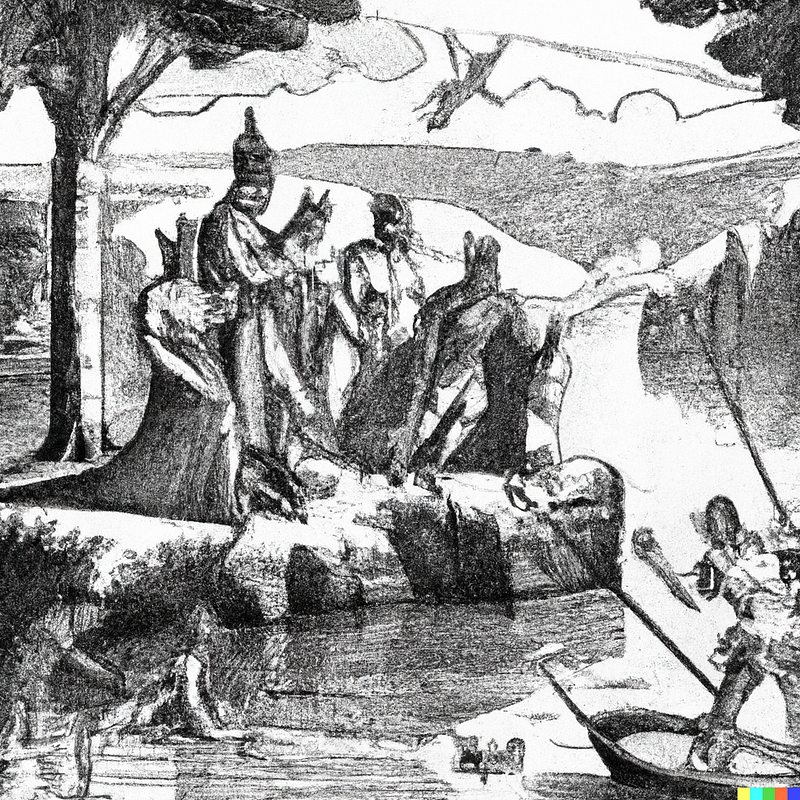
In an earlier selection from The Mixtape of Taliein — The Tower, I claimed “in my opinion about Agent 18s work The Tower, a ‘Tarot’ poem in the suit of clubs is the first really great poem that is also accessible to a large number of readers.”, which is to say the themes the poem deals with are relatively simple and there is not a bunch of references that one should have to fully appreciate it. If I were to say what is the first great poem, but difficult, it would be The Magician, also a Tarot poem, and in between those two poems is this one The Emperor, also a Tarot poem. As I noted in the article “Structure in the Mixtape of Taliesin”, the Tarot card poems often seem of higher quality — unburdened by the need to stick as closely to the Taliesin mythos.
THE EMPEROR
Fishing from an outstretched rock
furthest promontory of a wasted land
with courtiers & sycophants thronged
behind, one whispers with his lips
hidden by his hand
lily-white & manicured
as the Ambassador gently asks
if I will set my lands in order.
On a sullen day, fog-shrouded
bleeding from my side
sullying my marriage bed
I dispatched a trusted messenger
for you alone, Myrrdin,
carrying a wicked pack of cards
Basque, with Quabbalist intonations,
just the way you like your women.
AH! But laughter is a burning knife.
I rely on you to see my bones
are preserved, perhaps in that hillside shrine
none should gainsay such small honor
dry bones can hurt no one
maybe that will set my lands in order.
Yesternight
when Bedwyr brought
the hounds in the hallway
jumping merry, leaving black-gray prints
on white-gray stone
one turned to me & growled
from its black-fringed throat
“Bring out the dying King to us,
we’ll set his lands in order.”
In the courtyard’s darkness
my son paces incessantly
in rigorous six-step paths
turning from his left to right
as black hair falls on white forehead
his pale hand sweeps slowly by
the dagger at his belt
& every step seems a voice calls out
to set my lands in order.
The interest of the poem I think, is that it is a pretty straightforward detailing of a version of the King Arthur story, in which the later King, through successful establishment of his kingdom is now corrupted by that success and the desire to avoid dealing with unpleasantries late in life — the root unpleasantness being his traitorous son Mordred which the poems ends with.
This major villainy of Mordred is a par t of The Once And Future King and is called back to here with the blackness of costume and whiteness of complexion.
The poem starts and ends with these views of Arthur as grown soft with age, not dealing with the treason of his son at the end, and not dealing with the scheming courtiers at the start.
The middle of the poem however associates Arthur with the Fisher King, something that is often found in various literary works but here is made more direct — that is to say Arthur is not a mirror of the Fisher King and Arthur’s psychological ailment is not a mirror of the Fisher King’s physical one — in the poem they are the same.
So what story does the poem actually tell, what is happening.
The first stanza is straightforward, the King is fishing, courtiers are plotting, and the ambassador from somewhere is concerned and suggests, gently, that the King should do something, that he should “Set his Lands in order”
The second stanza is evidently after this, the King is in his bed and bleeding from the side — we move quickly past this but how is it that he is
bleeding from my side
sullying my marriage bed
And I think it is reasonable to suppose this is somehow related to the most famous problem King Arthur has with his marriage bed, that of Guinevere and Lancelot. In this version the betrayal of friendship and spousal betrayal have, it seems, taken a physical and violent form. But it is the King’s violated person that sullies his marriage bed, not his friend and wife.
The King in this section is like the Fisher King, dying, and he evidently does not feel that posterity will look well at him, and thus he asks Merlin (Myrddin — ancient Welsh version of the name)
I rely on you to see my bones
are preserved, perhaps in that hillside shrine
And he thinks perhaps by his death the situation of his country that his weakness has allowed will be fixed — that it will “Set his Lands in order”, the recurring phrase which here is of course more violent that the first Stanza. In the first Stanza the setting of lands in order is something that the King can do perhaps by getting rid of a lot of sycophants and couriers. Here the setting in order is by dying from his wounds and being buried and perhaps forgotten.
In the third stanza the King details a supernatural event that happened the night before the second stanza — Bedwyr, the loyal Knight of King Arthur who is generally associated with returning the mythical sword Excalibur (source of Arthur’s royal might) to its magical source, the Lady in the Lake
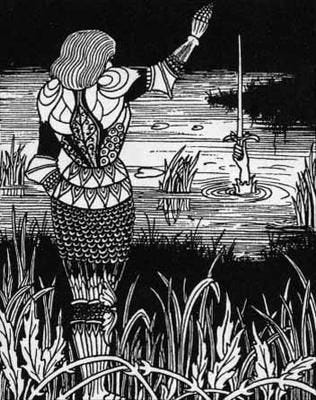
And among whose notable accomplishments in the Welsh roots of King Arthur was the hunting of the giant boar Twrch Trwyth with the aid of Arthur’s dog Cavall, which seems not just coincidental in relation to his mention in the poem.
Cavall is generally described as being Arthur’s favorite dog, it is not unreasonable to suppose that he is the dog given voice here
one turned to me & growled
from its black-fringed throat
“Bring out the dying King to us,
we’ll set his lands in order.”
Upping the violence from second stanza to a primitive vision of ritual regicide, evidently supernaturally ordained, to heal the problems of the land. Even though Arthur is dying in the verse, his death should come quicker, and more violently, from those he loves. It certainly is a bleak vision when the symbol of loyalty, a man’s favorite dog, calls for his death. (on the other hand the name Cavall is not used, so perhaps I am taking liberties in my interpretation)
It should also be noted that if the dogs want the dying king brought out the wound has been there for some time at least, given also that he is also walking about the hallway to see the dog calling for him to be brought out so they can kill him and “Set his lands in order”.
The final verse is of course detailing Mordred (although the name is not used) pacing incessantly in the courtyard in rigorous six-step paths and fiddling with his dagger as though he were trying to make up his mind about something; obviously the subject at hand being ‘should I kill dear, old dad’.
& every step seems a voice calls out
to set my lands in order.
And here we get to the root of the problem as it were, here we are back to the first verse — it is the king who can set his lands in order by ridding himself of traitors but evidently he does not want to, he is old and does not want to deal with getting rid of all these sycophants and courtiers whispering behind their lily-white and manicured hands (unused to the violence and hard work of putting a country together in the 500s AD is the implication here) and he definitely does not want to deal with his only son plotting to kill him, and thus if the king will not set his lands in order violence will be brought to bear not by the king but by others who have wounded him the side with a probably killing wound, or by supernaturally motivated hounds to rip him asunder; others will come to set the king’s lands in order by killing him.
This last stanza as well as bringing things round is also somewhat up in the air, because it shows the king as completely understanding the problem, and by implication that he knows he must set his lands in order, but will he? Or will his son stop his pacing, commit regicide, and becoming the new king set the lands in order thereby.
The quoted poem was written by IG Agent 18
Rest of Article Text was written by IG Agent 13.
Previously writings of Agent 13 on The Mixtape of Taliesin
Selections From The Mixtape of Taliesin — The Tower
Themes in The Mixtape of Taliesin: Youth And Age In the Suit of Clubs
Structure In The Mixtape of Taliesin
The Mixtape of Taliesin can be found on Amazon at https://www.amazon.com/gp/product/B0B6PMM294/ref=dbs_a_def_rwt_bibl_vppi_i0


