
How We Lose Ourselves in a Stream of Digital Refuse
The deeper meaning of content feeds in the creator economy
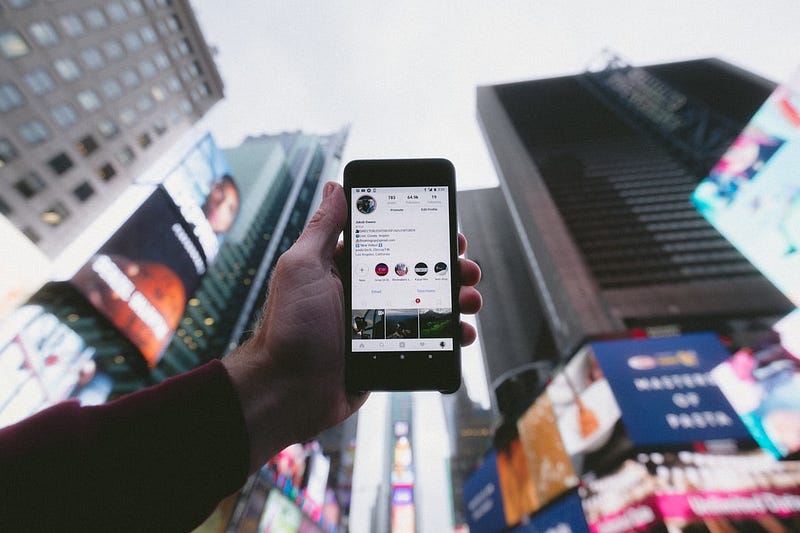
Are you content with being lost as a ripple in a stream?
Whether it’s consuming art on Instagram, news on Facebook, articles on Medium, aphorisms on Twitter, songs on Spotify, or videos on YouTube, the medium is clearly the message, as Marshall McLuhan would have observed.
What this means is that we shouldn’t lose sight of the wood for the trees. We should keep in mind how the structure of our social systems impacts our daily experience. Indeed, the background overwhelms the foreground when the contents flow so quickly and when they’re evidently disposable, so that all that’s left is the stream or the feed as a whole, whatever that might be.
Digital Streams in the Creator Economy
Viewing a physical painting at a gallery or a museum, for example, is very different from glancing at a digital one on Instagram. When the painting hangs on the wall and the gallery isn’t too crowded, you can sit or stand and take your time, admiring the craft and contemplating the work’s deeper meanings. There may be only a few paintings on the wall, so they don’t crowd each other out, and they hang there for the length of an exhibition or a season.
By giving the art some time and space, we don’t experience the painting as being worthless in so far as it’s doomed to be replaced by an infinite stream of digital copies. On Instagram, though, the stream is constantly updated. The stream as a system becomes paramount as it overtakes the significance of any of the contents that flow past.
But what is the stream? Has anyone ever seen the whole of it? Is that even a meaningful question? How could something that’s endless and meaningless take the place of the artworks that artists slave over and that are supposed to be featured? We flock to these tech platforms to consume this content so that superficially the drawings, songs, poems, articles, or videos receive top billing.
Yet if we’re aware of the business model, we know that that’s not how the designers of the tech platform understand what’s happening. We think we’re the consumers, whereas the platforms are consuming our attention. The so-called contents are the baits that lure us to these deep waters, holding our attention long enough for the ads to sink in. More importantly, the endless cycling of contents trains and addicts us to keep consuming for more dopamine hits.
What matters isn’t the merit of any content that passes quickly into oblivion in the creator economy. No, what matters are the turnover rate, the feedback loops, the addictiveness, the mindless scrolling, and the dread that organic and social life outside the digital confines is increasingly unsatisfying. All that matters is the wish to be surprised, the expectation that the next painting, song, or other comment that flows our way will be worth it. We’re like miners sifting for gold, but always coming up empty.
This kind of platform was pioneered, of course, by the casino’s slot machine. If you’ve tried your luck with one before, you know that you keep pulling the lever like a mouse in a science experiment, hoping against the odds to win big. You see the pictures of fruits and numbers that roll on to the screen dozens or hundreds of times, until they’re no longer inherently fascinating. Eventually, you take them for granted, but you keep feeding the slot machine your coins and your time and attention for the thrill of having the chance to win the jackpot.
Like the digital contents, the symbols on the slot machine are scrambled and they whirl past whenever you pull the lever. You think the machine is feeding you with fun, but the fun grows stale eventually as your addiction takes over or your adrenalin rush wanes, in which case you’re numbed to the experience. What’s more substantial is how you keep feeding the machine your money and your fading mental energy.
From the perspective of the tech platforms and of the advertiser, then, there are two streams, that of the content creators and that of the content consumers. The contents attract the consumer who spends her time and attention, and the contents become less important as the consumer’s addiction is established, to the creator’s chagrin.
What matters to the tech companies is their ability to collect the users’ information, which they analyze and sell in the pursuit of some hidden, likely nefarious or farcical purpose. Supposedly, this information on how we consume data is valuable in that it teaches some companies how they can tailor their advertising and increase their profits. The whole business model could be a fraud, of course, based as it might be on something like the hype that inflated the dot-com bubble in the late 1990s.
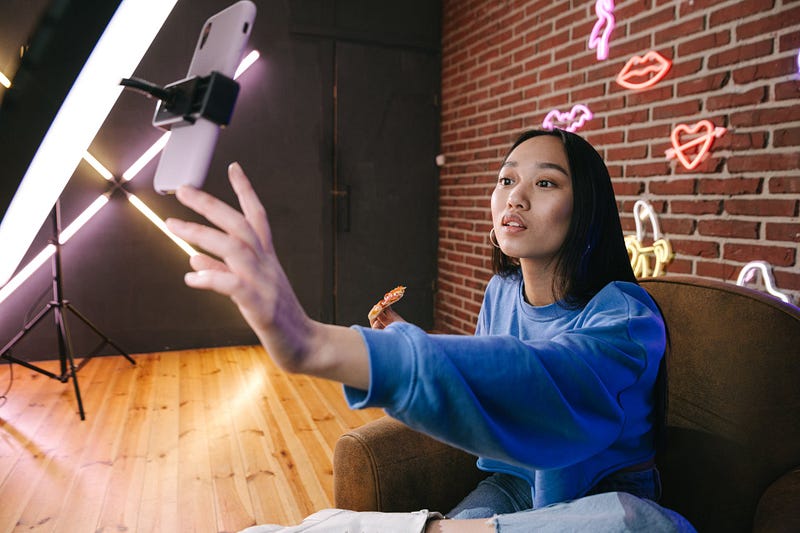
Twitch Streams and Mob Noise
Let’s look more closely at an instructive example. There are Twitch streams that feature influencers such as popular players of online games. The content creators stream their exploits or their antics, and the tech platform hosts them. But running alongside is a second stream, the stream of comments by the viewers, known collectively as “Chat.” The comments are often encoded using Twitch jargon such as “sadge,” which indicates that something sad has happened to the streamer, or “F,” which means the video stream is failing to load. Memes also abound in the comments.
The more popular the streamer, the larger the audience, of course, and thus the faster the comments flow. Eventually, the comments roll past so quickly that they’re unreadable unless you pause the chat.
Think of a Zoom videoconference which can be informative when the size of the group is manageable, but which becomes a fiasco when there are too many participants who talk over each other. Likewise, although the stream’s viewers will give themselves or their avatar a funny, memorable name to try to stand out in the comments, none of the comments matters in the long run, especially in the more popular chatrooms.
This is the equivalent of a celebrity being mobbed on the street, with hundreds of fans shouting for the celebrity’s attention. What matters isn’t any of those individual cries, although each is evidently crucial to the fan who yearns for the celebrity to notice him or her. Instead, the exclamations are lost in the crowd, and what a bystander hears is the sheer noise that expresses the mob’s collective appetite.
Sometimes, the streamer interacts with the commenters, favouring individual remarks with replies or speaking collectively to the crowd, calling it “Chat.” Writing comments in such a medium must be humbling, like losing your ego while high on a psychoactive drug. You type your comment, reacting to what you’re seeing on the stream, and no sooner does your comment appear on the Twitch channel than it’s replaced by other fans’ comments, never to be seen again.
Alternatively, the dynamic here resembles that of an ancient temple’s sacrificing of zealots to a god. The celebrity is all-important, and the fans are lowly peons by comparison. They demonstrate their fealty by prostrating themselves or by symbolizing their comparative smallness by sending their dumbed-down, Twitter-like inanities into the ether. The influencer is immortalized on the Twitch screen while the stream of comments transmogrifies into the mob’s barely intelligible noise.
But the gods or celebrities are recycled in turn. There are many content creators to choose from, just as many pantheons and religions have come and gone in the flow of history. Streamers compete for your attention, as indicated by another panel on the Twitch page which displays other relevant streamers that are currently active, including the size of their audience which ranges from the dozens to the thousands. At any moment, the viewer can leave one stream for another or have multiple streams open at once in the internet browser.
The streams and the celebrities are thus equally meaningless from the tech platform’s perspective. Granted, some moments from a stream might be repackaged as YouTube videos to see if they’ll go viral. However, this is like a “crossing of the streams,” to pun on Ghostbusters. The content creator double dips or leaves the frying pan for the fire: even a viral video on YouTube is soon replaced by the next sensation. The digital immortality here is illusory.

The Stream of Moments in Deep Time
But perhaps there’s an unintended existential lesson to draw from these social media. Again, we can ask why anyone bothers to comment on these platforms. Yet the digital streams might be taken to stand for the flow of history which thus encompasses the smallness of every individual life.
Why bother living out our eight or so decades, then, when each generation is swallowed up and repacked by the genes and the environment? What’s the value of any life compared to deep time? These are just some familiar morbid questions arising from existential philosophy that the proliferation of digital contents in the creator economy might bring to our attention.
Only from an enlightened or melancholy perspective, though, can an individual human life seem too short to bother with. From the standpoint of our more conventional, animalistic preoccupations, we can hardly see past the next few moments, let alone envision a lifespan or an eon’s worth of human generations. Typically, our attention is absorbed by this or that task or pastime, and we seldom detach from them and obtain an overview by pondering the big questions.
The point, though, is that if the medium is often the message because the packaging of content contains implicit meaning, we should notice not just the tech platform’s cynical agenda but the even larger meaning, the role that such behaviours have as we define our period in history. As social scientists have pointed out, ours is a relatively fast-moving, seemingly ephemeral period. Our lives seem to speed by, as our populations increase and as competition for resources is more frantic. Our powerful high technologies show us a million things at once, overwhelming our senses and deadening our sensibilities.
We evolved to deal with a band of around a hundred people (Dunbar’s number), which was the norm in the Paleolithic period. Large cities eventually arose, but they didn’t shock and alienate the citizens since no one had an overview of the civilization. Digital media provide us that overview, and for those who don’t unplug, the common results are increasing jadedness, paranoia, narcissism, and addiction. We’re no longer the Promethean gods wielding our tools in our Faustian or quixotic quest to conquer nature. The machines are manipulating us.
We feed the platforms our art and our longings, and the tech companies use those promises to feed us to the algorithms, which addict us to social media until we no longer appreciate what’s in front of us. We mindlessly scroll through the futile contents, having become one with the stream or with the Matrix or cyberspace.
We merge with the insatiable feed of data, and we both feed the tech companies with our online presence and are fed to the inhuman algorithms. The digital feed thus represents the infantilized consumer’s appetite and nature’s savage process of creative destruction.


