
Seeking Eden: the Lovers and the Millennium of Heaven
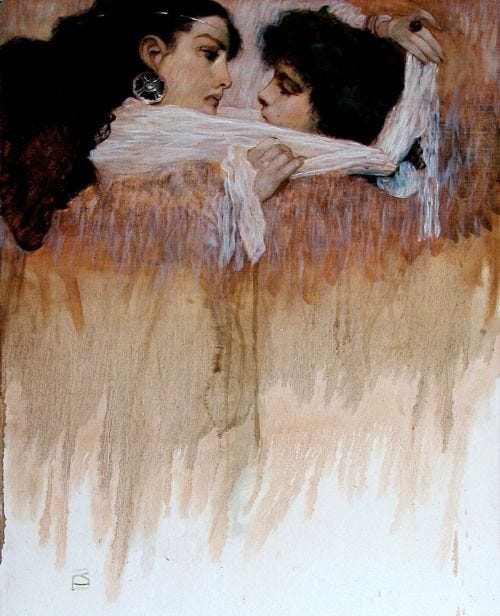
The journey to self always involves comparison and contrast to other, an exploration of duality and contrast that sharpens our intelligence and hones our perspective. In tarot, this point arrives with the Lovers, the 6th card of the major arcana. Not surprisingly, it’s one of the most misread cards in the system. As tarot continues to capture the imagination of artists and seekers and new versions of the card continue to appear, the card is portrayed as one of romance and longing featuring couples in acts of embrace, hands grasping, lips crushed in passion. It’s interpreted literally as earthly relationships, marriage, sexual liaisons in so many readings. In a system known for its deep symbolism and coded wisdom, why is this arcana above all others taken at face value?
Like every card in the tarot, the Lovers has undergone major transformations over the years. From the gameplay of the 14th Century to the tables of the Forefathers of Cartomancy, that card largely represented marriage as a moment of united faith. This was truly the Triumph of Love: a mirror of value, Truth and Honor united under Love, Divinely Inspired and Sanctified. But Eliphas Levi saw the scene very differently: in his work with the Tarot de Marseilles, he saw these figures not as Truth and Honor, but as Vice and Virtue, the moment of choice between Spirit and Matter. To Levi, this card belonged to Vav, the Hook, and represented the tether between Heaven and Earth. The 6th Card to the 6th Letter of the Aleph-Bet, the Lovers embodied the tension between two triads: this was the constant choice, the freedom of will afforded uniquely to mankind, the ultimate human experience. This, Levi emphasized, was the path between Wisdom and Mercy: toil and liberty, affirmation and rejection, intelligence and faith.
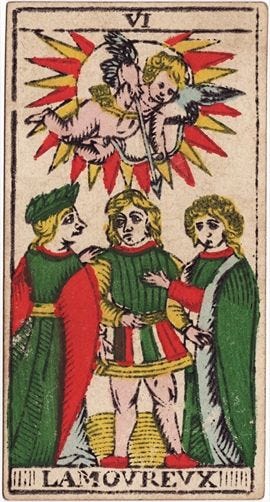
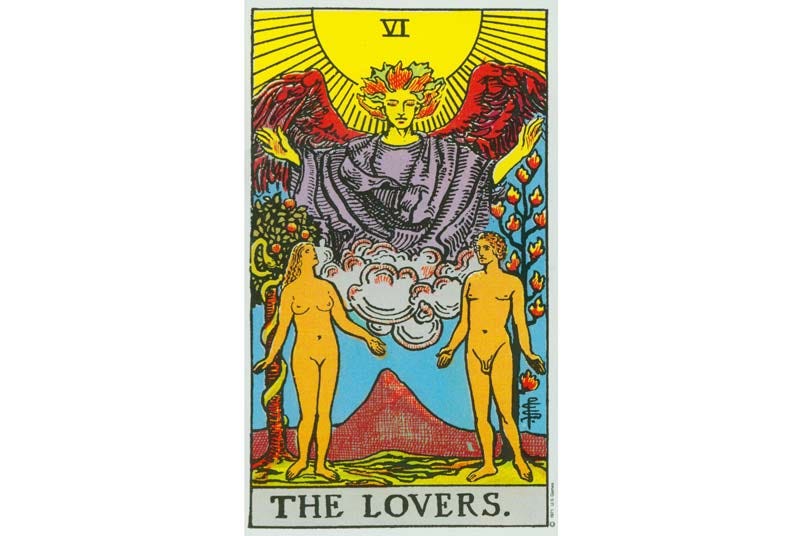
But when the Fool was placed at the beginning of the journey, tarot took on a more individualistic tone. As the cards shifted, so too did the Lovers’ place on the Tree of Life. Though it retained its original numeration, it was now the seventh card of the major arcana and absorbed all the mystical associations one would expect. Now aligned with Zayin, it was the “disposing intelligence” of the Sefer Yetzirah, the pathway between Understanding and Beauty by which we understand the divine architecture of the universe. When the Golden Dawn redesigned the tarot according to their own correspondences, the Lovers became a lush allegory: Adam and Eve at the moment of temptation.
If you’re brought up in the Christian faith, this is the moment of Original Sin. A literal reading of Genesis will lead to a belief that Satan, in the guise of a snake, tempted Eve to eat the forbidden fruit who in turn convinced Adam to partake. Paradise came crashing down around them. But students of the occult are seekers of the hidden, unafraid to chip away at the surface and uncover truths within. It takes a disposing intelligence to see what lies beneath, and this is the moment at which it arrives.
To understand this hidden element, we need to examine the card’s new pathway and the manifold complexity it brings. Zayin is composed of two strokes, one horizontal and one downwards. The Golden Dawn understood this as the Sword and Hilt, an association which compounded the intellectual element of the letter — an energy we see again in the minor arcana in the Ace of Swords. However, Zayin is also described as the Crown and Sceptre, Authority and Power, Knowledge and Action. In Gematria, it’s impossible to separate the number seven from the Sabbath, the seventh day of creation, the day of rest and reflection. This number echoes throughout scripture, bringing us the count of hierarchies, firmaments, and even millennia, each expressing the divine wisdom and power of God with the seventh reigning supreme. The Day of Rest then exists as a preparation for the Seventh Millennium, a new Age of Paradise, which we taste each Sabbath. Zayin also means “sustenance,” and the sacred rest of the Sabbath restores our strength for the march forward. In order to bring about eternal paradise, we must create and indulge in heaven on Earth: just as the Sabbath feast sustains us through the toil of the week, moments of pleasure sustain us through the toil of life as we prepare for Heaven.
The Lovers does not depict a moment of Temptation, but a moment of Sustenance: divine inspiration which brings knowledge of Heaven. Adam looks longingly at Eve, sharing in her moment of ecstasy as she receives inspiration from the Angel of the Morning Star, not depicted here as the demon of Christian lore but as the gnostic counterpart of wisdom, a Divine Masculine force. This is a return to paradise, a choice of higher perspective, the decision to become a conduit for divine inspiration. Just as Gemini is the point at which we introduce and explore the perspective of others, the Lovers is the moment we recognize the divine intelligence of love through earthly experience.
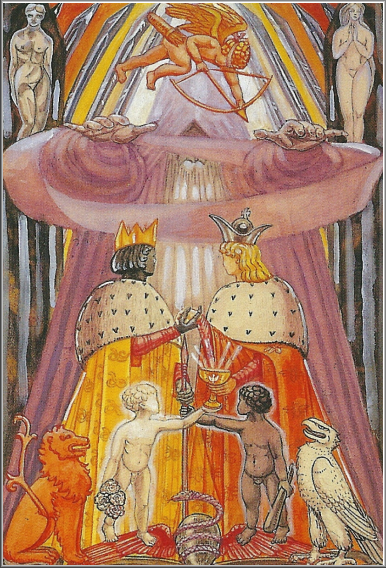
Early incarnations of the card bore a cupid-like figure and even though this symbol was later replaced, Eros still leaves his signature all over the card. Rather than the cherubic putti of early modern art, we feel a very human sense of desire. As Aleister Crowley explained in the Book of Thoth, what we see is the “will of the soul to unite itself with all and sundry,” the lust for all experience and the tendency to externalize desire. What is love but the search for Eden through another? Romance may be the ultimate test of perspective, a taste of beauty understood through the gaze of the other, a stroke of inspiration through which we perceive unity. It’s the contrast between individual experience and union by which we are sustained for the toil ahead. The Lovers represents not a literal relationship, but the choice to fortify ourselves in the union of faith with another in order to continue on our path as stronger, more sustained individuals. Just as the Sabbath is not the Millennium of Paradise, the Lovers is not the fulfillment of integration but it is a taste of the feast before us. The passion of lovers is an earthly echo of paradise, “the libido to express 0 as 2,” a means of dividing our experience for analysis and synthesizing it into tools for integration and sovereignty. Through the Beauty of Paradise, we arrive at Understanding, fortified for the journey ahead and ready to face the ever-echoing firmaments before us.
Fairlie Theta is a professional astrologer and lifetime student of the esoteric. You can find more of her work and book a personal consultation through her website, MoonandMajesty.com


