WRITING
See the Writing Properties From the Engineering World That You’ve Overlooked
Embrace the engineer inside of you.

Steve Jobs credited the calligraphy class he took in college as the inspiration for Apple’s beautiful typography some years later. In 2005, during his speech at Standford University, he told the audience that he could have never connected the dots looking forward. But looking back, the connection was very clear.
As a former engineer, my mind often defaults to theories and models in the physical world. I recently discovered that these intrusive brain-wirings are making random connections in my writing.
Now, unlike Jobs, I’m not about to credit engineering for some invention that I just stumbled upon. No. This article is simply to illustrate the power of connections over time.
Let me explain the three connections between engineering and writing.
Material Science
Newton’s third law of motion is known the world over, a law that’s very important for those involved in space exploration.
“Every action has an equal and opposite reaction.”
Here’s how it works. If you push or drop anything, it pushes back. For example, if you lean against the wall, it pushes back against you. That’s why you don’t fall through it.
If you throw or drop something, you or gravity puts more force behind the action than simply leaning against a wall.
Try dropping a ball from a fixed height. The reactions (forces) are equal in the downward travel, to the point where it bounces and changes direction, when it returns upwards.
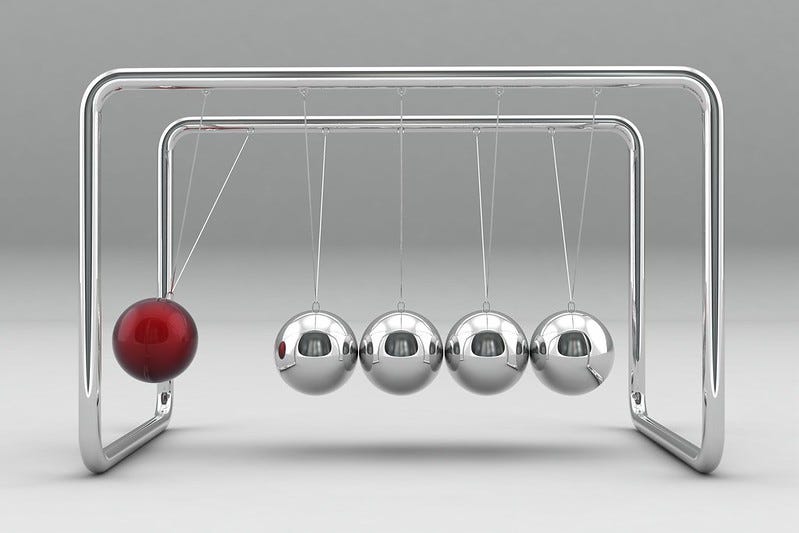
Now you may think this is untrue because a ball doesn't return to the same height it was dropped from. The reason for this is energy transfer and forces:
- On the way down gravity accelerates the ball
- Energy is transferred, converting to sound when the ball strikes the floor
- Energy is also transferred by friction to change the direction of the ball
- On the way up gravity decelerates the ball
Mathematically, when all reactions are taken into account the downward motion is equal to the upward motion.
Now more to the point for writers.
All things being equal, writers can manipulate how high a ball bounces by changing one element grounded in material science.
Take three balls with different properties:
- A tennis ball — medium bounce
- A sliothar (Irish hurling ball) — low to zero bounce
- A ping-pong ball — the springy rubber-type with high bounce
The ball represents content, an article. Other factors like gravity (writing platform) are fixed, height is something writers can influence, like SEO or social sharing, but the material quality is what truly differentiates.
Material, or content quality, determines how high an article will bounce.
Mechanical Advantage
Mechanical advantage is an engineering term that measures the factors to move a tool or mechanical device.
The input effort (force) is a trade-off with distance — the force required to move an object to travel a certain distance to obtain the desired amplification.
This is known as the law of the lever.
Think of a door handle. A movable lever that pivots on a spindle, a fulcrum, at a fixed point. We open doors by applying force to a lever. The force required at different distances from the fulcrum, or pivot, is proportional to the effort.
- If we try to move a door handle near the pivot point the effort is high, but the distance is low
- If we move a door handle at the end of the lever, the pivot point, the effort is low, but the distance is higher
Mechanical advantage is the very same principle used in modern buildings for vertical transportation systems— electric lifts.

As writers, we have strengths and weaknesses in genres, topics, and styles of writing. So at any given time, we have two doors to choose from:
- Door 1 — The path of least resistance, our field of expertise, where we can knock out one or more articles in a day
- Door 2— A path of high resistance, outside our comfort zone, where we must invest time, energy, and effort to produce a piece of work
Now, this doesn't mean that writers should always take the easy road. Not at all. From experience, the Pareto principle is a good rule of thumb.
Push on the door of least resistance often, but don't be afraid to smash down a locked door either.
Fluid Power
Have you ever traveled on an airplane? That’s Bernoulli’s equation, a formula that explains the logic behind fluid-physics.
Bernoulli’s principle is derived from Newton's second law of motion. When a fluid flows (horizontally), from a source of high-pressure towards low pressure, the pressure behind is greater than that in front.

Named after Daniel Bernoulli, the principle deduces that pressure decreases when flow speed increases.
An increase in a fluid’s speed is proportional to a decrease in pressure, or a decrease in energy potential.
The principle applies to numerous types of flow, in various forms. In a nutshell, pressure, flow, and temperature are interdependent.
Most writers are familiar with the mesmerizing state of ‘flow’. A hypnotic experience where time stands still and creative energy unfurls effortlessly.
Embracing our individual flux between pressure, energy, and flow is simply the undulating existence of a writer.
Final Thoughts
Engineers and writers have similar traits. They share a creative mind. They’re artists, innovators, and inventors of tomorrow.
To recap, allow me to remind you of the three principles of ‘Write-neers’:
- Material Science — Choose a ball and watch it bounce
- Mechanical Advantage —Leverage least resistance, but have the courage to explore the unknown
- Fluid Power — Embrace your undulating flow as a writer
Writers engineer words, engineers rewrite the world.
To all writers out there, embrace the engineer inside you. The laws of engineering, incubated in physics and mathematics, are born from the same energy that envelops all creative minds.