Security Risks Associated with Support Teams
ACM.176 Take a look at what supports team are requesting from customers and employees give them
Part of my series on Automating Cybersecurity Metrics. The Code.
Free Content on Jobs in Cybersecurity | Sign up for the Email List
In the last post I finished writing up how to deploy Okta as an Identity Provider (IDP) for AWS. You can access all those posts here:
Part of that process led to a few support tickets and ultimately this blog post. I understand that most support people have very challenging jobs and are doing the best they can under the circumstances.
But there have been a few issues over time involving certain support people that make me wonder if companies really understand the things support people are asking for and telling customers. There’s also a real concern over the information employees give support teams as well because that information can lead to data breaches as well.
I’ve had numerous encounters with support teams that concern me. I am not sure if the organizations that hire and manage these support teams are aware of the risk these interactions pose or are monitoring for suspicious or at least unnecessary behavior in all cases. Do organizations train support teams on cybersecurity and encourage teams to help each other when it comes to security best practices?
I’m not sure if the organizations that allow their employees to contact customer support teams understand how the information they divulge can be used in a data breach. When a support person “says” they need an excessive amount of data to answer a question do your employees just hand it over without clarifying the need and purpose for that information?
Support teams can be both a security risk and a source of lost sales revenue. Organizations should take these risks seriously, and especially cloud and identity platforms.
Support teams may be costing you customers and sales
Not only can support teams cause security problems, in my last support encounter, I almost cancelled a contract. It’s not the most expensive contract compared to a large company but it’s not cheap either.
The problem was that the support team flat out told me something really basic was not possible. That person was wrong and I have since written back to support to explain to them what the problem was and how to fix it. I’ve also provided steps on this blog to implement things that I couldn’t find correctly documented in that company’s online documentation.
My experiences trying to get something similar working on Azure (related to Identity Providers) was very strange. The amount of time I had to spend convincing Azure that a bug existed was excessive. Almost every ticket I supported took many rounds to get simple answers or acknowledgement that the issue I had was a bug.
Are companies monitoring what is going on with support tickets?
- Do you periodically spot check a thread?
- Do you check on threads that are taking a long time to resolve?
- Do you even have a way to do that?
- Are you aware of all the cases where a support person simply told a customer what they were trying to do is not possible so they could close a ticket?
- Are support responses accurate — on the first interaction?
- Is your support team wasting time on questions that have simple answers?
- Are your employees giving out too much information and asking support teams questions they should be asking internally?
Organizations cannot always blame the support teams for these problems.
- Do you have simple and easy to follow policies?
- Do you use technical solutions to help prevent mistakes?
- Is it easy to find the answer for common questions and error messages?
- Do your system error messages and documentation prevent the support calls in the first place?
- If not, do you have a way to get documentation for common support requests updated to help prevent the requests in the first place?
Don’t just blame support staff…figure out what is causing the behavior and prevent it or fix it to make people’s jobs easier all around.
Are your support portals and processes secure?
What if the person I’m talking to is not even on the support team? What if someone has intercepted the communications and a third-party not connected with your company is interacting with customers and obtaining their data. How do you know that is not happening at your company? This is a challenge. How can you be sure the person logging in is your customer? How do you know that the response to the customer is coming from your employee?
Well one way to do that is through a secure web portal. One thing I appreciate about AWS customer support is that when you ask them to respond it the web portal, they do. Thank you. When you have an exchange in a support portal you can see the interaction, who said what, and if it was appropriate. The portal can log connections, time and date, and IP addresses, among other things.
How do you monitor your support team?
On the other hand, if a person is requesting a screen share or a phone call, you may have no way to monitor what that person did or said, especially in a screen share on a customer machine. How do you know that the person connected to the customer’s machine with approved software? How do you know that software is not compromised? If the person is working remotely and supposed to use particular software, how do you know they actually did?
How do you know they are talking to the actual customer and not some attacker who is on the customer’s machine impersonating the customer?
And how can you monitor phone calls? Azure support ALWAYS, ALWAYS, ALWAYS, tries to call me with numbers from Mexico or India even when I explicitly check the box to use the web portal. Why is that check box even there? They rarely use it unless I repeatedly ask them to do so.
How do I know that random number from India or Mexico — or even Redmond! — is actually Microsoft customer support? No way I’m giving out information on the phone. In addition, they end up emailing me outside the portal and the emails don’t always show up in the web portal.
How do customers monitor support interactions?
Are support teams doing this to your staff? Do you know if they are actually talking to true support people at a vendor or some impersonator that contacted them through phone, email, or text? Using a secure web portal will help secure your vendor interactions.
How much information are your support people providing vendors? Can the support person obtain enough information to compromise your systems or potentially facilitate a social engineering attack? How much information about your infrastructure and architecture does a low level support engineer need to answer a simple question? If it is not a simple question, can you get the right type of support a person at an appropriate level? Do you let anyone and everyone submit support cases to your vendors?
Contacting the vendor when you are asked for something suspicious will also help. Do you have a support channel outside the web portal in case of a problem that support cannot properly resolve? What actions will you take when you cannot resolve a problem?
Out of band resolutions
But there’s the next problem. When I got the rogue support person at Microsoft and another recent encounter, those people would not escalate the problem. The customer has to have an out of band way to report a problem with a ticket and the responses they are getting.
In a recent issue where my Stripe account got improperly closed and the support team was just like, “too bad, so sad.” I had to take to Twitter and blogging to get it resolved.
Sometimes the issues are too complex and out of the ordinary for a support team to handle. Sometimes it is not their fault. They don’t have the resources, training, or big picture knowledge to resolve the problem.
Maybe those responses go to a sales person or the security team or someone else OUTSIDE the support department. In my latest case, my contract was almost up for renewal. I asked my sales person and he said the feature I was talking about did exist. He was going to have me chat with his sales engineer, but then I resolved the issue.
Fix your training, documentation and error messages
That last issue where I almost had to get help from my sales rep was all unnecessary, however.
- If the support person was properly trained, the answer was simple.
- The error messages from the system they are integrating with did not have a very good error message, so that was also partially the reason I couldn’t immediately resolve the problem.
- The documentation was incorrect and confusing. Though the particular issue I had was in the documentation, the support person thought I was doing something “custom” which I was not.
- The error message should have quickly helped the support person what the problem was and the documentation should have explained how to fix it. Test and document common errors and their solutions. It seems like the support person could have a standard answer for that error message though, as I’ve seen it posted also in their support forum — without the correct answer.
Clear and complete documentation and error messages saves everyone time, money, and frustration!
What if your support team members are paid to sabotage your company or steal information?
Support team members don’t generally make a lot of money do they? I don’t actually know the going rate for support staff, but it seems like someone who wanted to sabotage your business could easily pay off a few support people.
For example, a Russian individual tried to bribe an employee to spread ransomware at Tesla.
What if someone on your support team was approached to sell customer account information. How would you know that was happening and stop it? What if the person was allowing a third-party to interact with customers? What if the support person was providing customer phone numbers that could be used in phishing or smishing attacks?
One of the best ways to prevent this is to limit the customer data and information available to support personnel to precisely what they need to do their job. In addition, you can separate duties to limit different roles to different parts of the information so no one person has all of it.
No, we do not need a screen share
In multiple cases, at multiple companies, I have been asked to participate in a screen share before the person even understood the problem. In pretty much every case these screen shares were completely unnecessary. Are people trained to immediately ask for screen shares when they do not even understand what I am asking? Or is something else going on here that is causing these people to try to get me to do a screen share when it is not necessary?
Why do I want to avoid screen shares?
- Screen share and support software has been the source of many breaches and security incidents.
- I have no way to validate the person connecting on the other side is actually from the company they claim to be connecting from.
- I have not evaluated their screen share software to understand if it is secure or not.
- I do not want the person on the other end seeing my whole screen or poking around on my system. I am asking a specific question and that is the only information I need.
- I don’t want the person on the other end to have information like my IP address, etc. if they are simply working in support. Hopefully low level support people such as the person who responded to me do not have that information.
What companies have asked me to do screen shares?
- DocuSign support asked for a screen share?? I was asking a straightforward question that in the end, their product did not support. So why is someone asking for a screen share when what I am asking to do is simply not possible? Someone that formerly worked for DocuSign told me they were not supposed to do that. How are companies monitoring these requests?
- I was recently asked for a screen share by Okta. This is especially concerning because this is for an identity provider that could potentially have access to all my accounts and credentials. An Okta support person was involved in a recent breach at that company (for a third-party with a now ended contract, but what about the rest of the support people)? Was this person supposed to be asking for a screen share or no? Perhaps it is standard procedure but I wish it were not, and if you use Okta I recommend avoiding this.
I would like to note that in the end, the Okta breach had minimal impact according to what is written in that Okta blog post. The media had a feeding frenzy with this breach, while at the same time breaches at Microsoft blow over in minutes. According to the above post, the final investigation showed that the attacker was on the system for 25 minutes and successfully accessed two tenants. The attacker achieved no successful MFA or password resets.
So although I am providing this warning about customer support, I have yet to know if Okta support poses a risk. But under the circumstances, the support teams should be under a lot of scrutiny at the moment at Okta, to make sure something similar cannot and does not happen again. Not only that, I am wondering how attackers have known which Okta customers to target in the Oktapus attacks. Are they just lucky, getting the Okta integration from the network, or some other source? I would suggest that a screen share should be a last resort and is a risk for both vendors and their customers.
I have been asked for screen shares at other companies. I think someone from Microsoft tried to ask me this on the phone but it was so long ago I cannot remember for sure. In recent interactions with Microsoft I always insist on using the portal. It always makes me a bit suspicious when requesting a screen share is the first response to a problem and the support person hasn’t even attempted to question or understand what I submitted.
Asking for excessive and questionable information
I already mentioned how an AWS support person asked me for debug output that included my account credentials and why that is a problem:
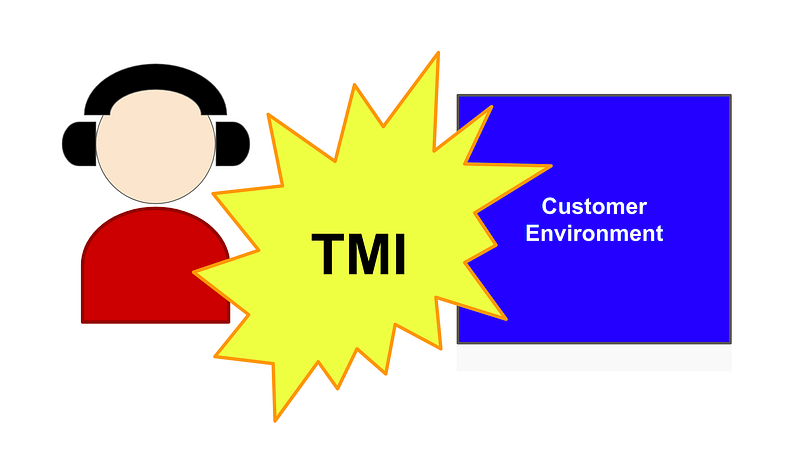
If you are a customer of a cloud provider or other service where you host senstive data, does your team automatically hand over anything a support team requests? In the case of the Capital One breach, how did the support person turned attacker know so much about the environment that was exploited? TMI (too much information) from a person who contacted AWS customer support? Or was it the internal controls at AWS that led to the insider knowledge that person seemed to have?
There was a time when any time I contacted AWS support they had a repeated initial response. The person would answer with “send me these 5-million documents, logs, and pieces of information” and drop off. I exaggerate, but the request was excessive and time-consuming for a customer to provide.
After replying, generally with a, “Actually, you don’t need all that” it would take hours or days to get the person to come back and respond again. Once I got past that initial annoyance the support was often decent. I think perhaps the people on the team were just overloaded and trying to meet quotas so trying to keep customers busy initially, but I’m not sure. I don’t know if they still do that because I stopped using AWS support. I generally spend a lot of time with support teams on communication challenges and end up resolving the problem myself.
I have noticed since that time, AWS has added a support role in all accounts that I wrote about here:
Customers don’t have control over this so I hope it is secure. I don’t see any MFA requirements on that role. But I’m also not sure how it is used. It could be that due to this support role, AWS support staff has no reason to ask customers for data to resolve problems. But I would like to know what support staff access when with something like Google’s Access Transparency:
My experiences with Microsoft support have been probably some of the worst (next to Comcast and a recent experience with AT&T that was pretty bad). I had an issue trying to set up an Identity Provider. At the time of setting this up I realized that anyone with your domain could register that domain in any other Azure account and then you wouldn’t be able to use it. I was asking a support person a very specific question and he refused to answer for nearly a month. But he kept asking me for my domain name. Because I knew of this problem I did not want to provide it. He did not need it to answer my questions. He also would not escalate the ticket.
Somehow, maybe from a blog post I published, a manager took over the ticket. Finally, after like a month, the manager responded, admitted the problem I was having was a bug, and then wanted me to test it a while later. However I was very busy and by the time they fixed it, I had stopped trying to set it up because my need for that particular solution no longer existed.
As it turns out, what I was trying to do is supposedly not possible — so why was that support person repeatedly asking me for my domain — and nothing else? Hmm? Was he planning to set up access for his own account using my Identity Provider or something like that? Because the only piece of information that seemed to be necessary to set up a remote IdP in an Azure account at that time seemed to be the domain. The service was in preview so I need to go back and see how it works now.
I know one company that asks for a lot of dumps off a firewall to answer support tickets. I wonder how much information is in that dump? I also happen to know that they used the session ID from logged in user as the name for a particular report file. I explained the problem to them so I hope that is fixed now.
That is such a basic flaw with potentially disastrous consequences when it comes to web security. Who did that and were support teams aware of this egregious flaw? Anyone who got a copy of that file could then potentially login in using the active session id of the report if the firewall management interface was exposed to the Internet (which it should not be, but not everyone knows that).
What are your support team members asking your customers to provide? Is it necessary? Excessive? Do your managers that are monitoring these requests understand how that information may be used to compromise your customers? Do you understand the risks associated with connecting to customer environments? If you don’t absolutely need to do that — don’t.
How much data can your support team see in customer accounts?
One very disturbing account of an employee with too much access was this case where a Facebook security employee turned out to be potentially stalking women.
At Twitter, the fact that some support staff had “God Mode” led to a social engineering attack and breach by teenagers that impacted many high-profile accounts.
In the case of the Oktapus attacks (which are really not an Okta “flaw” but basic social engineering attacks against Okta customers) excessive visibility into customer text messages by the Twilio support team led to breaches of Signal customer accounts.
A person from one particular cloud provider (not AWS, Azure, or GCP) I met at an OWASP meetup told me how he was proud of how they had architected segregation between customers on their platform. Then he proceeded to tell me (before asking what I do for a living) that, oops, they forgot about the access their employees had to customer systems for support purposes. Somehow employees were accessing things in ways they should not.
Do you ask related questions when you assess new potential vendors?
Besides support teams we’ve had a rash of similar problems with developer credentials with more access than they should have, but I’ll save that for a separate post (or like the nearly 200 I’ve already posted to explain how to prevent that through a solid security and governance architecture).
Pay for bug reports and documentation errors?
In general, I found AWS support people to be the most technical of the teams I’ve worked with, even though I mostly find the answers faster myself. Whenever I’m dealing with support, a lot of the things I have questions about turn out to be bugs (on any platform).
This always gets to me. I don’t want to pay more to report bugs. Should be the other way around, no? What if support teams deducted the cost of support for each month where a customer reported a bug? That seems more fair, doesn’t it? I mean, the customer is essentially doing the work of your QA team.
What if you paid people to help you fix your documentation? Companies are putting their documentation online and letting people login to GitHub and submit changes. I don’t really want to link my GitHub account with other organizations. When I’m reading the documents and find a problem I don’t have time to jump over to GitHub and figure out where to submit that.
If you want people to fix your documentation, why not pay them and crowdsource that work like a bug bounty? It’s not really worth my time, but I bet a lot of editors or people who have other types of jobs would do it. Someone did recently ask me to help with online documentation in exchange for a “link.” I appreciate the offer, but my comment was — isn’t it the responsibility of the company producing the code or documentation — even if open source — to make sure it is secure and accurate? I wonder if there is any liability related to leaving source code and documentation online with known security flaws that are leading to exploits in customer accounts.
To that person’s credit, he was searching for a way to get it fixed when the company was not taking action to do so themselves. I applaud his efforts and feel his pain, having worked for companies like that in the past. I would absolutely love to help everyone for free but at the end of the day, people need to somehow be compensated for their time, unless it is pure charity or a hobby. This blog is already charity enough for me. It takes hours and pays next to nothing.
For now, I’m just blogging about errors and issues I run across here and on the blog below because at least I get a couple of cents and it takes me less time to blog here than to figure out how to login and report it to some other system. Maybe it will help get some things fixed.
The bottom line for support teams is that if companies would take more time up front to test their products and write better documentation and error messages, you would have less customers contacting support. Support teams could work on training new customers or more complex problems (and get paid more!) instead of trying to troubleshoot your systems and documentation or answering the same questions over and over.
Companies would probably save money and reduce the risk of a data breach (which can cost millions or billions) associated with the various types of breaches I’ve covered in this post facilitated by support team activities.
By the way, if you want a “secret shopper” to review your documentation and interact with your support team and then provide feedback — a kind of security and usability assessment — I’d be happy to do that. Contact me on LinkedIn. Otherwise, follow my bug blog an I’ll report non-security bugs, feature requests, and suggestions in the products I use over there.
Now that I’ve gotten that off my mind I’m going to proceed with building out our AWS Organization governance infrastructure.
Follow for updates.
Teri Radichel | © 2nd Sight Lab 2023
About Teri Radichel:
~~~~~~~~~~~~~~~~~~~~
⭐️ Author: Cybersecurity Books
⭐️ Presentations: Presentations by Teri Radichel
⭐️ Recognition: SANS Award, AWS Security Hero, IANS Faculty
⭐️ Certifications: SANS ~ GSE 240
⭐️ Education: BA Business, Master of Software Engineering, Master of Infosec
⭐️ Company: Penetration Tests, Assessments, Phone Consulting ~ 2nd Sight Lab
Need Help With Cybersecurity, Cloud, or Application Security?
~~~~~~~~~~~~~~~~~~~~~~~~~~~~~~~~~~~~~~~~~~~~~~~~~~~~~~~~~~~~~
🔒 Request a penetration test or security assessment
🔒 Schedule a consulting call
🔒 Cybersecurity Speaker for PresentationFollow for more stories like this:
~~~~~~~~~~~~~~~~~~~~~~~~~~~~~~~~~~~~~~~~~~~~~~~~~~~~~~~~~~~~~
❤️ Sign Up my Medium Email List
❤️ Twitter: @teriradichel
❤️ LinkedIn: https://www.linkedin.com/in/teriradichel
❤️ Mastodon: @teriradichel@infosec.exchange
❤️ Facebook: 2nd Sight Lab
❤️ YouTube: @2ndsightlab