
Security-Driven Development with OWASP Top 10 for LLM Applications
Exploring remediation tips and strategies for OWASP top 10 for LLM applications
LLM Security
LLM Security, or Large Language Model Security, is a rapidly evolving field that focuses on identifying, understanding, and mitigating the security risks associated with large language models (LLMs). As LLMs become increasingly sophisticated and integrated into a wide range of applications, the potential for security vulnerabilities also grows. AI engineers play a crucial role in addressing these concerns by incorporating LLM Security principles into their development practices.
The OWASP Top 10 is a widely recognized and influential document published by OWASP (Open Web Application Security Project) that lists the top 10 critical security risks for web applications. The term “OWASP top 10” is not new for those with a traditional programming background. However, the OWASP top 10 for LLM applications is a different list from the OWASP top 10 for web applications, as indicated by the names of these two lists.
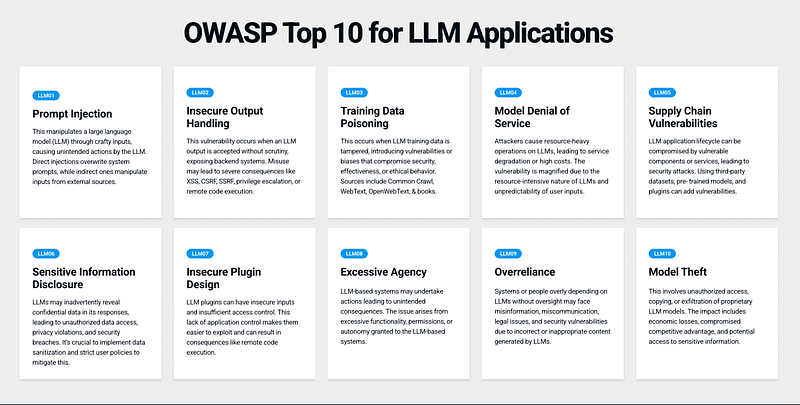
OWASP Top 10 for LLM Applications
The OWASP top 10 for LLM applications lists the most critical vulnerabilities in applications utilizing LLMs. It was created in 2023 by OWASP to provide AI engineers, data scientists, and security professionals with practical, actionable, and concise security guidance to navigate the complex and evolving terrain of LLM security.
Creating the OWASP Top 10 for LLM applications list was a major undertaking, built on the collective expertise of an international team of nearly 500 experts, with over 125 active contributors. The team brainstormed and proposed potential vulnerabilities, refined these proposals down to a concise list of the ten most critical vulnerabilities, and each vulnerability was then further scrutinized and refined by dedicated sub-teams and subjected to public review.
The latest version of OWASP top 10 for LLM applications is 1.1, published on October 16, 2023. The team expects to update it periodically to keep pace with the state of the industry.
The whitepaper of the OWASP top 10 for LLM applications dives deep into each of the top 10 vulnerabilities. I highly recommend you check it out. In this article, we will not dive deep into the details of those top 10 vulnerabilities, but we will focus on the remediation tips and strategies for those top 10 vulnerabilities.
This article aims to raise awareness of LLM security and promote the mentality for Security-Driven Development (SDD) so AI engineers can proactively incorporate these remediation tips and strategies during the LLM app design and development phase to mitigate such vulnerabilities.
After researching the OWASP website and many other websites related to LLM security and chatting with ChatGPT and Bard, I am compiling a list of remediation tips and strategies for the OWASP top 10 for LLM applications as follows, ordered by the same order as in the OWASP top 10 for LLM applications list, with the description for each vulnerability quoted from the whitepaper. Sample code snippets have been added for some remediation strategies for reference purposes only. This remediation list is by no means comprehensive, but at least it gets us started to bring LLM security onto the horizon of our LLM application development.
Let’s get started by walking through the list for the top 10.
Update on 12/27/2023:
About 10 days after this article was published, Meta released Llama Guard, which can be used to classify content in both LLM inputs and responses. I have wrote a new article titled Safeguarding Your RAG Pipelines: A Step-by-Step Guide to Implementing Llama Guard with LlamaIndex, in which we explore Llama Guard and how to incorporate it into RAG pipelines to moderate LLM inputs and outputs and combat prompt injection. I highly recommend you check out that article for more details on the remediation approaches for prompt injection, insecure output handling, and sensitive information disclosure.
LLM01: Prompt Injection
“This manipulates a large language model (LLM) through crafty inputs, causing unintended actions by the LLM. Direct injections overwrite system prompts, while indirect ones manipulate inputs from external sources.”
When working with prompts for LLMs, it’s essential to validate and sanitize them appropriately to prevent security vulnerabilities. Here are some tips for validating prompts:
1. Whitelist Input Validation
Define a whitelist of allowed characters or patterns, such as allowing only alphanumeric characters and spaces, for prompts to prevent injection attacks. See below for a sample code snippet.
import re

def whitelist_prompt_validation(prompt):
    # Define a whitelist pattern (allow only alphanumeric characters and spaces)
    pattern = re.compile(r"^[a-zA-Z0-9\s]+$")

    # Validate prompt against the whitelist pattern
    if not re.match(pattern, prompt):
        raise ValueError("Invalid prompt. Please use only alphanumeric characters and spaces.")
2. Escape User Input in Prompts
If the prompt includes user-generated content, escape or sanitize that content to prevent unintended interpretation by the language model. The sample code snippet below removes any characters from user_content that are not letters, digits, underscores, or whitespace characters.
import re

def escape_user_content(user_content):
    # remove any characters from user_content that are not letters, digits, underscores, or whitespace characters.
    escaped_content = re.sub(r'[^\w\s]', '', user_content)
    return escaped_content
3. Sanitization for Special Characters
Sanitize prompts to remove or escape special characters that might be misinterpreted by the LLM. The following sample code snippet sanitizes the prompt in an HTML context.
def sanitize_prompt(prompt):
# Remove or escape special characters
sanitized_prompt = prompt.replace("<", "<").replace(">", ">")
return sanitized_prompt4. Parameterization for Dynamic Prompts
If your prompts are dynamic and include user input, use parameterization to safely include that input in the prompt. But first, ensure that the user input is validated. See the sample code snippet below.
import html

def generate_dynamic_prompt(user_input):
    # Validate and escape user input
    validated_input = validate_and_escape(user_input)

    # Use parameterization to include user input in the prompt
    dynamic_prompt = f"User input: {validated_input}"
    return dynamic_prompt

def validate_and_escape(user_input):
    # Perform any additional validation if needed
    # For example, check if the input is within acceptable limits

    # Escape special characters using HTML escaping
    escaped_input = html.escape(user_input)

return escaped_input- The
validate_and_escapefunction is introduced to encapsulate the validation and escaping logic. This function can be expanded to include any additional validation steps you might need. - The
html.escapefunction is used to escape special characters in the user input, making it safer for contexts such as HTML. - If additional validation steps are required (e.g., checking the length or format of the user input), you can incorporate them within the
validate_and_escapefunction. - The
generate_dynamic_promptfunction first validates and escapes user input, then uses parameterization to include user input in the prompt.
5. Length Validation
Ensure that the length of the prompt is within reasonable limits to prevent potential performance issues or denial-of-service attacks.
def prompt_length_validation(prompt, max_length=512):
    # ensures that prompt is a string
    if not isinstance(prompt, str):
        raise TypeError("Input prompt must be a string.")

    # ensures that prompt max_length is a positive integer.
    if not isinstance(max_length, int) or max_length <= 0:
        raise ValueError("max_length must be a positive integer.")

    # ensures that prompt doesn't exceed max_length, if so, raise error
    if len(prompt) > max_length:
        raise ValueError(f"Prompt length exceeds the maximum allowed of {max_length} characters.")
6. Carefully Design Instructions
A recent paper, Prompting Frameworks for Large Language Models: A Survey, offered a few suggestions from the perspective of instruction design as defense mechanisms against prompt-based attacks:
- Employ delimiters to rigorously differentiate instructions from content.
- Place crucial instructions at the end of the prompt.
- Consider incorporating a pre-filtering layer, such as establishing whitelists and blacklists for prompt content.
Keep in mind that the specific validation measures will depend on the characteristics of your application and how prompts are used in the interactions with the LLM. Regularly review and update your validation mechanisms to address emerging security concerns and best practices.
LLM02: Insecure Output Handling
“This vulnerability occurs when an LLM output is accepted without scrutiny, exposing backend systems. Misuse may lead to severe consequences like XSS, CSRF, SSRF, privilege escalation, or remote code execution.”
Here are some effective strategies for mitigating insecure output handling in LLM app development:
1. Treat LLM Output as Untrusted Data
Always treat LLM-generated output as untrusted data, similar to user inputs. This means applying rigorous input validation and sanitization techniques to ensure the output meets security standards before integrating it into backend processes. See the code snippet below, you can fill in the details for both sanitize_text and validate_content based on your business requirements.
def validate_llm_output(llm_output):
    # Remove any potentially harmful characters or code snippets
    sanitized_output = sanitize_text(llm_output)

    # Validate the output against predefined security rules
    if not validate_content(sanitized_output):
        raise ValueError("LLM output contains invalid content. Please check the output for prohibited elements.")

    return sanitized_output
2. Encode Output for User Consumption
When displaying LLM output to users, employ encoding mechanisms to prevent malicious code injection or manipulation. This ensures that users receive the intended content without compromising their security.
import html, json
from urllib.parse import urlencode

def encode_output_for_user(llm_output):
    # Encode special characters in the llm_output as HTML entities to prevent XSS attacks
    encoded_output = html.escape(llm_output)

    # Call urlencode if llm_output is string and is url parameter (you can implement your own logic)
    if isinstance(llm_output, str) and is_url_parameter(llm_output):
        encoded_output = urlencode({'output': encoded_output})
    # Call json.dumps if llm_output is list or dictionary
    elif isinstance(llm_output, (list, dict)):
        encoded_output = json.dumps(llm_output)

    return encoded_output
Choose the encoding method based on the context in which the data is used:
- If you're dealing with HTML content, use
html.escapefunction. - If you’re dealing with URLs and query parameters,
urlencodeis appropriate. - If you’re dealing with list or dictionary data that may contain characters that need to be properly escaped in JSON, the
json.dumpsfunction can handle that for you. It automatically escapes special characters, ensuring that the resulting JSON is valid and safe.
3. Limit LLM Privileges
Restrict the privileges granted to LLMs within the application to minimize the potential damage caused by any vulnerabilities. Only allow LLMs to perform their intended tasks and prevent them from accessing sensitive data or executing privileged actions.
4. Implement Input Validation and Sanitization
Thoroughly validate and sanitize all inputs, including user inputs and LLM outputs, before incorporating them into downstream processes or rendering them to users. This helps prevent malicious code injection and data manipulation. Sample code snippets can be found in “LLM01: Prompt Injection” section above.
LLM03: Training Data Poisoning
“This occurs when LLM training data is tampered, introducing vulnerabilities or biases that compromise security, effectiveness, or ethical behavior. Sources include Common Crawl, WebText, OpenWebText, & books.”
A few remediation tips on how to prevent training data poisoning:
1. Data Quality Checks
Implement rigorous data quality checks to identify and remove anomalies, outliers, and potentially malicious data points before training the LLM. This helps maintain the integrity of the training data and prevent biased or harmful outputs.
2. Data Provenance Tracking
Track the provenance of training data to understand its origin and ensure its trustworthiness. This helps identify potential sources of bias or manipulation.
def track_data_provenance(training_data):
    # Associate each data point with its source and collection method
    data_provenance = {}
    for data_point in training_data:
        data_provenance[data_point] = {
            "source": get_data_source(data_point),
            "collection_method": get_data_collection_method(data_point)
        }

    return data_provenance
3. Adversarial Training
Employ adversarial training techniques to expose the LLM to carefully crafted malicious data samples. This helps improve the model’s robustness and generalization to handle diverse inputs, and it helps the LLM recognize and resist poisoning attacks.
def generate_adversarial_samples(training_data):
    # Create slightly modified data points that trigger undesired LLM behavior
    adversarial_samples = []
    for data_point in training_data:
        adversarial_samples.append(modify_data_point(data_point))

    return adversarial_samples
4. Anomaly Detection for LLM Outputs
Implement anomaly detection mechanisms to monitor LLM outputs and identify deviations from expected behavior. This helps detect potential poisoning attacks.
def detect_output_anomalies(llm_outputs):
    # Compare LLM outputs to historical patterns or expected results
    anomalies = []
    for output in llm_outputs:
        if not is_output_within_expected_range(output):
            anomalies.append(output)

    return anomalies
By implementing these strategies, developers can significantly reduce the risk of training data poisoning and ensure the reliability and trustworthiness of LLM-based applications.
LLM04: Model Denial of Service
“Attackers cause resource-heavy operations on LLMs, leading to service degradation or high costs. The vulnerability is magnified due to the resource-intensive nature of LLMs and unpredictability of user inputs.”
Here are some effective strategies for mitigating Model Denial-of-Service (MDDoS) attacks in LLM app development.
1. Input Validation and Throttling
Implement rigorous input validation to filter out invalid or malicious requests. Additionally, throttle incoming requests to prevent resource exhaustion attacks. Many API gateway options on the market offer both account-level and usage plan-level throttling, allowing you to control the rate at which requests are sent to your backend services. But if you have to write the validation and throttling logic from scratch, refer to the sample code snippet below.
import time

def validate_and_throttle_requests(incoming_requests):
    # Validate each request against predefined criteria
    valid_requests = []
    for request in incoming_requests:
        if is_valid_request(request):
            valid_requests.append(request)

    # Throttle valid requests to prevent overwhelming the LLM
    throttled_requests = []
    max_requests_per_second = 10
    request_count = 0
    start_time = time.time()
    max_time_threshold = 60  # Adjust this value based on your requirements

    for request in valid_requests:
        if request_count < max_requests_per_second:
            throttled_requests.append(request)
            request_count += 1
        else:
            time.sleep(1)

        # Reset request_count after processing the allowed number of requests
        if request_count == max_requests_per_second:
            request_count = 0

        # Check elapsed time and exit the loop if needed
        elapsed_time = time.time() - start_time
        if elapsed_time > max_time_threshold:
            break

return throttled_requests- The
validate_and_throttle_requestsfunction takes a list ofincoming_requestsas input. It iterates through each request and calls theis_valid_requestfunction to determine if it meets the predefined criteria. If a request is valid, it is appended to thevalid_requestslist. - The code then applies throttling to the valid requests to control the processing rate. It sets a maximum of
max_requests_per_secondrequests to be processed per second. It maintains arequest_countvariable to track the number of requests processed and astart_timevariable to measure the elapsed time. - Within the throttling loop, it checks if the
request_countis less than themax_requests_per_secondlimit. If so, it appends the request to thethrottled_requestslist and increments therequest_count. Otherwise, it pauses for one second usingtime.sleep()before processing the next request. - After processing the allowed number of requests (
max_requests_per_second), it resets therequest_countto zero. Additionally, it checks the elapsed time since the start time using thetime.time()function. It exits the loop if the elapsed time exceeds themax_time_threshold(60 seconds).
2. Resource Monitoring and Allocation
Continuously monitor resource utilization and dynamically allocate resources based on demand. This helps prevent resource starvation and maintain LLM availability.
Some well-known resource monitoring tools include Prometheus, Grafana, Datadog, etc. All these tools can provide real-time insights and alerting capabilities to detect and address resource contention issues.
Sample resource allocation tools:
- Kubernetes: provides automated resource allocation and scaling capabilities to ensure your LLM app has the resources to handle varying workloads.
- Amazon Elastic Container Service (ECS): a fully managed container orchestration service that simplifies the deployment, management, and scaling of containerized applications on AWS. It provides automated resource allocation and scaling capabilities to optimize resource utilization and ensure your LLM app has the necessary resources.
3. Prioritization and Queuing
Prioritization and queuing are crucial strategies for mitigating model DDoS attacks by ensuring that legitimate requests are prioritized and processed promptly while malicious traffic is identified, throttled, or dropped to protect the LLM app from resource exhaustion.
Tools for Prioritization and Queuing:
- API Gateways: API gateways, such as Amazon API Gateway, offer built-in queuing and throttling capabilities, allowing you to prioritize and control the flow of requests to your LLM app.
- Load Balancers: Load balancers, such as AWS Elastic Load Balancing, can distribute traffic across multiple instances of your LLM app, preventing a single instance from being overwhelmed by malicious traffic.
- Custom Queues: To prioritize and manage traffic flow to your LLM app, you can implement custom queuing mechanisms using programming languages or frameworks, such as Python with RabbitMQ.
- Machine Learning-Based Solutions: Machine learning algorithms can analyze traffic patterns and identify malicious requests, enabling real-time prioritization and throttling decisions.
By employing these tools and strategies, you can effectively prioritize legitimate requests, identify and mitigate malicious traffic, and protect your LLM app from model DDoS attacks, ensuring consistent and reliable service for your users.
LLM05: Supply Chain Vulnerabilities
“LLM application lifecycle can be compromised by vulnerable components or services, leading to security attacks. Using third-party datasets, pre- trained models, and plugins can add vulnerabilities.”
A few remediation tips on how to prevent supply chain vulnerabilities:
1. Implement Software Bill of Materials (SBOM)
Implementing a Software Bill of Materials (SBOM) is crucial for preventing LLM supply chain vulnerabilities. It provides a comprehensive inventory of all software components and their dependencies in developing and deploying LLM apps. This detailed list allows for effective vulnerability identification, tracking, and remediation, safeguarding LLM systems from potential security breaches.
Approaches to implement SBOMs for LLM supply chain security:
- Automated SBOM Generation: CycloneDX, SPDX, and Syft can automatically generate SBOMs from source code repositories and package managers, simplifying the creation and maintenance of accurate inventories. GitHub also offers the feature to allow users to export SBOM from a repository by navigating to the “Settings” tab → “Dependency graph” → “Export SBOM”.
- SBOM Integration: Integrate SBOMs into your CI/CD pipelines to automatically identify and notify relevant teams about newly discovered vulnerabilities.
- Vulnerability Management: Integrate SBOMs with vulnerability management platforms to streamline vulnerability tracking, prioritization, and remediation.
- Supply Chain Security Monitoring: Utilize SBOMs to monitor the LLM app’s software supply chain for anomalies and potential tampering, ensuring the integrity of software components.
- SBOM Sharing: Share SBOMs with software vendors and partners to facilitate vulnerability disclosure and coordinated remediation efforts across the supply chain.
2. Employ Vulnerability Scanning and Patch Management
Employing vulnerability scanning and patch management is crucial in preventing LLM app supply chain vulnerabilities by identifying, assessing, and mitigating security weaknesses in the software components used in developing and deploying LLM apps. This proactive approach helps safeguard LLM systems from potential exploitation by malicious actors.
Approaches to implement vulnerability scanning and patch management for LLM app supply chain security:
- Integrated Scanning and Patching: Utilize integrated vulnerability scanning and patching tools that combine vulnerability identification with automated patch deployment, streamlining the remediation process.
- Regular Scanning: Schedule regular vulnerability scans to ensure the LLM app is continuously monitored for newly discovered vulnerabilities.
- Prioritized Patching: Prioritize patching based on vulnerability severity and potential impact, ensuring that critical vulnerabilities are addressed promptly.
- Automated Patch Deployment: Leverage automated patch deployment capabilities to efficiently apply patches to vulnerable components, minimizing downtime and disruptions.
- Continuous Monitoring: Monitor the LLM app for patch compliance and any newly discovered vulnerabilities, ensuring the system remains protected and up-to-date.
LLM06: Sensitive Information Disclosure
“LLMs may inadvertently reveal confidential data in its responses, leading to unauthorized data access, privacy violations, and security breaches. Its crucial to implement data sanitization and strict user policies to mitigate this.”
A few remediation strategies on how to prevent sensitive information disclosure:
1. Data Sanitization and Redaction
Implement data sanitization and redaction techniques to remove or mask sensitive information before training the LLM or using it in production.
Here are some key strategies for redacting data to prevent LLM sensitive information disclosure (SID):
- Identify and Categorize Sensitive Data: Begin by identifying and categorizing the types of sensitive data in your LLM training data and prompts. This may include personally identifiable information (PII), financial data, medical records, confidential business information, and other sensitive categories.
- Implement Data Masking and Replacement: Employ data masking techniques to replace sensitive information with non-sensitive placeholders. This can involve techniques like anonymization, pseudonymization, and tokenization. I briefly explored masking PII data in RAG pipelines a few weeks ago, but more work needs to be done to look into the fine-tuning aspect of NER models to tailor them to your business requirements.
- Leverage Data Loss Prevention (DLP) Tools: Utilize DLP tools to scan LLM outputs for sensitive information. These tools can identify and flag potential data leaks, allowing for further scrutiny and redaction if necessary.
- Train LLMs on Redacted Data: Consider training LLMs on sanitized or redacted datasets to minimize the risk of SID. This approach can reduce the exposure of sensitive information during the training process.
- Monitor and Audit LLM Outputs: Monitor LLM outputs for potential SID occurrences. Regularly audit LLM responses to ensure sensitive information has not been inadvertently disclosed.
- Establish Data Governance Policies: Implement robust data governance policies to guide the handling of sensitive data throughout the LLM lifecycle. These policies should clearly define data usage, access control, and redaction procedures.
2. Access Control and Role-Based Authorization
Enforce strict access controls (e.g., RBAC and rule of least privilege) and role-based authorization to limit access to sensitive data and LLM capabilities.
3. Output Filtering and Monitoring
Filter and monitor LLM outputs to detect and prevent the disclosure of sensitive information.
def filter_and_monitor_llm_outputs(llm_outputs):
    # Identify potential leaks of sensitive information in LLM outputs
    filtered_outputs = []
    for output in llm_outputs:
        if not contains_sensitive_information(output):
            filtered_outputs.append(output)

    # Monitor LLM outputs for anomalies or suspicious patterns
    detect_output_anomalies(filtered_outputs)
4. Data Provenance Tracking
Track the provenance of sensitive data to maintain an audit trail and facilitate incident response.
def track_sensitive_data_provenance(sensitive_data):
    # Associate each piece of sensitive data with its origin, modification history, and access logs
    data_provenance = {}
    for data_point in sensitive_data:
        data_provenance[data_point] = {
            "origin": get_data_origin(data_point),
            "modification_history": get_modification_history(data_point),
            "access_logs": get_access_logs(data_point)
        }

    return data_provenance
5. Regular Security Audits and Penetration Testing
Conduct regular security audits and penetration testing to identify and address vulnerabilities related to sensitive data handling.
LLM07: Insecure Plugin Design
“LLM plugins can have insecure inputs and insufficient access control. This lack of application control makes them easier to exploit and can result in consequences like remote code execution.”
Here are a few remediation tips on how to prevent insecure plugin design:
1. Plugin Validation and Sanitization
Implement rigorous validation and sanitization mechanisms to ensure plugins adhere to security standards and not introduce vulnerabilities.
def validate_and_sanitize_plugin(plugin):
    # Verify plugin authenticity and integrity using digital signatures or checksums
    if not verify_plugin_integrity(plugin):
        raise ValueError("Plugin integrity cannot be verified")

    # Validate plugin code for known vulnerabilities and malicious code patterns
    if not is_plugin_code_safe(plugin):
        raise ValueError("Plugin code contains potential vulnerabilities")

    # Sanitize plugin inputs to prevent malicious code injection or data manipulation
    plugin.sanitize_inputs()
2. Least Privilege Principle
Grant plugins the minimum necessary privileges to perform their intended functions. Avoid granting excessive permissions that could lead to unauthorized access or resource exhaustion.
3. Input Validation and Output Filtering
Validate all inputs passed to plugins to prevent malicious code injection or data manipulation. Filter plugin outputs to remove sensitive information or potentially harmful content. The details on validation of input values and output filtering have been covered in the sections above on prompt injection and insecure output handling.
def validate_plugin_inputs(plugin, inputs):
    # Validate each input against predefined criteria and security rules
    valid_inputs = []
    for input_data in inputs:
        if validate_input_data(input_data):
            valid_inputs.append(input_data)

    # Pass only validated inputs to the plugin
    plugin.process_inputs(valid_inputs)
4. Plugin Sandboxing
Run plugins in a sandboxed environment to isolate them from the LLM application and limit their ability to access sensitive data or system resources.
5. Plugin Monitoring and Logging
Continuously monitor plugin activity and log all interactions to detect anomalous behavior or suspicious patterns.
def monitor_and_log_plugin_activity(plugin):
    # Track plugin inputs, outputs, and resource utilization
    plugin_activity_log = []
    for input_data, output in plugin.run():
        activity_log_entry = {
            "input_data": input_data,
            "output": output,
            "resource_usage": plugin.get_resource_usage()
        }
        plugin_activity_log.append(activity_log_entry)

    # Analyze plugin activity logs to identify anomalies or potential threats
    analyze_plugin_activity_logs(plugin_activity_log)
LLM08: Excessive Agency
“LLM-based systems may undertake actions leading to unintended consequences. The issue arises from excessive functionality, permissions, or autonomy granted to the LLM-based systems.”
A few remediation tips on how to prevent excessive agency:
1. Limit LLM Permissions and Functionality
Restrict the LLM’s permissions and functionality to those necessary for its intended purpose. Avoid granting excessive permissions that could lead to unauthorized actions or unintended consequences.
def limit_llm_permissions_and_functionality(llm_client, user_input):
    # Check if the user input is allowed
    if not is_input_allowed(user_input):
        return "Sorry, you don't have permission to use this input."

    # Generate text using the LLM
    generated_text = llm_client.generate_text(user_input)

    # Filter the generated text based on allowed content
    filtered_text = filter_generated_text(generated_text)

    return filtered_text

def is_input_allowed(user_input):
    # Implement your logic to check if the user input is allowed
    # This can include whitelisting certain prompts or validating inputs

    # For example:
    allowed_inputs = ["generate_text", "translate_language"]
    return user_input in allowed_inputs

def filter_generated_text(generated_text):
    # Implement your logic to filter the generated text based on allowed content
    # This can include removing or modifying certain parts of the output

    # For example:
    filtered_text = generated_text.replace("execute_commands", "[Command execution disabled]")
    return filtered_text
2. Implement User Approval for LLM Actions
Require user approval for any LLM actions that significantly impact or involve sensitive data. This ensures that human oversight is involved in critical decisions.
def require_user_approval_for_llm_actions(llm_client, action_type):
    # Prompt the user for approval before executing the LLM action
    user_approval = get_user_approval(action_type)

    # Proceed with the LLM action only if user approval is granted
    if user_approval:
        llm_client.execute_action(action_type)

def get_user_approval(action_type):
    # Provide additional context about the action to the user
    print(f"Action: {action_type}")
    user_input = input(f"Do you approve the {action_type} action? (yes/no) ")
    return user_input.lower() == "yes"
3. Implement Input Validation and Sanitization
Validate and sanitize all inputs to the LLM, including prompts, data sources, and user interactions. This helps prevent malicious code injection or data manipulation. The sample code snippets have been provided in the sections above.
4. Monitor LLM Activity and Outputs
Continuously monitor LLM activity and outputs to detect anomalies or suspicious patterns. This helps identify potential misuse or unexpected behavior. More details can be found in section “LLM04: Model Denial of Service” above.
5. Implement Rate Limiting and Throttling
Apply rate limiting and throttling mechanisms to restrict the frequency and volume of LLM app requests. This helps prevent resource exhaustion attacks and malicious overuse of the LLM app. More details and code snippet can be found in section “LLM04: Model Denial of Service” above.
LLM09: Overreliance
“Systems or people overly depending on LLMs without oversight may face misinformation, miscommunication, legal issues, and security vulnerabilities due to incorrect or inappropriate content generated by LLMs.”
A few remediation tips on how to prevent overreliance:
1. Combine LLMs with Human Expertise
LLMs are tools to augment human expertise, not as replacements for human judgment and decision-making. Maintain human oversight and involvement in critical tasks and decision-making processes.
2. Implement Explainability and Transparency
Make LLM decision-making processes more transparent and explainable. Provide insights into the rationale behind LLM outputs to enable informed evaluation and decision-making.
3. Employ Data Diversity and Bias Detection
Ensure that training data used for LLMs is diverse and representative. Implement bias detection and mitigation techniques to prevent biased LLM outputs.
4. Implement Continuous Monitoring and Evaluation
Continuously monitor LLM app performance and outputs to identify potential performance degradation issues. Regularly evaluate the value and effectiveness of LLM app usage.
5. Implement Error Handling and Fallback Mechanisms
Implement robust error handling and fallback mechanisms to gracefully handle LLM app errors or unexpected outputs. Ensure that the application can function effectively even during LLM app failures.
def handle_llm_errors_and_fallback(llm_client):
    try:
        # Attempt to execute the LLM task
        llm_output = llm_client.run()
    except LLMError as error:

        # Log the error for debugging purposes
        logging.error(f"LLMError: {error}")

        # Handle LLM errors gracefully
        handle_error(error)

        # Implement fallback mechanisms to continue operation without relying on the LLM
        fallback_output = generate_fallback_output()

        return fallback_output

    return llm_output

def generate_fallback_output():
    # Implement fallback logic to generate an alternative output
    # This might involve using default values, cached data, or other strategies
    return "Fallback output"
LLM10: Model Theft
“This involves unauthorized access, copying, or exfiltration of proprietary LLM models. The impact includes economic losses, compromised competitive advantage, and potential access to sensitive information.”
A few remediation tips on how to prevent model theft:
1. Model Obfuscation and Protection
Employ obfuscation techniques to make it more difficult to reverse engineer or extract the LLM model. Use proprietary encryption methods and access control mechanisms to protect the model from unauthorized access.
2. Watermarking and Digital Fingerprinting
Embed unique watermarks or digital fingerprints into the LLM model to identify its ownership and provenance. This helps trace unauthorized model distribution and usage.
def watermark_llm_model(llm_model, owner_id):
    # Insert unique watermarks or digital fingerprints into the LLM model
    watermarked_model = insert_watermarks(llm_model, owner_id)

    return watermarked_model

def track_model_distribution_and_usage(llm_model):
    # Monitor model usage and identify potential leaks or unauthorized distribution
    monitor_model_access_logs()

    # Use watermarks or digital fingerprints to trace the source of unauthorized model usage
    trace_model_origin(llm_model)
3. Secure Deployment and Model Versioning
Employ secure deployment practices to prevent unauthorized access to the LLM model during deployment. Maintain strict version control for LLM models to track changes and revert to previous versions if needed.
4. Legal Protection and Intellectual Property Rights
Secure intellectual property rights for the LLM model through patents, copyrights, or trademarks. Consider legal action against unauthorized model theft or distribution.
5. Community Education and Awareness
Educate the LLM development community about the risks of model theft and the importance of model protection. Encourage responsible LLM usage and promote best practices for model security.
Summary
The OWASP Top 10 for LLM applications is a valuable resource for developers and security professionals developing or using LLM-based applications. By following the recommendations in the OWASP Top 10 for LLM applications, developers and security professionals can help ensure that LLMs are used responsibly and ethically, and that there is transparency and accountability in the development of LLM-based applications.
I welcome any input regarding the remediation tips and strategies. Together, let’s study and explore LLM security in a Security-Driven Development mentality, apply the mitigation strategies to reduce our exposure to these risks, and help ensure a successful LLM application development and deployment experience.
Happy coding!
References:
- OWASP Top 10 for LLM Applications
- OWASP Top 10 for LLM Applications Whitepaper
- Intro to Large Language Models
- OWASP Top 10 for Large Language Model Applications
- Prompting Frameworks for Large Language Models: A Survey
- LLM Security — Safeguard Artificial Intelligence
- LLM Data Security Best Practices
- Best Practices for Securing LLM-Enabled Applications


