
Secrets about the Female Body Every Man Should Know
And women too

The female body has always confused men. Ancient Greek physicians believed the uterus wandered around the body. In the sixteenth century, doctors thought the clitoris was used for urination, and the uterus had two demonic horns. (This did nothing for the women’s movement.)
Many of these misconceptions arose out of inaccurate medical drawings. Until the nineteenth century, physicians were only allowed to dissect men and animals. Leonardo da Vinci’s anatomical drawings are surprisingly accurate with one exception — he really botched the female reproductive system. Even Hippocrates, the father of medicine, never dissected a female body.
Although half the population has the same parts, it has taken medicine over two thousand years to understand female anatomy. Many of us are still clueless, and it’s not just men who are confused. In a recent survey by YouGov, six in ten men (59%) and nearly half of women (45%) could not label the vagina correctly. (Results got comical when asked to label the urethra and labia.)
It’s time our minds (and our uterus) stop wandering aimlessly in the darkness. The following are facts every man (and woman) should know about the female body if you want to enjoy sex more.

An intact hymen does not indicate virginity
In the sixteenth century, it was customary for newlywed women to hang their blood-stained sheets out for display the morning after their wedding. This practice was to show the world that the new bride was a virgin on her wedding night. Unfortunately, it forced many women to squirt fake blood on their sheets.
And thus, a dangerous fallacy was born — a “broken” hymen indicated virginity. In some countries, women can still be jailed if they do not pass the hymen virginity exam.
This is wrong on many different levels. First off, the hymen only tears if you are doing things wrong. Really wrong. And approximately 50% of sexually active teens have an intact hymen.
The hymen is the thin, stretchy bits that surround the vaginal opening. (See diagram below.) It is NOT a barrier. (Unless you have an imperforate hymen — a rare congenital disorder in which the hymen obstructs the vaginal opening.) Think of the hymen as more like the window frame that supports a window.
And just like any window frame, the thickness varies in every female. The hymen’s thickness also changes as a woman reaches puberty and may eventually disappear with age. But I repeat…every woman is different.
So if the hymen is not a barrier men break like a finish line ribbon, why do women have one? Some scientists stick to the old virginity hypothesis — a hymen ensured that the man would not be raising another man’s child.
Dr. Jennifer Gunter has a more rational theory. Our ancestors were once rolling on the ground more. Thus, the hymen may have protected the vagina from dirt and debris before a girl reached reproductive age.
The clitoris is complicated
Ask a woman what the average penis size is, and most will get it in the ballpark. Ask a man this same question, and many still answer about the size of a pea.
Wrong answer. The clitoris is approximately the same size as your average erect penis — about 4 to 5 inches. It branches out like a wishbone in a complex network of nerves and blood vessels. The protruding nub that many men mistake for the whole enchilada is the glans clitoris — the head of the clitoris. (Similar to the head of your penis.)
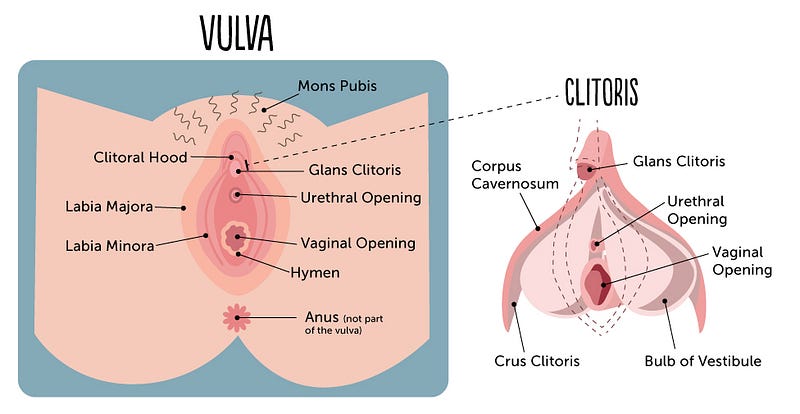
The glans clitoris gets all the attention because it swells when aroused. If you are observant, it also tells you when a woman is about to orgasm. Right before the crescendo, it retracts under the clitoral hood. (This causes many men to stop performing oral sex when she is about to orgasm. Please stop doing this.)
The clitoral network is so perplexing because 90% is hidden underneath. It also comes in many different shapes and sizes and changes shape throughout a woman’s life. The glans clitoris is 1.8 times larger by the time puberty ends and shrinks after menopause.
If you still can’t find it, try searching when your partner is ovulating. The glans clitoris gets 1/5 larger during ovulation to increase the odds of conception.
That’s right. The clitoris is not just for pleasure. It also plays a role in reproduction. Stimulating it during sex increases your odds of conception in several ways. An aroused clitoris increases vaginal blood flow, lubrication, oxygen, and temperature. Most importantly, it opens the cervix to receive sperm. The clitoris is like a door knocker. It’s rude to enter without knocking first.
The clitoris is like a door knocker. It’s rude to enter without knocking first.
Not every woman has a G-spot
Known as the Gräfenberg spot, the G-spot was named after German gynecologist Ernst Gräfenberg. Dr. G. believed the G-spot was a magical pleasure button that, when stroked, led to untold pleasures. The 1950s science community laughed their butts off. Poor Dr. G.
The G-spot is part of the clitoral network. It resides on the tip of the clitoris, about 2 -3 centimeters inside the vagina. In other words, when you stimulate the G-spot, you are stimulating part of the clitoris.
Many men do the old come hither motion with their index finger to find the G-spot, but not all women are sensitive in this area. And some women hate to be touched here. This has led many sex experts to claim the G-spot does not exist.
It does exist…just not in all women. Similar to how you are more or less sensitive on different areas of your penis, women also vary. But if you want to find the elusive G-spot, you don’t have to go all Shakleton on her lady bits. Try asking.
The labia is like a belly button
The inner labia (the folds inside the vulva) is like a belly button. Some women have innies, and some have outies. And although labioplasty — cosmetic enhancement of the labia — has increased by 500% in recent years, both shapes are entirely normal.
Ovulation changes the shape and color of our bodies
When a woman ovulates, her face reddens slightly and becomes more symmetrical. Her voice also takes on a higher pitch, and her body odor becomes more alluring.
As her body produces more estrogen, her cervical mucus becomes stretchy and clear, like egg whites. This mucus acts like a Slip n’ Slide to help your swimmers reach her egg.
The location of the urethra matters for pleasure
In the 1920s, Napoleon’s great-grandniece, Princess Marie Bonaparte, became frustrated with her lack of orgasms. So she did what any repressed scientist would do…she collected data. She found that women whose clitoris was less than the distance of the tip of her thumb away from the urethra were more likely to orgasm.
In 2011 (yes, it took that long), researchers began to explore why some women orgasm from penetration alone and some don’t. Only 18.4% of women report they can orgasm without direct clitoral stimulation.
Researchers found the Princess with the pea measurements was correct. Women are more likely to orgasm solely from penetration if the distance between their glans clitoris and the urethral opening is less than 2.5 cm (1 inch).
But instead of getting your ruler out, try asking her. Because the takeaway should be clear by now. Women’s bodies are exquisite snowflakes. No two are the same.
Before the turn of the 20th century, gynecologists practiced blindly. And I mean they literally….practiced medicine blindly. Victorian gynecologists were not allowed to see a woman’s genitalia, so they had to place an examining sheet between the physician and the patient’s genitalia and rely on touch alone. But are we more sophisticated now if 59% of men still can’t identify the vagina on a diagram?
If men (and women) want to better understand their anatomy, they need to look. And I mean really look. Get out a mirror, identify your parts, compare it to my fun diagram, and enjoy what the Renaissance artists would have cherished — knowledge.


