
Scrumban: The best of both frameworks
Combine the best of both worlds from Scrum and Kanban
If you are looking for a way to combine the best of both worlds from Scrum and Kanban, you might want to consider Scrumban.
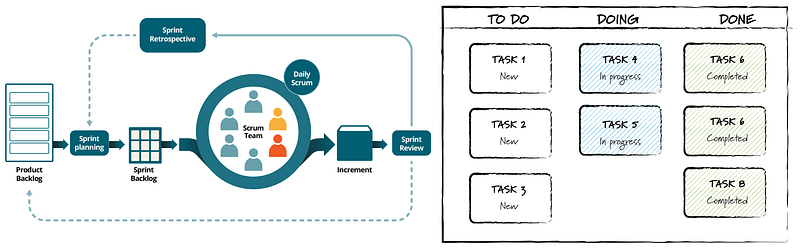
Scrumban is a hybrid agile framework that blends the structure and discipline of Scrum with the flexibility and flow of Kanban.
In this blog post, I will give you a quick overview of what Scrumban is, how it works, and what benefits it can bring to your team.
What is Scrumban?
Scrumban is a term coined by Corey Ladas in his book Scrumban: Essays on Kanban Systems for Lean Software Development.
He describes it as:
“a transition method for moving software development teams from Scrum to a more evolved software engineering state”.
In other words, Scrumban is a way to gradually introduce Kanban practices into a Scrum environment, without disrupting the existing process.
Scrumban is not a rigid framework with fixed rules and roles. Rather, it is a set of principles and practices that can be adapted to suit the needs and context of each team.
The main goal of Scrumban is to optimize the flow of work, minimize waste, and deliver value to customers faster and more frequently.
How does Scrumban work?
Scrumban borrows elements from both Scrum and Kanban, but also introduces some new ones.
Here are some of the key characteristics of Scrumban:
- Planning: Scrumban still uses regular planning sessions, such as sprint planning, backlog refinement, and release planning. However, the planning is based on demand rather than time. This means that the team only commits to work that they are confident they can deliver within a certain period, based on their current capacity and velocity. The team can also adjust their plan as new information or feedback emerges.
- Work items: Scrumban uses user stories as the main unit of work, similar to Scrum. However, the user stories are not estimated in terms of story points or hours. Instead, the team uses a definition of ready (DoR) to ensure that each user story has enough clarity and detail before it enters the workflow. The team can also use other types of work items, such as bugs, tasks, or experiments, depending on the nature of their project.
- Workflow: Scrumban uses a Kanban board to visualize the workflow and track the progress of work items. The board consists of columns that represent different stages of the process, such as backlog, ready, doing, testing, done, etc. The team can customize the board to reflect their own workflow and policies. The board also shows the work in progress (WIP) limits for each column, which indicate the maximum number of work items that can be in each stage at any given time. The WIP limits help the team to avoid multitasking and focus on finishing what they start.
- Roles: Scrumban does not prescribe any specific roles for the team members. However, it does recognize some common roles that are often found in agile teams, such as product owner, scrum master, developer, tester, etc. The team can decide how to distribute these roles among themselves, or even rotate them if they wish. The main responsibility of each team member is to collaborate with others and deliver value to customers.
- Events: Scrumban still uses some of the Scrum events, such as daily stand-up meetings, sprint reviews, and sprint retrospectives. However, these events are not tied to a fixed timebox or cadence. Instead, they are triggered by certain conditions or signals in the workflow. For example, the team can hold a sprint review when they have delivered a certain amount of value or reached a certain milestone. The team can also hold other events as needed, such as replenishment meetings (to replenish the backlog), kaizen meetings (to improve the process), or demos (to showcase their work).
- Metrics: Scrumban uses various metrics to measure and improve the performance of the team and the process. Some of these metrics include lead time (the time from when a work item is requested to when it is delivered), cycle time (the time from when a work item enters the workflow to when it exits), throughput (the number of work items delivered per unit of time), quality (the number of defects or errors), customer satisfaction (the feedback from customers). The team can use these metrics to identify bottlenecks, inefficiencies, or opportunities for improvement.
What are the benefits of Scrumban?
Scrumban offers several benefits for teams that want to adopt agile practices without compromising their existing workflow or culture.
Some of these benefits are:
- Improved flow: By limiting WIP and focusing on delivering value incrementally and continuously, Scrumban helps the team to improve their flow of work and reduce delays or interruptions.
- Reduced waste: By using demand-based planning and eliminating unnecessary activities or artifacts, Scrumban helps the team to reduce waste and optimize their resources.
- Increased flexibility: By allowing the team to adjust their plan and process as they learn and receive feedback, Scrumban helps the team to increase their flexibility and responsiveness to changing customer needs and market conditions.
- Enhanced quality: By using a DoR and implementing quality checks throughout the workflow, Scrumban helps the team to enhance the quality of their work and prevent defects or errors from reaching customers.
- Higher customer satisfaction: By delivering value to customers faster and more frequently, Scrumban helps the team to increase customer satisfaction and loyalty.
- Greater team empowerment: By empowering the team to self-organize and make decisions based on data and feedback, Scrumban helps the team to increase their autonomy and ownership of their work.
Scrumban is a powerful and versatile agile framework that can help you to achieve better results with less stress and more fun.
I hope you found this article useful and informative. If you have any questions or comments, please feel free to contact me.
If you are a Scrum master wanting more audio content, check out my special audio talks:
Interested in more of my content?
I have some new books out for you to read. Click below to find out more:
Or check out more of my blog articles here on Agile | Adapt.


