avatarWorld As One 4PEACE

Free AI web copilot to create summaries, insights and extended knowledge, download it at here

7276

Abstract

echanisms on the London Metals Exchange (LME) got out of control, causing <a href="https://readmedium.com/nickel-chinas-future-and-stability-1e40dae5991d"><b>China’s Tsingshan Holdings Group</b></a><b> </b>to hedge production against a surging nickel price that hit a whopping 100,000 a tonne.</p><figure id="3ac5"><img src="https://cdn-images-1.readmedium.com/v2/resize:fit:800/0*Tb9vL6m6WvI3jTDi"><figcaption>Argus Media provides data analytics and consulting services for a wide-range of global commodities. This graph was shared via presentation of Argus Metals on March 18, 2022</figcaption></figure><p id="cc9b">Due to the events on LME the company was expecting only a <a href="https://www.mining-technology.com/news/igo-takeover-western-areas/"><b>“relatively short delay”</b></a> for the takeover deal at first. It was then reported on <a href="https://www.reuters.com/business/energy/australian-miner-igo-says-western-areas-terminate-buyout-deal-2022-04-05/"><b>April 5, 2022</b></a>, that IGO would completely back out of the deal to acquire Western Areas — citing only an independent expert report as the rationale for foregoing the acquisition.</p><figure id="ee70"><img src="https://cdn-images-1.readmedium.com/v2/resize:fit:800/0*AroxGYakUHaTwZCl"><figcaption></figcaption></figure><p id="d07c">This story about China’s Tsingshan Holdings Group sheds light on how critical the metals markets are becoming for global finance and investment banks.</p><p id="e54d">With China’s capabilities to produce cheaply in Indonesia, and raise capital from the world’s largest international banks and financial institutions, I’d call this a recipe for stability and disaster offset by the production and supply of metals. This essential truth is even hidden within this story about the nickel industry: the whole point of the standstill agreement was to stabilize pricing and trading mechanisms to prevent a disaster in global markets.</p><h1 id="82ea">#2 Strategic Dilemma: Copper</h1><p id="bd08">The People’s Republic of China (PRC) has tremendous political, economic and strategic interests to maintain the strong momentum of the <a href="https://www.reuters.com/article/sponsored/copper-in-chinas-economy"><b>copper industry</b></a> both now and in the future. With copper prices hitting an all-time high in 2020<b> </b>the world’s largest consumer of copper raised the level of its production activity to its highest levels since 2011, while importing 656,483 tonnes in <a href="https://www.institutionalinvestor.com/article/b1n9p4h5ssr4h7/the-importance-of-copper-in-chinas-economy"><b>June 2020</b></a><b> </b>while continuing at record pace all the way through <a href="https://www.mining.com/web/chinas-copper-imports-continue-at-record-pace-on-lower-prices/"><b>2021–H12022</b></a>.</p><p id="c4db">In addition to the expansion of its domestic copper production, China’s international influence over metals can be seen from in Africa (cobalt and lithium), Southeast Asia (nickel) and South America (copper).</p><p id="c6d5">The Las Bambas mine in Peru is a case in point. Already <a href="https://asia.nikkei.com/Business/Materials/China-s-MMG-races-for-deal-to-protect-copper-flow-from-Peru-mine"><b>this year</b></a> China’s MMG is facing restraint from the local indigenous population in Las Bambas.</p><p id="c931">The history of this relationship between the People’s Republic of China (PRC) and <a href="https://www.reuters.com/world/americas/peru-community-wants-its-land-back-threatening-chinese-copper-mine-2022-05-12/"><b>Peru’s indigenous groups</b></a> is very relevant to the copper industry.</p><p id="2c88">Ever since China’s MMG bought the Las Bambas mine from Glencore for 5.85 billion in<a href="https://www.metalbulletin.com/Article/3330331/MMG-agrees-585bn-deal-to-buy-Las-Bambas-from-Glencore-Xstrata.html"><b> April 2014</b></a> the mining company has faced continuous opposition from Peruvian indigenous groups over the control status of the mine’s production — e.g. force majeure declared in <a href="https://www.spglobal.com/commodity-insights/en/market-insights/latest-news/metals/120321-mmg-to-halt-las-bambas-copper-mine-operations-mid-december-if-roadblocks-remain"><b>2019</b></a><b> </b>and roadblock obstruction in <a href="https://www.spglobal.com/commodity-insights/en/market-insights/latest-news/metals/120321-mmg-to-halt-las-bambas-copper-mine-operations-mid-december-if-roadblocks-remain"><b>2021</b></a><b> </b>— that has devestated output for a country who consumes over half of the world’s copper.</p><p id="7cb1">There have been many reasons <a href="https://www.latimes.com/world/mexico-americas/la-fg-peru-china-mining-20160224-story.html"><b>cited</b></a> for why Las Bambas’ indigenous groups have put up a struggle against China’s mining activities and businesses, such as labor and payment concerns; environmental issues and local grievances toward the destruction of the mine itself.</p><p id="6589">But China’s MMG has stated that it wants to take this opportunity to contribute to Peru’s economy. They have strived to give the indigenous groups ample reasons to cooperate. They were consequently invited to have talks with the company on <a href="https://www.reuters.com/world/americas/peruvian-protesters-agree-attend-talks-over-mmgs-shut-copper-mine-2022-05-07/"><b>May 6, 2022</b></a>.</p><p id="a717">Domestically, most of the copper is being dug out of extremely politically sensitive areas on the Chinese Mainland — Tibet, Xinjiang, Inner Mongolia — so the political costs to the Chinese Communist Party (CCP) are tremendous. Not to mention the cobalt and lithium being extracted out of risky countries in the Democractic Republic of Congo (DRC).</p><p id="9e21">Deep pockets come with high political costs. The PRC also doesn’t want to give this advantage up to the USA or any other country. But the backlash we’ve seen from the oil and gas industry against Russia’s actions in Ukraine, prompts a new discussion about global metal miners and producers — and to what extent the PRC has influence over the geopolitical trends that are significant to the China’s industrial policies.</p><p id="29ee">Valuable production assets of copper can be found in <a href="https://www.mining.com/web/bhp-eyes-10-billion-chilean-investments-but-only-with-legal-certainty/"><b>Chile </b></a>and <a href="https://miningdigital.com/automation-and-ai/bhp-expands-interest-stake-ecuador-cascanbel-copper-gold-project"><b>Ecuador</b></a><b> </b>but<b> </b>the Democratic Republic of Congo (DRC) are where some of the world’s largest copper mines are being planned for future facing commodities. To this point, geopolitical trends are likely to have an impact on companies such as BHP and <a href="https://www.mining.com/teslas-battery-metals-bill-balloons-to-100-billion/"><b>Tesla</b></a> that are both key players in the developments of future facing commodities.</p><p id="4d92">Anyone following metals mining and political transitions would know that metals such as copper and nickel are correlated with Chile’s and Indonesia’s politics. Click on this link to learn why the <a href="https://edition.cnn.com/2022/08/09/americas/chile-sanction-sinkhole-intl-scli/index.html"><b>new administation in Chile is getting tougher

Options

on copper mines</b></a><b>.</b></p><p id="80e8">It was reported that a <a href="https://edition.cnn.com/videos/us/2022/07/19/van-sinkhole-the-bronx-orig-mss.cnn"><b>huge sinkhole</b></a> appeared in a field around a Canadian company Lundin Mining’s operation in Indonesia. For this reason the Chilean mining regulators forced the company to halt all mining activities in the area. An investigation is still being carried out as to what happened but it is being speculated that it is possible the area was over exploited by copper mining.</p><p id="c04f">This is a classic story about how governments and companies are coming under more pressure as a result of Environment, Social, Governance (ESG)<b> </b>frameworks and the impacts on local communities from mining operations. Chile’s new administration under <a href="https://www.aljazeera.com/news/2022/7/3/chiles-new-constitution-finalised-after-turbulent-process"><b>President Gariel Boric</b></a> already finalized a new constitution after calls from the public to address social inequality.</p><p id="a9e3">It was announced by Indonesia’s investment minister that <a href="https://www.mining.com/web/indonesia-revokes-thousands-of-mining-permits-covering-over-3m-hectares/"><b>Indonesia President Joko Widodo revokes mining licenses</b></a><b>. </b>There were reportedly<b> </b>more than 2,000 mining permits were revoked due to the government’s land redistribution plan. Citing non-compliance from coal mining companies such as PT Bayan Resources, the government claims that the land redistributon plan will help level the playing field for newer enterprises in the mining sector.</p><p id="5da7">Indonesian politics and economy are synonomous with mining operations, foreign investment, and a wide range of ethnic disputes over territories with natural resources. Battery metals have become quite an important part of Indonesia’s future economic development. It is also making them more vulnerable to sanctions on China and Russia.</p><p id="2424">The Widodo government is under pressure both domestically and internationally for how it is handling political opposition. It is being debated on whether Widodo would be willing to step down per the results of an upcoming democratic election in Indonesia. How and if there is a political transition in Indonesia would be a major sign for how some of the world’s most critical metals are supplied in the near-future.</p><figure id="ec06"><img src="https://cdn-images-1.readmedium.com/v2/resize:fit:800/0*bSqkSI-xJDdtGa1Q"><figcaption>Photo by <a href="https://unsplash.com/@hghfve?utm_source=medium&amp;utm_medium=referral">Pascal Scholl</a> on <a href="https://unsplash.com?utm_source=medium&amp;utm_medium=referral">Unsplash</a></figcaption></figure><h1 id="358d">Final Thoughts</h1><p id="8be1">Here I have compiled some of the most significant analyses about the results of the Shanghai Cooperation Organization (SCO) Summit in 2022:</p><ol><li><a href="https://www.china-briefing.com/news/chinas-relations-with-russia-in-a-new-age/"><b>The growing mutual interests in trade between China and Russia’s Far Eastern region</b></a></li><li><a href="https://oilprice.com/Energy/Energy-General/China-And-Russia-Move-To-Disrupt-The-Dollars-Dominance-In-Oil-Markets.html"><b>China and Russia want to disrupt oil markets by axing the US Dollar</b></a></li><li><a href="https://edition.cnn.com/2022/09/16/china/china-russia-united-front-sco-intl-hnk/index.html"><b>Russia’s invasion of Ukraine reveals divergences within Central Asia</b></a></li><li><a href="https://thehill.com/opinion/national-security/3644072-xi-would-be-wise-to-ignore-putins-pleas-for-more-assistance/"><b>President Xi’s decision to not assist Russia’s war effort</b></a></li><li><a href="https://www.reuters.com/business/energy/does-china-need-more-russian-gas-via-power-of-siberia-2-pipeline-2022-09-15/#:~:text=Russia%20proposed%20the%20route%20years,after%202030%2C%20industry%20experts%20said."><b>The dilemma or China’s gas supplies via Power of Sibera 2 pipeline</b></a></li></ol><p id="2e81">The Shanghai Cooperation Organization (SCO) is a regional initiative that promotes military and security cooperation as well as economic development, among other things of a multilateral nature.</p><p id="e649">It is a classic example of economic regionalism.</p><p id="62cd">To illustrate further, all of the talk about economic regionalism, and the subsequent focus on regional development is over-sold by political analysts and economists alike.</p><p id="ae3f">Commodities are global in nature. The only attention being truly paid to regional development is about large investments in infrastructure — these investments do not seek to enhance regional connectivity, but give an advantage to a producing country so that it can more efficiently transport raw materials to markets far away from the original source.</p><p id="ea16">This is the essence of the Arctic Strategy, Belt and Road Initiative (BRI) and Indo-Pacific Strategy: all of them revolve around the maritime domain while also seeking defense mechanisms through military cooperation.</p><p id="ce86">In my view, this is the future trends for which the world is headed. Whereas countries are rethinking industrial policies, while also emphasizing the need for new security measures to industrial assets as a result of nascent, unpredictable cyber threats from adversaries. An adversary, or group of adversaries, can target an industrial asset because it has immediate results, and which the perpetrator can determine the trajectory of action on the cyberattack. Governments, corporations or even individuals could be consumed in a cyberattack that effectively shuts down an industrial asset or network which it is operating on.</p><p id="995c">It’s very important to undertand this phenomenon in the context of sanctions on Russia and China. Under the backdrop of a resurgence in global commodities, the legal aspects of Russia’s sanctions include industrial asset seizures and targeted oil and gas mergers with Russia’s national companies. Both of these aspects have a cybersecurity dimension</p><p id="700e">What this means at a political level is that Russia intends to transform its industrial policies in a way that favors the “anti-West” rhetoric; from a geographical point of view, raw materials are located in vulnerable areas where supply chains are being disrupted by sanctions. This is why Russia must expand its “sovereignty” over global commodities.</p><p id="518e">Simply put, this is Russia’s geopolitical objective within the context of global commodities, hence the critical nature of the China-Russia relationship. China basically has the same geopolitical objective within the context of global commodities, which is why the two countries could seek to dominate raw materials in some of the world’s most vulnerable areas.</p><p id="6abe">The question of whether China and Russia will align industrial policies shall be determined by the outcomes of the Arctic Strategy and BRI — not the Shanghai Cooperation Organization (SCO) — and how the defense and security interests of the United States converge with other actors in the Indo-Pacific. This is the long game of geopolitics for decades to come.</p></article></body>

SCO Summit of 2022: Will China and Russia Align Industrial Policies For Metals?

This story about China’s and Russia’s industrial policies is an extension of another story I published in Areas & Producers called “The Interconnection Between Russia’s Arctic Strategy and EU’s Industrial Policies.”

See the link below:

Will China and Russia Align Industrial Policies For Metals?
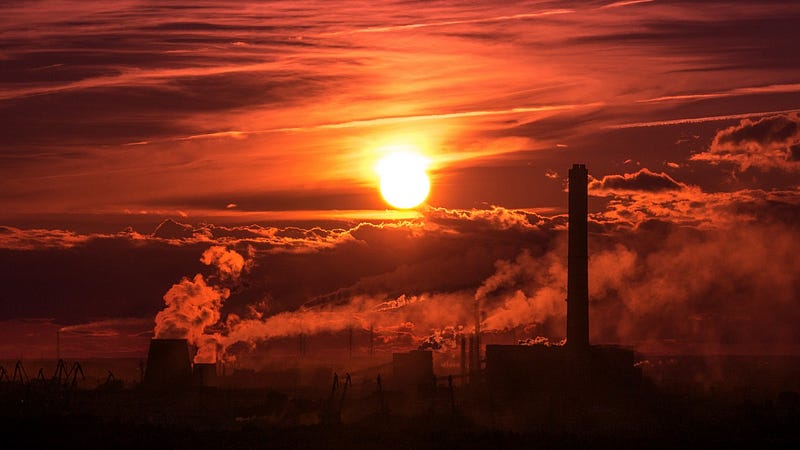
A new dawn is approaching for China and Russia.

Metals are becoming so valuable to the global economy that Russia (plus others) must carefully consider how its industries will avoid sanctions from the United States and European Union. Avoiding the massive blow from sanctions due to its invasion of Ukraine would be a high achievement in their overall strategy to defend Russia’s nationalist policies.

Whatever happens with Russia’s commodities and the impact brought on by related industries from sanctions, will have an effect on the relationship between Russia and China, which will also cause great concern to the USA and European Union.

The fact is that the Russia-China strategy is still very uncertain to how far it will go, though China’s Chairman and President Xi Jin Ping did stand by Vladimir Putin’s side irrespective of the war in Ukraine, which in my view shows a lot about the direction of the two countries common interests in world politics.

The Olympics is certainly one of the largest stages to make such a statement.

To understand what is happening more broadly in the metals industries, I suggest reading more about on the unprecendented crisis on London Metals Exchange (LME) in March 2022, which I have provided below

My overall opinion in this writing is that the metals industries will become a bigger factor in a country’s strategy in the future, while companies such as Tesla and BHP are bearing the burden of the geopolitical crosshairs, especially in the aftermath of Russia’s invasion of Ukraine.

#1 Strategic Dilemma: Nickel

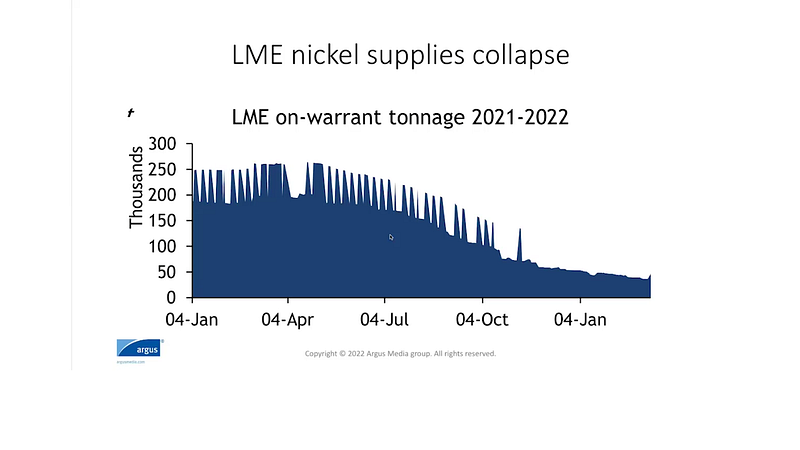
In March 2022, there was a substantial crisis for China’s nickel trading giant — Tsingshan Holding Group — led by Chinese Wenzhounese billonaire Xiang Guangda who bet zealously on the growth of nickel production and supply this year at the London Metals Exchange (LME). When the price of nickel surpassed $100,000 per tonne the LME had to stop nickel trading at an instant.

In response to the EV battery production shortages, Tsingshan Holding Group devised a strategy that would keep prices lower, and thus allow for cheaper production of battery ingredients, especially from areas of Southeast Asia like Indonesia. But unfortuantely the events in Ukraine have caused the markets to act in an extraordinary way — a way that was adverse to Tsingshan’s nickel production investment strategy.

Since March 8, 2022, international investors and bankers have been awaiting Tsingshan’s response. It wasn’t until March 15, 2022, that they finally announced an agreement with bank creditors, such as JP Morgan and CCBI Global Markets, to discuss a “standby secured liquidity facility” arrangement to solve the company’s problems. This agreement is being referred to by most sources as a standstill agreement for which it is expected that the haphazard nickel trading will once again stabilize.

The company released a statement, saying:

“As an integral feature of the agreement, there is provision for the existing hedge positions to be reduced by the Tsingshan group in a fair and orderly manner as abnormal market conditions subside.”

Any new rules will be applied by regulatory authorties in Great Britain: the Financial Conduct Authority (FCA) and the Bank of England.

Next, this story continues with a scheme implementation deed (SID) agreed to in December 2021 when Australia’s IGO Ltd sought to acquire another Australian metals miner outfit, Western Areas Ltd, to boost its nickel and lithium portfolio. By adding some of the highest-grade nickel and lithium mines that Western Australia has to offer, IGO would be able to significantly take on the metal production base that is crucial to Electric Vehicles (EV) and Clean Energy Technologies.
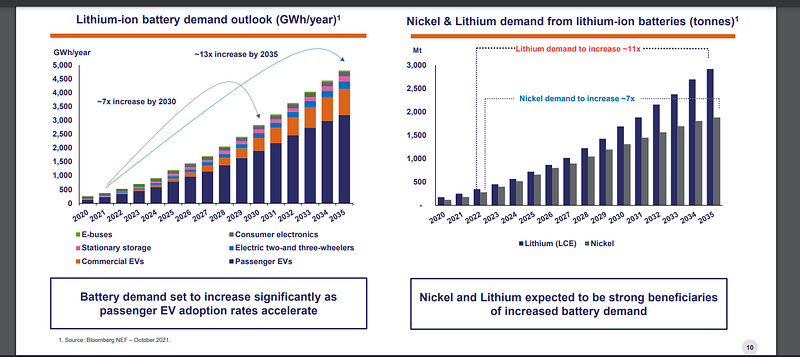
This data was inserted into a PPT presentation from IGO Ltd. about the acquisition of Western Areas Ltd. on December 16, 2021. Find the entire PPT here: https://www.igo.com.au/site/PDF/a7963a4b-46d2-4504-bcd3-00924ef1f75c/WesternAreasAcquisitionPresentation

Originally valued at A$1.096 billion, IGO would takeover Western Areas Ltd assets with a 100% interest in the mines in Western Australia. IGO appeared to be on its way to a massive acquisition that would put it at the top of Western Australia’s nickel production capacity. Until recently when the nickel trading mechanisms on the London Metals Exchange (LME) got out of control, causing China’s Tsingshan Holdings Group to hedge production against a surging nickel price that hit a whopping $100,000 a tonne.
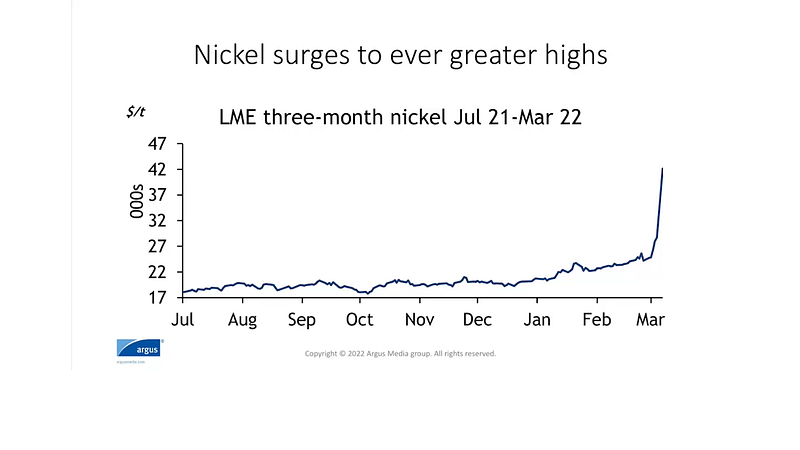
Argus Media provides data analytics and consulting services for a wide-range of global commodities. This graph was shared via presentation of Argus Metals on March 18, 2022

Due to the events on LME the company was expecting only a “relatively short delay” for the takeover deal at first. It was then reported on April 5, 2022, that IGO would completely back out of the deal to acquire Western Areas — citing only an independent expert report as the rationale for foregoing the acquisition.
This story about China’s Tsingshan Holdings Group sheds light on how critical the metals markets are becoming for global finance and investment banks.

With China’s capabilities to produce cheaply in Indonesia, and raise capital from the world’s largest international banks and financial institutions, I’d call this a recipe for stability and disaster offset by the production and supply of metals. This essential truth is even hidden within this story about the nickel industry: the whole point of the standstill agreement was to stabilize pricing and trading mechanisms to prevent a disaster in global markets.

#2 Strategic Dilemma: Copper

The People’s Republic of China (PRC) has tremendous political, economic and strategic interests to maintain the strong momentum of the copper industry both now and in the future. With copper prices hitting an all-time high in 2020 the world’s largest consumer of copper raised the level of its production activity to its highest levels since 2011, while importing 656,483 tonnes in June 2020 while continuing at record pace all the way through 2021–H12022.

In addition to the expansion of its domestic copper production, China’s international influence over metals can be seen from in Africa (cobalt and lithium), Southeast Asia (nickel) and South America (copper).

The Las Bambas mine in Peru is a case in point. Already this year China’s MMG is facing restraint from the local indigenous population in Las Bambas.

The history of this relationship between the People’s Republic of China (PRC) and Peru’s indigenous groups is very relevant to the copper industry.

Ever since China’s MMG bought the Las Bambas mine from Glencore for $5.85 billion in April 2014 the mining company has faced continuous opposition from Peruvian indigenous groups over the control status of the mine’s production — e.g. force majeure declared in 2019 and roadblock obstruction in 2021 — that has devestated output for a country who consumes over half of the world’s copper.

There have been many reasons cited for why Las Bambas’ indigenous groups have put up a struggle against China’s mining activities and businesses, such as labor and payment concerns; environmental issues and local grievances toward the destruction of the mine itself.

But China’s MMG has stated that it wants to take this opportunity to contribute to Peru’s economy. They have strived to give the indigenous groups ample reasons to cooperate. They were consequently invited to have talks with the company on May 6, 2022.

Domestically, most of the copper is being dug out of extremely politically sensitive areas on the Chinese Mainland — Tibet, Xinjiang, Inner Mongolia — so the political costs to the Chinese Communist Party (CCP) are tremendous. Not to mention the cobalt and lithium being extracted out of risky countries in the Democractic Republic of Congo (DRC).

Deep pockets come with high political costs. The PRC also doesn’t want to give this advantage up to the USA or any other country. But the backlash we’ve seen from the oil and gas industry against Russia’s actions in Ukraine, prompts a new discussion about global metal miners and producers — and to what extent the PRC has influence over the geopolitical trends that are significant to the China’s industrial policies.

Valuable production assets of copper can be found in Chile and Ecuador but the Democratic Republic of Congo (DRC) are where some of the world’s largest copper mines are being planned for future facing commodities. To this point, geopolitical trends are likely to have an impact on companies such as BHP and Tesla that are both key players in the developments of future facing commodities.

Anyone following metals mining and political transitions would know that metals such as copper and nickel are correlated with Chile’s and Indonesia’s politics. Click on this link to learn why the new administation in Chile is getting tougher on copper mines.

It was reported that a huge sinkhole appeared in a field around a Canadian company Lundin Mining’s operation in Indonesia. For this reason the Chilean mining regulators forced the company to halt all mining activities in the area. An investigation is still being carried out as to what happened but it is being speculated that it is possible the area was over exploited by copper mining.

This is a classic story about how governments and companies are coming under more pressure as a result of Environment, Social, Governance (ESG) frameworks and the impacts on local communities from mining operations. Chile’s new administration under President Gariel Boric already finalized a new constitution after calls from the public to address social inequality.

It was announced by Indonesia’s investment minister that Indonesia President Joko Widodo revokes mining licenses. There were reportedly more than 2,000 mining permits were revoked due to the government’s land redistribution plan. Citing non-compliance from coal mining companies such as PT Bayan Resources, the government claims that the land redistributon plan will help level the playing field for newer enterprises in the mining sector.

Indonesian politics and economy are synonomous with mining operations, foreign investment, and a wide range of ethnic disputes over territories with natural resources. Battery metals have become quite an important part of Indonesia’s future economic development. It is also making them more vulnerable to sanctions on China and Russia.

The Widodo government is under pressure both domestically and internationally for how it is handling political opposition. It is being debated on whether Widodo would be willing to step down per the results of an upcoming democratic election in Indonesia. How and if there is a political transition in Indonesia would be a major sign for how some of the world’s most critical metals are supplied in the near-future.

Photo by Pascal Scholl on Unsplash

Final Thoughts

Here I have compiled some of the most significant analyses about the results of the Shanghai Cooperation Organization (SCO) Summit in 2022:

  1. The growing mutual interests in trade between China and Russia’s Far Eastern region
  2. China and Russia want to disrupt oil markets by axing the US Dollar
  3. Russia’s invasion of Ukraine reveals divergences within Central Asia
  4. President Xi’s decision to not assist Russia’s war effort
  5. The dilemma or China’s gas supplies via Power of Sibera 2 pipeline

The Shanghai Cooperation Organization (SCO) is a regional initiative that promotes military and security cooperation as well as economic development, among other things of a multilateral nature.

It is a classic example of economic regionalism.

To illustrate further, all of the talk about economic regionalism, and the subsequent focus on regional development is over-sold by political analysts and economists alike.

Commodities are global in nature. The only attention being truly paid to regional development is about large investments in infrastructure — these investments do not seek to enhance regional connectivity, but give an advantage to a producing country so that it can more efficiently transport raw materials to markets far away from the original source.

This is the essence of the Arctic Strategy, Belt and Road Initiative (BRI) and Indo-Pacific Strategy: all of them revolve around the maritime domain while also seeking defense mechanisms through military cooperation.

In my view, this is the future trends for which the world is headed. Whereas countries are rethinking industrial policies, while also emphasizing the need for new security measures to industrial assets as a result of nascent, unpredictable cyber threats from adversaries. An adversary, or group of adversaries, can target an industrial asset because it has immediate results, and which the perpetrator can determine the trajectory of action on the cyberattack. Governments, corporations or even individuals could be consumed in a cyberattack that effectively shuts down an industrial asset or network which it is operating on.

It’s very important to undertand this phenomenon in the context of sanctions on Russia and China. Under the backdrop of a resurgence in global commodities, the legal aspects of Russia’s sanctions include industrial asset seizures and targeted oil and gas mergers with Russia’s national companies. Both of these aspects have a cybersecurity dimension

What this means at a political level is that Russia intends to transform its industrial policies in a way that favors the “anti-West” rhetoric; from a geographical point of view, raw materials are located in vulnerable areas where supply chains are being disrupted by sanctions. This is why Russia must expand its “sovereignty” over global commodities.

Simply put, this is Russia’s geopolitical objective within the context of global commodities, hence the critical nature of the China-Russia relationship. China basically has the same geopolitical objective within the context of global commodities, which is why the two countries could seek to dominate raw materials in some of the world’s most vulnerable areas.

The question of whether China and Russia will align industrial policies shall be determined by the outcomes of the Arctic Strategy and BRI — not the Shanghai Cooperation Organization (SCO) — and how the defense and security interests of the United States converge with other actors in the Indo-Pacific. This is the long game of geopolitics for decades to come.

Geopolitics
Russia
China
Industrial
Sanctions
Recommended from ReadMedium