
Scientists Developed a Questionnaire To Determine If Your Cat Is a Psychopath
In case you didn't already know
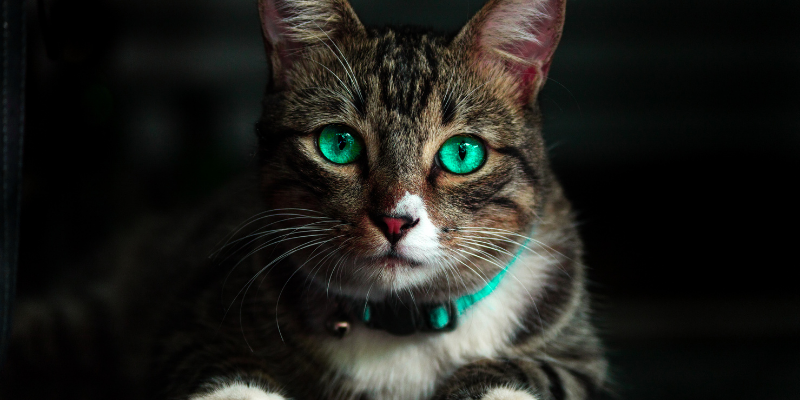
The results are in, and it turns out that your cat may be a psychopath.
A team of scientists developed a questionnaire to determine if your cat exhibits signs of psychopathy. This article will detail how they came up with this groundbreaking research, how to take the test for your cat, and what it all might mean.
Why Are Scientists Studying Psycho Cats?
It’s time to get serious about your cat.
Scientists at the University of California, Berkeley have developed a questionnaire that can help determine if your cat is, in fact, a psychopath (as you always guessed they were).
The questionnaire is based on the triarchic model of psychopathy.
According to PubMed:
The essence of the triarchic model is that psychopathy encompasses three distinct phenotypic constructs: disinhibition, which reflects a general propensity toward problems of impulse control; boldness, which is defined as the nexus of social dominance, emotional resiliency, and venturesomeness; and meanness, which is defined as aggressive resource seeking without regard for others (“dysaffliated agency”).
As you might have guessed, this is a test for humans applied to your feline friend.
Why you might ask?
According to the researchers, they want to improve the relationships between people and cats. They hope that knowing your cat’s tendency toward psychopathy helps you better relate to them.
As UK psychologist Rebbeca Evans says:
Personally, I am also interested in how owner perceptions of psychopathy in their cat can affect the cat-owner relationship. My cat Gumball scores relatively highly on the disinhibition scale — which means he can be quite vocal, proximity-seeking and excitable.
The researchers also hope that the results will reduce the number of cats dropped off at shelters.
This Is How The Test Actually Works
First of all, you can take the test for free online.
To complete the test, you (not your cat) answer 46-questions about your cat using a 5-point Likert scale. Responses range from “Does not describe my cat” to “Describes my cat extremely well.”
Here is a screenshot of the test:
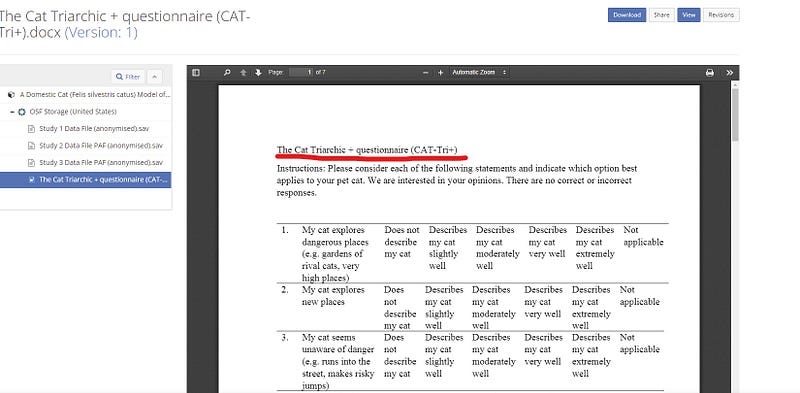
The questions ask about boldness, meanness, disinhibition, pet unfriendliness, and human unfriendliness.
For example, you’ll answer questions like, “My cat chases other cats out of the residency/garden” and “My cat runs around the house for no apparent reason.”
Sidenote: I like the assumption that we all have gardens.
Once you complete all of the questions, you tally up the results to get your CAT-Tri+ score. This involves some math that the bottom of the test will explain.
The CAT-Tri+ score reveals your cat’s level of psychopathy.
Surprising Conclusions From the Cat Study
2,042 cat owners and their pets were examined during the development of the final questionnaire. From this large sample size, several surprising patterns surfaced in the research (Published in the Journal of Research in Personality).
The gist of the findings:
Disinhibition and pet-unfriendliness predicted a higher quality cat-owner relationship; meanness and boldness predicted a lower quality relationship.
In other words, the study may say just as much (or more) about the cat-owners as it does the cats.
If your cat shows signs of being a psychopath, does that mean you are a terrible pet owner?
Not at all.
In fact, Rebecca Evans points out:
It is likely that all cats have an element of psychopathy as it would have once been helpful for their ancestors in terms of acquiring resources: for example food, territory and mating opportunities.
For example, if your cat scores low on “not feeling guilty after misbehaving” that doesn’t mean you (the cat owner) should start studying the new season of Dexter for tips on how to be a serial killer.
How Did My Cat Score?
I grew up with a grey cat named Calvie. Raised as a German barn cat, she traveled back to the United States with us after my dad’s military tour ended.
Although it’s been 20 years since I’ve seen Calvie (rest in peace), I decided to take this test for her anyway. It seemed a nice way to keep her memory alive.
I may or may not have shed a tear during this test.
As it turns out, Calvie scored a 1.69 on the CAT-Tri+ scale. This means she has a very low level of psychopathy.
I honestly thought she would rate around average, maybe even slightly above average. Maybe that’s because I took the test for her using her behaviors as a mature cat.
I think she would have scored differently as a younger cat.
What does this mean for me?
Honestly, not much. I’m unlikely to drastically change my ways based on a below-average score from an online test that was taken by proxy.
But it’s interesting to think about my cat in these terms. It’s emotionally moving to think about her at all.
Final Thoughts
This is a great reminder that we can’t always take ourselves too seriously, especially when it comes to our furry friends.
Cats are notorious for their independence and standoffishness — they’re not going to let us know what they want or how they feel every time.
If you’re looking for an interesting thought experiment that might help you connect with your cat, take the free test.
You might be pleasantly surprised at the results.
If you’re into cat-related content, you might also like:
- The Kidnapped 12-Year-Old Girl Rescued by Lions
- Your Cat Is Your Best Life Coach
- The Brilliant “Cat Marketing” That Saved a Japanese Railway
If you want to support my writing, become a Medium member. If you do, I will get a small commission. Thanks!
References: