
School Reopening and the Allure of Surveillance
What is your privacy worth? That’s a broad, general question that underpins the heartbeat of this newsletter. Worth, in that sense can be answered through the traditional capitalist lens (how much are you willing to spend on “privacy’), and it can also be answered on moral grounds, of how much should you care when the concept of privacy comes under attack.Then again, if you’re to believe the Mark Zuckerbergs of the world, the questions isn’t a question at all. Privacy, after all, according to them, is dead.
But there’s another way the “worth” of privacy is measured; not as a single value of itself, but rather of its value in relationship to something else. If you’ve read this newsletter before, this type of of value will sound familiar. Time and time again, governments around the world have sold the idea of privacy as sitting on one end of a weighted scale with “national security” staring it down across the seesaw.
More recently though, there’s another figure seemingly sitting across from, and at odds with privacy, and that’s public health. In the age of the coronavirus, which has left over 200,000 Americans dead and many millions worldwide infected, the emphasis on public health, from all corners of the world, has been injected with a full dose of urgency. As it related to privacy and surveillance, local and state governments —working hand in hand with major technology companies — told us in varying forms, that personal privacy might have to take a brief backseat for personal health. We were told that coronavirus contact tracing. apps, which would work through Bluetooth or Wifi location data or some other aggregate data. would find clusters of the disease before they became outbreak, alert people, and save lives.
As I’ve discussed previously on this newsletter, the choice was never that simple. The technological solutions promised to save us often fell flat and privacy advocates, worrying of a repeat of 911 where civil liberties were quickly eroded on mass out of immediate fear, spoke out. In the US at least, people largely made a choice against relying on these tracking technologies and instead relied on traditional over the phone, human centered tracing. Could the harrowing 200,000 number have been avoid if the choice had been made in the reverse?
It’s with that rather morbid though in mind that I come to today’s most pressing coronavirus debate: school reopenings.
So far, over 150 colleges across the country have reported at least 100 cases. The mix of large scale sporting gatherings, close living situations, and a natural carefree partying culture have made college and universities the undisputed leader in new coronavirus case so far. As I typed out these words last week, Merrick College in Massachusetts found itself quarantining nearly three hundred students after 11 residents tested positive for the virus.
This US map below from The New York Times documents the reported outbreaks so far.
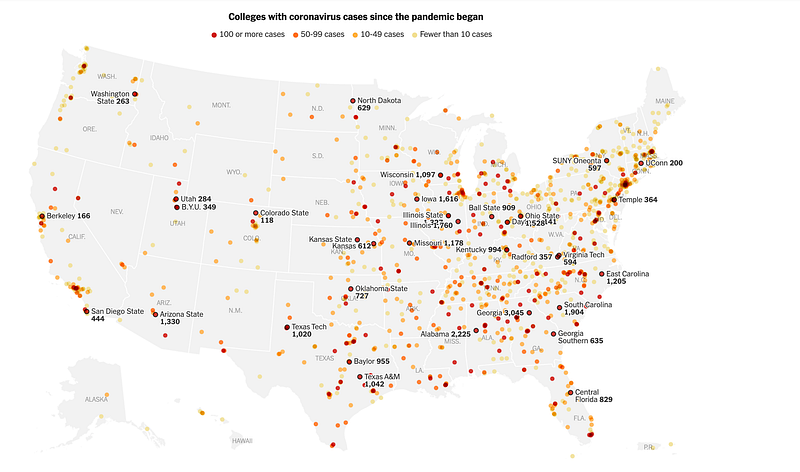
The image is shocking, especially when one considers that this only considers universities. Though some of the country’s largest school systems, like New York City, have begrudgingly pushed back their reopening, some Primary and high schools have started to open around the country only to face similar results.
The question of when and how schools will reopen remains mired in dispute and any solutions may well differ from state to state. There are an untold number of elements up for consideration when deciding when or how to reopen, but one element that is becoming increasingly assumed is that any reopening will come with a hefty helping of digital contact tracing technology. The only alternative, we’re told, is a remote learning environment that would allegedly leave kids lagging behind. While some advocates have welcomed in coronavirus contact tracers or pivoted to remote learning under the mantle of public health, the decision has consequences. Consequences for quality of education, consequences for equal access amongst poor communities, and consequences for the privacy and freedom of students.
That last point, adjoined at the hip with surveillance, is the topic a recent report released by the Surveillance Technology Oversight Project titled, “Schoolyard Surveillance the Rise of K-12 Contact Tracing Technologies.” I’ve decided to take a slight detour from the typical approach on this newsletter to instead focus primarily on the main takeaways gleaned from this research. STOP, as the group is known, draws no line in the sand on whether or not schools should open. Neither am I. Like many of the decisions debated over the past six hellish months, the question of whether or not to open schools amid a pandemic has myriad pros and cons in either direction. To personally engage in all of them here would be an act of self induced madness.
Despite it’s mammoth consequences (The World Bank estimates continued school closures could cost upwards of $10 trillion) the criticism and praise of remote learning have largely fallen under two, sometimes competing faultlines: public health and the economy. But there’s a third element that’s often overlooked, and that’s surveillance.
The Many Faces of School Trackers
For many students physically walking into classrooms this fall, their mere presence will come with a tradeoff. Many universities, as well as high schools and primary schools, have opted to use a plethora of varying coronavirus contact tracers to alert students of whether or not someone they may have come in contact with has tested positive for COVID-19. The particularities of these pocket held surveillance devices differ. Some use GPS location while others opt to track students whereabouts through Bluetooth signals. Others still require students to manually scan QR codes every time they enter a new location. Regardless of the particularities these methods share the same stated goal of tracking groups, detecting who’s sick and alerting those potentially in contact with that person to self quarantine.
The report goes on top poke holes in the each of these tracking forms from. Wifi (too many false positives and potential “alarm fatigue”) Cellular towers, (not accurate enough) QR codes, (too impractical to be effective and wide scale biometrics, (just plain fucking scary) all of which have been considered as potential avenues for tracking the virus’ spread both within the confines of the academic square and elsewhere.
In some places, the fervent desire for parents and administration to shove students back in schools at all costs has led to the panic adoption of unproven phone monitoring apps and. wearable trackers.
The report points to two school districts in Ohio and New Jersey who are reportedly in talks with the firm Volan, which claims its Bluetooth tracker can provide “precise position” of thousands of people. Other companies like CENTEGIX whose CrisisAlert system has been used by schools around the country to surveil students in the name of public safety, are rebranding their technologies as potential COVID trackers.
Then there’s companies like RightCrowd, who are creating Fitbit like wearable trackers to keep tabs on students. In effect, these wearable devices would resemble a lanyard hanging around a student’s neck. While that seemingly ubiquitous freshman accessory appears harmless enough, embedded into that lanyard is a tracker constantly monitoring each student’s movements and periodically spurting out loud warnings if social distancing rules are broken.
While some of these particularities may differ from school to school, some governments, like that of Washington state, are considering statewide mandated contact tracing apps for school reopening.
These decisions all come with pluses and minuses, of course. However even if you decide the. potential privacy implications stated seem worth it if the end result means getting more kids back in school, there are still serious doubts over just how effective even the most invasive technologies would actually be. As has been discussed in this newsletter before, mobile contact tracing apps and their ilk rely on high adoption rates (a large portion of people actually downloading the apps) for them to be effective. While exact figures vary, most research I’ve read puts the point at somewhere around 60%. While we haven’t seen what adoption rates of these tracking apps look like in schools, we have seen what they look like in the general public when countries and states experimented with this solution over the summer. The result was abysmally low adoption across the board.
Here are some of the adoption rates of contact racing apps by major countries around the world, according to a chart produced by Quartz.
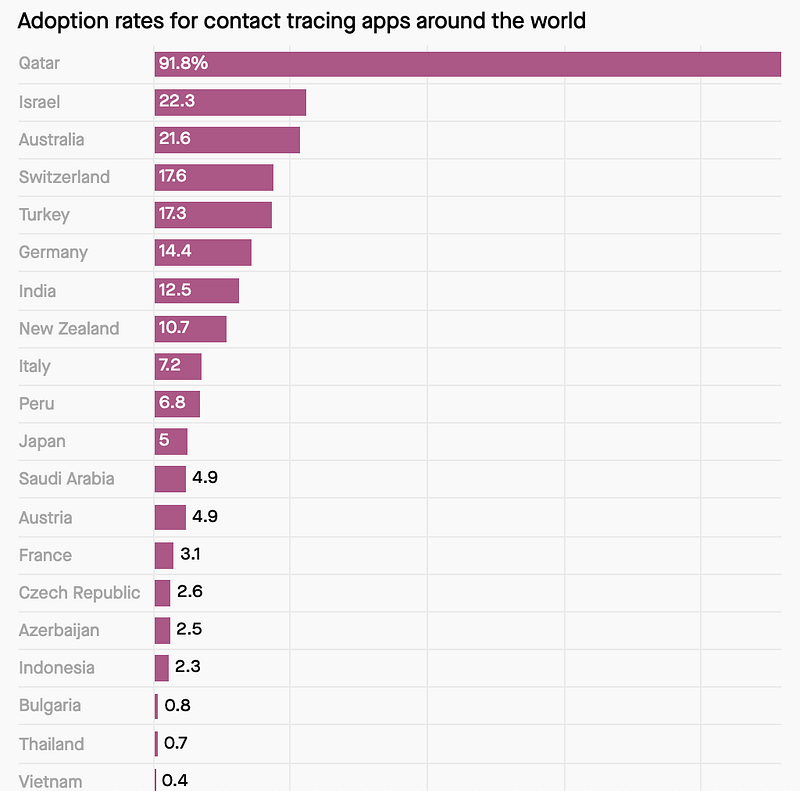
In the US, North Dakota saw less than 5% of its citizens sign up for its app. That lousy figure, pitiful as it might be, looks like a miracle though when compared to Utah, where just over 200 people in the entire state downloaded its tracing app, according to the STOP report.
And as the STOP report points out, there’s strong reason to believe any such adoption would be even lower in schools, particularly primarily schools. While a majority of children receive their first smart device by 11 years old (which definitely presents a problem in it’s own right) that still leaves out most elementary school children.
Access to smartphones amongst children mirrors inequality generally. Just 51% of teens from families earning less than $35,000 per year reportedly own a smartphone. White students are also slightly more likely to own a phone than minority students. It also potentially leaves out a large chunk of teachers who disproportionately tend to come from older populations. According to the report, around 79% of people between the ages of 50 and 64 own smartphones. That dips down to 53% for people over the age of 65.
There’s also the cost to consider. No matter what path schools decide to carve, whether it’s daily cleaning of classrooms and in the installations of blast shields or the purchasing of contact tracing technologies, schools around the country are looking at a steep price tag. Many of these potential tracking solutions, however, are unproven but prohibitively expensive nonetheless. In Hillsborough County Florida, the school district partnered with. CENTEGIX, the company mentioned above. The total cost for its schools? $7.6 million.
Ode to Old School Contact Tracing
One is then left with a similar question asked by the general population several moths ago: If not for contact tracing apps, then what? Again, the answer is simply if admittedly unsexy.
Here’s a direct quote from the report breaking down the substantial differences between the new tracking technologies being proposed and old school person to person contact tracing.
“The privacy impact of these “analysis systems” is different in kind, not degree, from the privacy threat of ‘tracking systems”’(GPS, Bluetooth, Wi-Fi, etc.).
Analysis systems rely on technology to compile and analyze information provided exclusively through consensual interviews with manual contact tracers. In contrast, tracking systems do just what their name implies: invasively track users’ movements. As a result, tracking systems obtain farmore information, potentially compiling a user’s location history over the course of years.”
The reality of the coronavirus disaster in the US and other countries might lead some to question the previous opposition to contact tracing apps. That’s a fair point, but I’d just pose that part of the problem, in regards to contact tracing at least, was was there was simply not enough investment into human contact tracers. There are, after-all, millions of Americans out of work who would seem perfect candidates for a affecting human contact tracing army.