
School of Thought: Christopher Nolan’s Tenet
How the mind-bending spy film explores faith and values

Christopher Nolan’s filmography is marked by ambitious projects that push both narrative and visual limits (characterization notwithstanding). Interstellar made waves in the field of astrophysics to visualize its dense source material. Inception delved into the similarly-dense strata of narrative structure and psychology while also serving as allegory for the film-making process. Nolan’s latest film, Tenet, is no less ambitious, boasting a complex narrative framework that belies an equally complex thematic one with focus placed on the unlikely pairing of time and faith.
The Spy of Faith
The hero of Tenet is appropriately named The Protagonist (John David Washington) and embodies the kind of mysterious persona we associate with the spy genre. No name, no history, no conflicts of interest to compromise the mission. Whereas the traditional spy is characterized by an abiding loyalty to country, The Protagonist is characterized by a more abstract loyalty that we might better understand as faith.
As if the film’s title weren’t enough — a tenet is defined as one of the main principles of a religion or philosophy — the religious connotations are clear from the moment The Protagonist first awakes after his failed mission to the ominous, “Welcome to the afterlife.”
The Protagonist’s character aligns heavily with the figure of the Knight of Faith set forth by the Danish philosopher Søren Kierkegaard. Kierkegaard outlined the traits of this figure across multiple works as he detailed the complexities of his views on faith. And it is through Kierkegaard’s philosophy that we can begin to see how Tenet’s strange mixture of faith and time begin to overlap.
In his work Four Upbuilding Discourses 1844 (Against Cowardliness), Kierkegaard wrote:
When someone who enjoys health and strength and who possesses the best gifts of the spirit enters the service of the good with all that he has, with the range of years that seem to stretch out before him, …— and when, on the other hand, someone who sadly sees his earthly frailty and the day of disintegration so close that he is tempted to speak of the time granted him as the pastor speaks of it, when in the hour of resolution a person like that promises with the pastor’s words “to dedicate these moments” to the service to the good — whose tower then becomes higher? Do they not both reach heaven?
Here Kierkegaard addresses the element of time in consideration of a person’s faith to do good. Similar to the Parable of the Workers in the Vineyard (also known as the Laborers of the Eleventh Hour), Kierkegaard expresses an idea of faith functioning irrespective of time. Rather than functioning as an investment that grows with time or punishes latecomers, time presents myriad opportunities for one to do their great work. We see The Protagonist racing against a clock in what feels like a hurried sprint toward redemption after the failure of his mission at the start of the film, only to realize that his journey is an ongoing one that spans well into the future. This ultimate reveal doesn’t diminish his great works, nor does the fact that he had to fail (“die”) to be set on his path in the first place.
What matters is that The Protagonist committed himself fully to the cause set before him and that took action based on his faith in that cause against absurd, unknowable odds. Though he is only at the start of his journey and Neil (Robert Pattinson) is at the end of his, both characters demonstrate the same devout commitment to Tenet and its objective of preservation of life. And in fact we find out that the two journeys are entwined like the spins of entangled particles (Nolan explored a similar concept of human quantum entanglement in Interstellar).
Beyond this timeless dimension to faith, The Protagonist also demonstrates Kierkegaard’s vision of the selfless nature of faith:
The work of praising love must be done outwardly in self-sacrificing unselfishness. Through self-denial a human being gains the ability to be an instrument by inwardly making himself into nothing before God. Through self-sacrificing unselfishness he outwardly makes himself into nothing, an unworthy servant. Inwardly he does not become self-important, since he is nothing, and outwardly he does not become self-important either, since he is nothing before God — and he does not forget that right where he is he is before God.
Kierkegaard’s concept of selfless action expresses itself most visibly in the character’s title: The Protagonist. A protagonist is the hero of a story, but the word’s etymology describes a “first mover” — basically the one who gets the ball rolling. In many ways, this definition aligns with the figure of Abraham (an archetype for Kierkegaard’s Knight of Faith) who is credited as the namesake of the Abrahamic religions (Judaism, Christianity, Islam).
The Protagonist is told that he is not alone in his role, and in fact his status as the film’s true hero is up for debate when considering the sacrifices made by Neil. But The Protagonist’s function as the “first mover” or the person who starts a movement that ultimately grows into the organization of Tenet is clearly his duty alone, best expressed when he admits his realization to Priya (Dimple Kapadia) that “We’re both working for me.” He is the Abraham of the past doing the bidding of the Abraham of the future, and both haven given themselves over to the their duty.
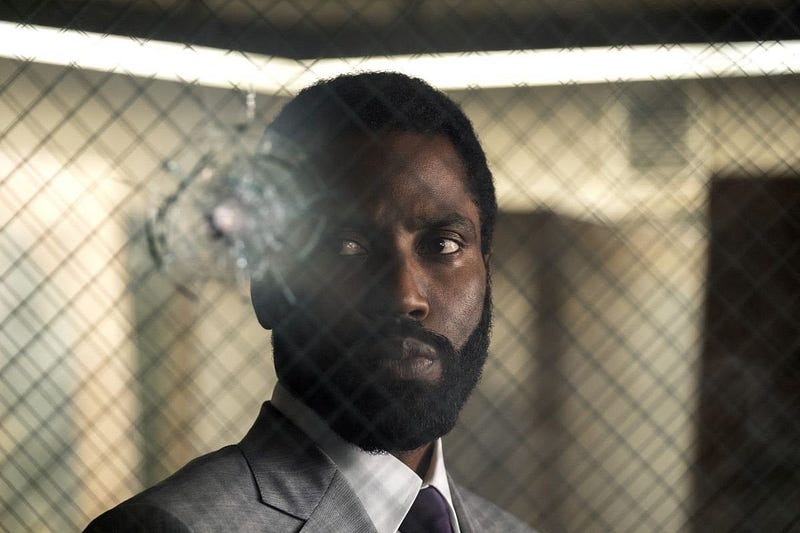
Nolan also touches on the paradoxical nature of faith raised by this relationship. He has The Protagonist and Neil address the “grandfather paradox” in which a person goes back in time to kill their own grandfather. The paradox is met with a succinct response from Neil — “There is no answer; it’s a paradox.” Kierkegaard describes the Knight of Faith in similarly paradoxical terms.
The Knight of Faith is able to focus intently on a passion and accept the nature of the world as an obstacle to that passion while also accepting the power to overcome the impossible — however absurd — through the power of his faith. Nolan presents us with an unfathomably complex scenario in which all life that is, was, or will be hinges on a single moment divided across timelines and approached from multiple perspectives. In the film’s meta-narrative, it becomes our job as the audience to take a leap of faith as well by trusting the director that the events that unfold ultimately form the same logical conclusion that we believe he leads us to.
Along his paradoxical journey, The Protagonist is born out of humble duty, having sacrificed his life in the line of duty, to be reborn as a nameless agent of duty itself. His duty may not be in service to God, but it is in service to the highest among secular callings: life. Though not religious in a conventional sense, he can be said to express a Humanist faith that resembles the devout.
The object of faith is the actuality of another person; its relation is an infinite interestedness. The object of faith is not a doctrine, for then the relation is intellectual, and the point is not to bungle it but to reach the maximum of the intellectual relation. The object of faith is not a teacher who has a doctrine, for when the teacher has a doctrine, then the doctrine is eo ipso more important than the teacher, and the relation is intellectual, in which the point is not to bungle it but to reach the maximum of the intellectual relation. But the object of faith is the actuality of the teacher, that the teacher actually exists.
Does Kierkegaard’s description of faith sound familiar? Compare The Protagonist’s objective — the survival of all peoples in time — with that of the film’s primary antagonist, Sator (Kenneth Branagh). Sator is concerned only with increasing his own status and power, regardless of how many people it may harm.
Sator typifies an antagonist common to Nolan’s storytelling, that of a lone actor able to cause a disproportionate amount of damage (à la Nolan’s depiction of Joker in The Dark Knight). The ultimate expression of Nihilism — destroying not only what is or what will be, but everything that has ever been.
The diametrically-opposed relationship between Sator and The Protagonist is probably better understood by moving away from Kierkegaard’s framework and considering the work of a different kind of thinker.
The Values of Man
Shalom Schwartz designed a cross-cultural theory of values common to all peoples, the Theory of Basic Human Values. At the theory’s core are ten values that engage with one another in various compatible and incompatible relationships.
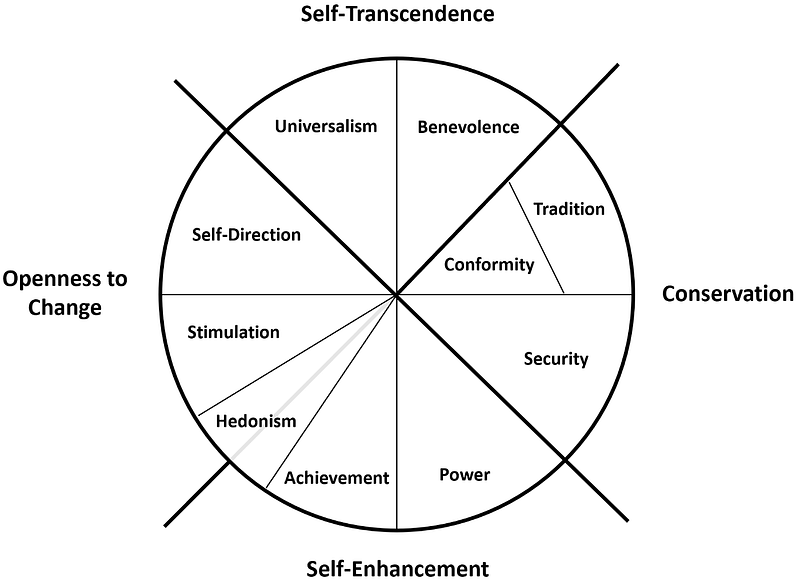
In Tenet, Sator and The Protagonist lie across from one another on Schwartz’s map of values — the most antithetical relationship possible. The Protagonist, exemplifying Kierkegaard’s Knight of Faith who is infinitely interested in the actuality of others, expresses Schwartz’s concept of Universalism.
For Schwartz, Universalism meant wanting what’s best for other people and allowing them to make those choices for themselves. The value derives from survival needs and includes broader concepts such as environmentalism (if we don’t work together to preserve our environment for each other, we can’t expect to survive ourselves). And isn’t the space-time continuum the ultimate essential environment for us all to protect?
By contrast, Sator embodies the value of Power. He wants dominance over others and sole control of resources rather than sharing. He trusts no one else to make decisions and disregards the interests of others. His proposals to Kat (Elizabeth Debicki) about her freedom and their son are nothing more than demonstrations of his control over her; no serious offer is made to give her a meaningful expression of her will.
Any legitimate inclusion of Kat in his decisions would move Sator toward Benevolence, defined by Schwartz as wanting what is best for one’s own group — a sort of tribal mentality. Instead, we can see clearly that Sator resides squarely in a mindset of Power, occasionally expressing its adjacent values through competition (rigged in his favor) and control (the heart monitor that acts as a “dead-man” switch).
The director of Sator’s freeport art repository makes these values clear when explaining how little time a person has to avoid being killed in a lockdown of the facility: “No priority above property.”
It’s no surprise, then, that Tenet circumvents Sator’s power and control by largely rejecting property. Members operate with a gesture and a word, similar to how Navajo code-talkers utilized the traditional, unwritten Diné language to combat Japanese code breakers in World War II. Apocryphal accounts also exist of persecuted Christians identifying one another by drawing an arc of the ichthys and waiting for the other person to complete the corresponding arc.
The film’s MacGuffin — the physical representation of the abstract equation that would destroy existence — is divided between the heroes of the final battle to be hidden away with no physical trace to be left behind (the tomb at the bottom of the world is empty!). The heroes are not concerned with the object(s) of power themselves, but with restoring that power to the people — those who have been, who are, and who are yet to be.
We witnessed in both Dunkirk and Interstellar how a person’s actions can echo through time, but only in Tenet does Nolan show the scope how far-reaching those echoes truly are.