
Scandinavian Mindfulness is Really Just Simple, Uncomplicated Common Sense
Without a ten-step program
We’re busier than ever. More stressed than ever. Unhappier than ever.
Also, the world is ending.
So, mindfulness has become a buzzworthy thing. Profitable for some, especially if they’re good with SEO and marketing.
The first thing that comes up when I Google “Mindfulness” is a story letting me know how I can get started with mindfulness. In the same story, there’s a five-step program.
The second thing that comes up is a story letting me know what the seven principles of mindfulness are. I have to subscribe and accept all the cookies just to find out what the steps are, so I’m not going to.
I’m starting to get a bit stressed just by reading.
At the sidebar in my browser, something else pops up. It’s another story. Four types of mindfulness, from a LinkedIn post.
It’s too much.
I’m closing the tabs.
Mindfulness and contentment
If we break it down, contentment and mindfulness are quite similar. Not one and the same, but similar.
As stated in Psychology Today, mindfulness is to live in the moment and reawaken oneself to the present, rather than dwelling on the past or anticipating the future.
The goal? To cultivate perspective on one’s consciousness and identity that can bring greater peace mentally and relationally. It’s also used in mindfulness-based therapies to address stress, anxiety, or pain, and simply to become more relaxed.
Contentment, defined by Merriam-Webster, is the quality or state of being contented or satisfied.
Both revolve around being at ease and satisfied in the here and now.
While mindfulness focuses on the journey to get there, contentment is kind of like the final stop. You’re content. It’s good as it is.
When we’re not content, we’re looking to mindfulness to help us get there.
This is where the informal, Scandinavian way differs from mainstream mindfulness and self-help. According to Acem Meditation in Norway, the Scandinavian outlook is pragmatic and level-headed.
It’s common sense.
For Scandinavians, nature plays a significant part.
Using nature
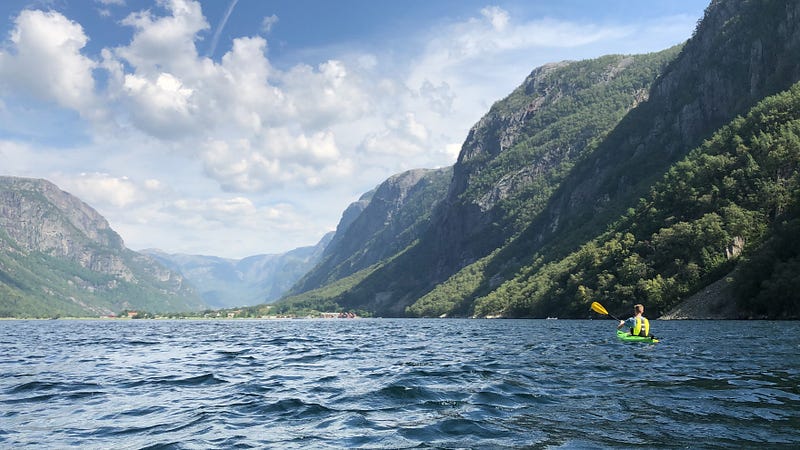
If you’re living in Scandinavia, what you do to live in the moment and reawaken yourself to the present, often involves nature.
There’s not always time to ponder over mindfulness while you’re working, which is often from 8:30 am to 4 pm in Scandinavia. It’s during your off-hours you take the time to wind down and focus on fully being in the moment. (if you can do it while working — great! I’m not that person.)
Recreation plays a big part.
For people in Norway, Sweden and Denmark, recreation isn’t all about organized sports or paved community park trails. It is regularly seeking the silence of nature, often every weekend, renewing oneself to meet the challenges of daily life.
Like many people, Scandinavians work.
We get stressed over work and we’re tired from time to time. Life is not always great and peaceful. Seeking nature to calm us falls very naturally. It doesn’t cost anything, and being in nature is ingrained in us from a very young age.
Relax, in a way that suits you
If you know me or have been following me for some time, you probably know I’m not a big fan of manuals.
From IKEA manuals to mindfulness guides. The IKEA manuals are more about my lack of patience, but when it comes to mindfulness guides and the many, many self-help steps, the reason I’m not a fan is that it generalizes the topic.
Sure, you can generalize mindfulness to an extent. According to Psychology Today, mindfulness can take place through meditation sessions or smaller moments throughout the day. To cultivate a state of mindfulness, you can begin by sitting down and taking deep breaths.
But at the core, and this is my opinion, it’s very personal.
Being mindful, living in the moment and reawakening yourself to the present, would look different for me than for you. It may be a breathing exercise for some, and a walk in nature for others.
We have different backgrounds, cultures, life habits and things that have shaped us and even scarred us over time.
For me, mindfulness is looking at the ocean waves on a summer night, and it is prioritizing a slower weekday morning, leaving time to simply sit and drink my coffee by the breakfast table instead of on the run.
Whatever you do to relax so you can become aware of your surroundings, feel calm and at ease on the inside, do more of that when you don’t feel your life is in balance.
Sounds like being mindful to me.
Mindfulness and that feeling of being content depend on so many factors, because people are complex. Mindfulness, from a Scandinavian viewpoint, is simple.
This approach to mindfulness is really all about common sense; allowing yourself to take time for your body and mind, spending time in nature and prioritizing the things that make you happy without adding pressure and stress. Perhaps most importantly, it’s not a one-size-fits-all.