
Saying 'Yup' to 3 Things in Nope
Spoiler-Free Thoughts on Jordan Peele's Latest Horror Film.
1. It's Actually a Movie Commenting on the Horrors of Cinema
Countless classical cinematography elements are established, maybe due to the setting being in California, maybe due to it being an interesting commentary.
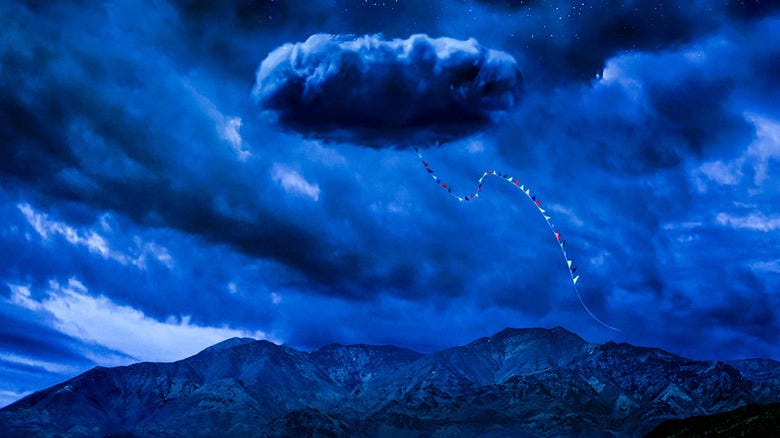
These elements are essentially all the things that are the most beautiful to film: horses, mountain ranges, skies/clouds and old houses. Then the horror events are applied in moments containing those elements to give them a new context, their everyday dangers more apparent: unpredictability, underestimated distance, harsh storms and old roofs. The result is equal parts love letter and warning.
2. Flashbacks to Childhood Trauma Are More Terrifying Than the Present-Day Threat
The film has an internal battle between chaos and mystery. Because the flashbacks involve a child's point-of-view, there's a heightened sense of fear that the audience is subjected to masterfully. The present-day threats involve very rational adults, so many of the moments are presented through the lens of problem-solving, especially when the characters are thrown into the literal roles of evidence-finders.
This stuck with me because the film's draw was the horror involving an extraterrestrial threat depicted in the trailer, not childhood trauma due to the human condition that the story flashes back to multiple times in extremely terrifying ways. But then again, the study of the unknown is very true to science fiction storytelling—its otherworldly mystery—and horror involving grounded events can be scarier than anything from outer space. So maybe the unexpected scares were part of Peel's design.
3. Characters Driven By Fame Instead of Human Survival Are Easy to Accept
It's interesting to note the refreshing motives of the characters in the Nope. When characters in horror films do questionable things, we deem them as stupid. Here, they are seen as intelligent, rational and driven by a desire to document the alien threat. They put their lives on the line to capture high-quality video footage of it—the Oprah shot, as they call it—so the threat can be studied and people's lives can be saved, of course.
As a result, we get characters rarely portrayed as concerned about each other's well-being and are more focused on being effective members of a makeshift documentary film crew, breaking the mould of horror movie characters and heightening the significance of their bravery in this film.
We're left with a realization that nothing achieved in the events of the film could have been accomplished without the black characters. A poignant nod to how nothing in classical cinema could have been achieved without the roles of black horse wranglers and stunt artists—all within the context of a very modern film. Yup.