
6 Ways to Build Confidence
Strengthen your Self-Care Assertive Self
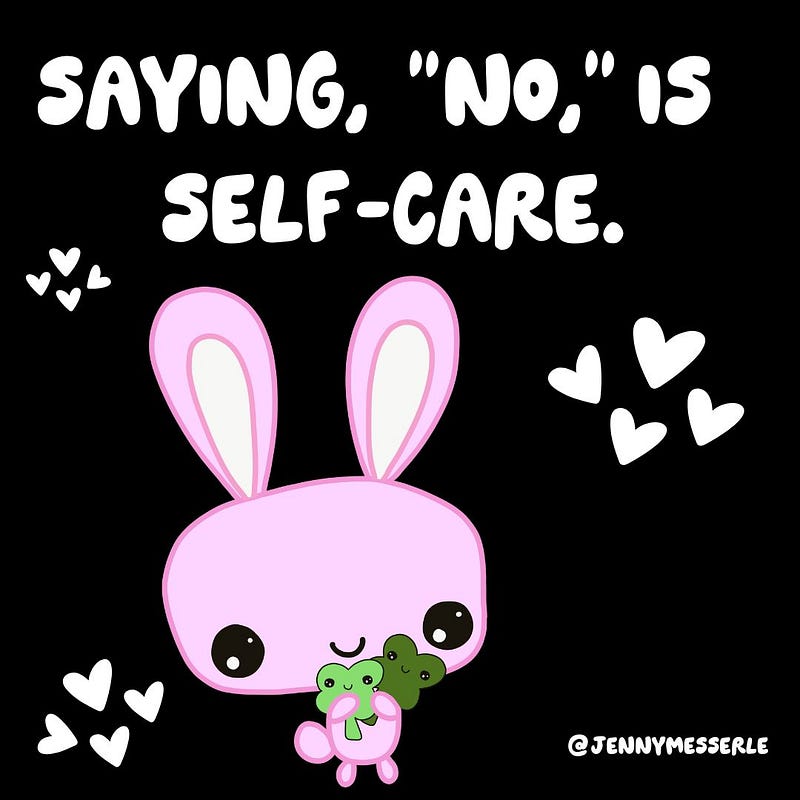
Are you a recovering people pleaser like me?
Early in 2022, something pushed me over the edge and made me realize, “I don’t want to be a people pleaser anymore.”
My Catalyst for Change
In February 2022, an old family friend sent me a Facebook message, “I love your cat character. Will you make it into a card for my brother’s retirement? He loves cats. I’ll pay you.” I replied, “I’m stretched thin. But I can squeeze in this commission.” I quoted a price and elaborated on how busy I was.
I reluctantly said “Yes,” because I did not want to disappoint her. Also, I wanted to delight her and her brother with my commissioned cat retirement card. But I later regretted my “Yes,” because the project took longer than estimated. Afterward, I needed to spend time crafting gracious messages asking her for payment. And she never paid me.
This situation made me realize, “I don’t want to be a people pleaser anymore. I need to prepare myself for how I can say “No.” This way, I’ll be ready for the next time that someone makes a request of me that I’m not gung-ho about.”
Mindset Preparation
When you want to say “Yes,” say “Yes!” But when you really want to say “No” but are afraid to, this article’s techniques will prepare you to say “No” with confidence.
Below are reminders that helped me. If you’re a recovering people pleaser, too, I hope you find these tips useful:
- Each time you reluctantly say “Yes” to a request, you perpetuate your people-pleasing tendencies. But each time you say “No,” you strengthen your Self-Care Assertive Self and weaken your People Pleasing Self.
- Don’t worry if it feels hard. This is normal. Remember: Your “No” muscle is weak. But with practice, your “No” muscle becomes stronger.
Let’s build your “No” muscle! The below habits will help!
1. Preselect Your “No” Sentence
It can be awkward and hard to say “No.”
To make it easier, choose your ready-to-go approach for how you’ll say “No.” This way, at the moment, you won’t fumble over your words. This advanced selection will allow you to speak with more confidence and grace.
For example, practice saying, “No, thank you,” and “No, I don’t have the bandwidth.”
It’s easier to say “No” when you’ve already preselected a go-to “No” sentence.
2. Count to Five After You Say “No”
After you say your “No” sentence:
- Don’t say anything else.
- In your mind, count to five. Let there be five seconds of silence after you speak.
- The silence will be uncomfortable for your People Pleasing Self.
- But sit with the discomfort.
- Don’t tack on extra explanations that turn that complete sentence into a rambling, run-on sentence.
3. Remember: You Do Not Cause Other People’s Feelings.
Imagine the below situation displayed as a five-panel comic strip. Each item is depicted in its own panel in the comic strip.
- Someone asks you a favor.
- You say your “No” sentence.
- Dismay washes over the person’s face.
- You feel responsible for the person’s disappointment. Worry and guilt flood your mind.
- You retract and say, “I can make your request work.”
Just because that person’s feelings (their dismay) followed your “No,” this does not mean you caused that person’s feelings.
So many factors contribute to how a person responds to a “No.” For example:
- The person is emotionally immature; or
- The person lacks the social conversation skills needed to make other people feel unconditionally accepted; or
- The person is desperate to have their request resolved and doesn’t have the energetic capacity to be patient; or
- The person was caught off-guard by the “No” and had not mentally prepared themselves with a gracious response; or
- The person is used to getting their own way and acts defensively when they feel “rejected” by someone.
4. Turn on Your Force Field
To remind yourself that you’re not responsible for how other people feel, turn on your force field.
Imagine creating a bubble force field around your body with your breath.
- With each inhale, gather energy from your environment.
- With each exhale, visualize the bubble getting bigger.
With each inhales and exhales, picture your force field getting larger and larger as if you’re expanding a party balloon with your breath. But this time, you’re creating an invisible barrier between you and the other person.
A good time to create your force field is during the five seconds of silence after you say your “No” sentence.
If you see annoyance creep into the other person’s face, imagine that displeasure moving toward you but bouncing off your force field and shattering on the ground into hundreds of pieces.
5. Create Empathy Envelopes
As a People Pleaser, you like to fix things. Fixing things makes you feel useful. Feeling useful makes you feel worthy.
- When a friend asks you to do something, your People Pleasing Self wants to say “Yes,” because saying “Yes” means you help fix your friend’s problem. (Your friend’s problem is why she made her request to you.)
- If your Self-Care Assertive Self says “No,” and you see dismay on your friend’s face, your People Pleasing Self wants to fix your friend’s mood. Your People Pleasing Self wants to say “Yes.”
Resist your desire to fix things for your friend.
You are not responsible for fixing your friend’s problem or mood. For self-care reasons, do not take on these responsibilities.
Instead, take the below steps to create an Empathy Envelope:
- Hold space for your friend’s problem.
- Hold space for your friend’s disappointment in your “No” answer.
- Imagine your arms lengthening and creating a big hug around your friend.
- Imagine you are enveloping your friend’s unresolved problem, unfulfilled request, and unsettled mood with empathy.
- Imagine creating an empathy envelope for your friend.
- Express your empathy. “That’s a predicament you’re in.” “It’s hard when things are unresolved, and you don’t know when they’ll be settled.” “I can understand why you’re upset.” Then, just listen to what your friend says. Listen, don’t try to fix anything.
If your friend asks you to reconsider their request, repeat one of the above empathy expressions.
If needed, divert the conversation to your needs: “I’m practicing more self-care in my life. Saying ‘No’ is a hard thing for me. But it’s important for my well-being. Thank you for understanding. Thank you for holding space while I prioritize my mental health.”
6. Practice in Front of a Mirror
Practice saying “No.”
Practice it in the privacy of your home such as in front of your bathroom mirror.
- Look at your face in the mirror and assert your preselected “No” sentence.
- Say it a second time.
- Say it a third time.
- Each time, say it intentionally.
Yes, it will feel awkward. You’ll judge the value of the exercise and think, “I’m talking to the mirror…. This is pointless…How is this going to help…”
Whatever you’re feeling is normal.
Awkwardness and doubt are types of discomfort. By practicing saying “No,” you are also strengthening your endurance to just be with discomfort instead of trying to fix it with action.
You are practicing in private to make public situations easier.
Shift in How I Viewed Myself
As I practiced the six steps to help me say, “No,” a powerful shift occurred:
I began to view myself differently. I started to see myself as a Self-Care Assertive Person instead of a People Pleaser. This shift in my identity reversed my flashlight of attention:
- As a People Pleaser, I would continually shine my flashlight outward looking, “How can I help? What can I do so you’ll like me? I want to make you happy. I don’t want to disappoint you.”
- As Self-Care Assertive Person, I began to shine my flashlight inward on myself. I started to ask myself, “What do I want? What do I need in this situation? By pleasing the other person, will I deny myself something?”
I became less nervous about saying, “No,” because with each “No,” I would gain something for myself regardless of how the other person responded. Each public “No” would be:
- An act of self-care and a step toward strengthening my Self-Care Assertive Self and
- A step toward weakening my People Pleasing Self.
I stopped being ashamed of the stigma of saying, “No.” I stopped feeling guilty about prioritizing my needs. I stopped viewing “No” as a selfish act.
I started to honor my needs. I started to see the importance of voicing my needs out loud. I started to value myself.
People in Your Future
“No” can come in other forms. It can be saying “No” to someone’s suggestion.
I took a trip with my artist friend, Gail (our first trip together!) On our first morning, she texted, “Would you like to go to Blue Moon Café? It has amazing reviews. I can’t wait to try their Cap'n Crunch-encrusted French toast!”
As I reviewed the menu, anxiety quickened my breathing and heartbeat. I thought, “Gail is so excited about this place. How am I going to tell her, ‘I don’t want to go here.’” Since I was practicing saying, ‘No,” I texted her, “Hi Gail, Thank you for researching breakfast options. Unfortunately, they don’t have vegan options. Would you like to try Liquid Earth or get something from the grocery store? Do you want to meet in the living room and talk about breakfast options?”
Gail replied, “I didn’t realize! I’m so glad you noticed this!”
When we talked, I expressed how relieved I was that she was fine with my “No,” because I was so nervous that she’d think, “Jenny is so high maintenance. I don’t want to travel with Jenny again.” When I told Gail about my worries about speaking up, it opened up another layer of conversations and connections between us, because she was also working on exercising her voice too.
This made me realize, “The people who understand when I say, ‘No,’ are the people I want to keep in my life. If someone gets upset with me, ‘No,’ I will reevaluate the future of my relationship with them.”
Gentle Reminder
I hope you found this article’s techniques useful. Even though this article focused on six ways to build confidence to say “No,” I’m not advocating that you say “No” to everything.
- I’m encouraging you to discern when “No” is the most appropriate answer. When it is, you now have six tools to help you.
- If “Yes” is the best reply, say “Yes” with a smile!
👉 Want more inner peace and self-love? Click here to receive a People Pleaser Workbook and a Self-Gratitude Journaling Guide. 👈