
Say bye to if-else — -Part2 orElse vs orElseGet

In my previous blog https://readmedium.com/a-new-way-to-check-for-null-say-goodbye-to-if-else-part-1-8179d3b8fd0a we talked about how to clean your code by using Optional` in this blog, lets dive deaper to see whats the difference between Optional.orElse and Optional.orElseGet.
The below is from Java21 Doc
public T orElse(T other)
If a value is present, returns the value, otherwise returns other.
Parameters:
other - the value to be returned, if no value is present. May be null.
Returns:
the value, if present, otherwise other
According to https://www.baeldung.com/java-optional-or-else-vs-or-else-get
parameter of orElse() is evaluated, even when having a non-empty Optional.
Before further discussing, lets consider the following code:
the result is “b”
What do you mean by evaluated here? My understood was the method will be executed.
Please be noted in the above statement, it is saying the parameter of orElse() is evaluated, but it is NOT saying it is used.
class User {
String name;
String phone;
@Override
public String toString() {
return "User{" +
"name='" + name + '\'' +
", phone='" + phone + '\'' +
", address=" + address +
'}';
}
Address address;
}
User user = null;
user = Optional.ofNullable(user).orElse(createUser());
System.out.println(user);
private User createUser() {
System.out.println("createUser was executed.");
User user = new User();
user.setName("John");
return user;
}
In the above code user is null, thus the createUser() was executed.
But what will happen if user is NOT null
User user1 = new User();
user1.setName("John");
System.out.println(Optional.ofNullable(user1).orElse(createUser(user1)));
The out come is:
createUser was executed.
User{name='John', phone='null', address=null}
To my surprise the createUser() method was CALLED.
What will happen if in the createUser(…) method I updated the user variable?
User user1 = new User();
user1.setName("Smith");
System.out.println("Im suppose to see the Smith user");
System.out.println(Optional.ofNullable(user1));
System.out.println("With orElse(…) Im suppose to see the John user");
System.out.println(Optional.ofNullable(user1).orElse(createUser(user1)));
private User createUser(User user ) {
System.out.println("createUser(…) was executed.");
user.setName("Smith");
return user;
}
The result is:
Im suppose to see the Smith user
Optional[User{name='Smith', phone='null', address=null}]
With orElse(…) Im suppose to see the John user
createUser(…) was executed.
User{name='John', phone='null', address=null}
My conclusion up to now is the orElse methods in the Optional class will execute the method (in my case, the createUser() method) eagerly, regardless of whether the Optional contains a non-null value or not.
Lets see the behavior of orElseGet with the same code:
User user2 = null;
user2 = Optional.ofNullable(user2).orElseGet(this::createUser);
System.out.println(user2);
System.out.println("now the user has been set");
User user3 = new User();
user3.setName("Smith");
System.out.println("Im suppose to see the Smith user");
System.out.println(Optional.ofNullable(user3).orElseGet(this::createUser));
The result is:
createUser was executed.
User{name='John', phone='null', address=null}
now the user has been set
Im suppose to see the Smith user
User{name='Smith', phone='null', address=null}
The difference between orElse and orElseGet was in orElseGet the createUser(…) method was NOT called because the variable user3 is NOT null.
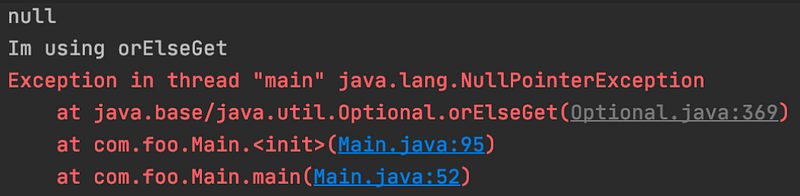
Last challenge. What will happen if the default value of orElse/orElseGet was set to null? shown below:
User user4 = null;
System.out.println(Optional.ofNullable(user4).orElse(null));
System.out.println("Im using orElseGet");
System.out.println(Optional.ofNullable(user4).orElseGet(null));
orElseGet will raise NPE
🔸Thank you for reading 👍.
If you liked this story then click on 👏👏 do follow for more interesting and helpful stories.