
PARENTING AT THE APOCALYPSE
Save The Boys, Save The World
Warrior culture is killing us all
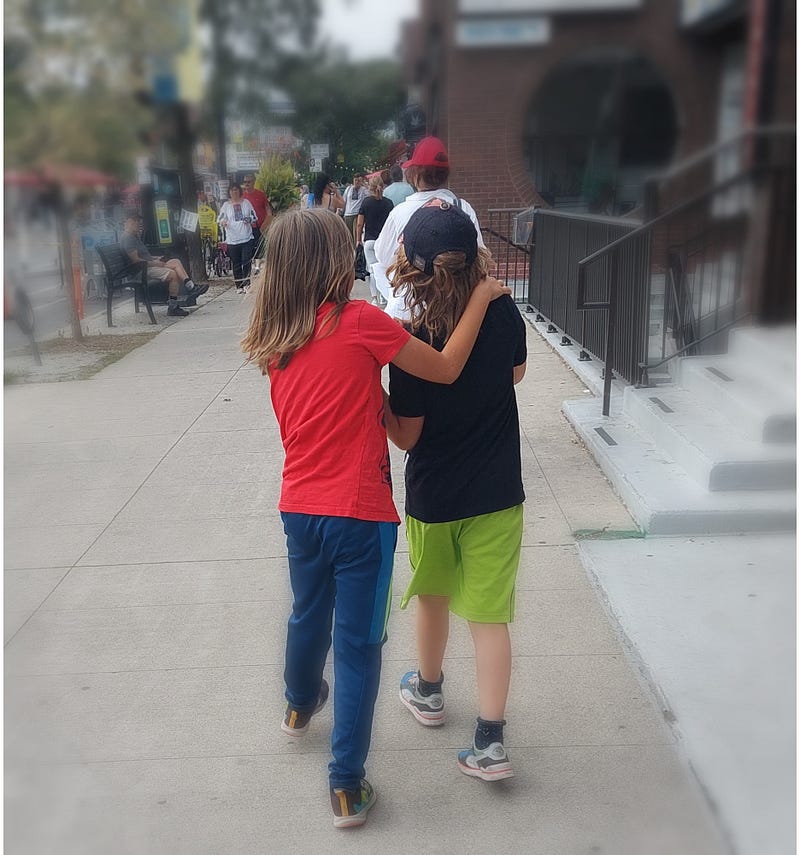
When my son Conall was younger, he played what passes for organized soccer among six-year-olds.
During one game, he was standing by himself during a pause in play. A bigger boy from the other team stomped over to him, got right up in his face, and started talking fast. I couldn’t hear what he was saying, but he was a combative kid — I’d just watched him shove his own teammate out of the way to get the ball.
The first boy was joined by two others, who also stood right up against Conall. Conall didn’t move, either aggressively or to back away, and he held the first kid’s eyes the whole time. I was getting concerned about how it would play out when a couple of the bigger six-year-olds from Conall’s team walked up and patted him on the shoulder — a “we’re with him” gesture that boys learn very early — and everyone dispersed.
I was proud of how Conall handled the situation, but it was dispiriting to watch. Toxic masculinity starts early.
It’s not surprising. Many cultures, including the one that Hollywood built, promote violence and aggression from men.
Why?
Most ancient societies celebrated warrior virtues — attributes like courage, strength, and perseverance. There are practical reasons for this; human history is bloody mayhem, and wiping out or absorbing the tribe down the road was how our ancestors passed on their literal and cultural DNA.
While these virtues are non-gender-specific, they became particularly associated with men, who did most of the fighting (there were certainly female warriors, in Dahomey for example, and probably in ancient Norse cultures, but it was the exception, not the norm).
These virtues are real, and sometimes the thread ran true.
The medieval European concept of chivalry at least paid lip service to the idea that knights were required, among other noble duties, “to protect the weak and defenseless” and “to give succour to widows and orphans.”
Most often, such high-minded concepts didn’t survive the practical exigencies of the day. It was easier to murder or enslave everyone than it was to give special treatment to the widows and orphans you’d just created.
A thirst for blood and vengeance became salient qualities of heroism, at least if the hero was on your side.
And here we are.
Popular culture hasn’t shifted much from this simplistic paradigm — nobody is paying to see Liam Neeson make a few polite inquiries about his daughter and turn the matter over to the local gendarmes. We admire men who take matters into their own hands, who fuck people up, who explode things and stride hard-faced out of the fireball.
MMA fighters don’t lean over and ask “You ok, buddy?” when they knock down an opponent, they go in for the ground and pound.
Boys learn early, from media, from friends, from family that aggression and masculinity are interchangeable. Boys don’t cry, they fight.
Even among the “woke” middle class, boys understand that they aren’t supposed to show their feelings, at least not the ones they come to perceive as feminine, the ones that display vulnerability, the ones that bring them to tears.
And if they aren’t allowed to show sadness or fear, the only color left in that palette is anger.
Incel, Islamist, White Nationalist, rapist, murderer. Angry men. It’s all the same shit.
And it plays out in less obvious ways too. Angry men refusing to accept the science of climate change because it’s associated with the opposing tribe. Because you can’t shoot the climate crisis, you have to work slowly and painstakingly to change it, and that’s not what heroes do.
Civilization can’t survive warrior culture much longer.
What now?
Fixing the problem will take a sea change in the way that we men see the world and our place in it.
Shortly after the pandemic started, Conall and I were walking down a quiet street when a man passing on the sidewalk muttered something about us not moving out of the way. I’d woken up in a lousy mood, and I turned around and hollered at him, “What did you say?” He answered back but kept walking, and we shouted at each other for a few minutes until we were both satisfied and out of earshot.
Conall watched this whole scene placidly, and even as it was unfolding I knew I’d messed up. But I had to call this dude out, he was challenging me, insulting me even, in front of my son. What else could I do?
Hell, no. I just lost my temper because I was cranky and let my ego get the better of me. Because I had to win.
I apologized to Conall right after, said I’d done the wrong thing, and set a bad example, but it was too late. Kids believe what they see you do, not what you tell them to do.
So how do we show them the right way?
By speaking kindly of others, or at least keeping our counsel, regardless of what they‘re saying about us. By giving people the benefit of the doubt. By walking away from trouble and the stupid pride that brings us there. By remembering to laugh.
This is our job — for everyone, but especially for men, whether you’re father to a boy or not.
Anyone who’s seen boys play knows that besides being chaos vortices they can also be an amazing force for good. Their spirit of adventure and play, and the essential kindness of which they’re capable, can be wonderful to watch. Happy boys grow into strong, gentle, men.
If there’s to be a human future, we need this. Let’s raise our boys bravely, truthfully, and with joy.


