
Save for 8 Years in Your Youth, a Retirement Without Worries
Tony Robbins Financial Freedom Blueprint

Discovering unexpected gems is one of the YouTube algorithm’s delightful quirks. Imagine my surprise when Tucker Carlson’s recent interview with the seasoned motivational speaker, Tony Robbins, materialized in my feed, a gem I wasn’t actively seeking but gratefully stumbled upon.
For those unfamiliar, Tony Robbins has been imparting motivation and performance coaching for longer than I’ve been on this planet. It’s a fantastic reminder of the passing years, especially on a Monday morning — a refreshing way to feel young!
The interview’s essence? Robbins, armed with his wealth of experience, tackled a pressing question: Why do many people harbor a sense of gloom about the future?
Before delving into the specifics, I highly recommend watching the first ten minutes of the interview to witness Tony Robbins’ remarkable communication skills. It’s a display that even leaves Tucker Carlson, typically unflinching, seemingly in awe of Robbins’ clarity and ease of conveying his message.
Now, to the crux of this article, a nugget of financial wisdom dropped by Tony Robbins around the 43-minute mark of the interview. It’s a piece of advice directed at parents, a financial strategy that, when instilled in their children, can set them on a path to financial security.
Robbins suggests:
From ages 19 to 27 (8 years),
- Save $300/month and invest in the stock market (consider index funds ETFs as an example)
- That totals to $28,000 over the eight years or $3,500 annually.
- Thanks to the magic of compound interest, diligent saving during these eight years can eliminate the need to worry about retirement savings afterward.
This financial nugget is not just about money; it’s a legacy, a gift that can potentially secure your child’s financial future. Let’s break down the wisdom embedded in Robbins’ advice.
The Magic of Compounding
I’m the first to acknowledge the remarkable power of compounding interest. Picture it as the process of building a snowman. Initially, you gather a handful of snow, compacting it to form a small snowball. Then, much like the compounding effect, you start rolling the snowball, and something magical happens — it grows, steadily and significantly.
Just as the snowball accumulates more snow with each revolution, compounding interest multiplies your savings, making it larger and more impactful over time. It’s a snowball effect that, when initiated early, can create a financial foundation of substantial proportions.
In my case, the journey into the stock market began during high school, a fortunate initiation thanks to entrepreneurial parents who instilled the foundations of financial success early on.

About 12 years ago, I further fortified my investment knowledge by completing the Canadian Securities Course, enhancing my abilities as an informed investor.
As of today, at the age of 43, the compounding effect has worked its magic. Both my wife and I have reached a point where we no longer need to actively contribute to our retirement fund. This tangible outcome is a testament to the effectiveness of compounding.
Now, let’s delve into a straightforward example to illustrate how Tony Robbins’ simple investment advice stands the test of time.
Here’s the breakdown:
- Average return of the S&P 500 over the past 30 years: 10%
- $300/month over 8 years from 19 to 27
- $3,500/year and $28,000 over that time
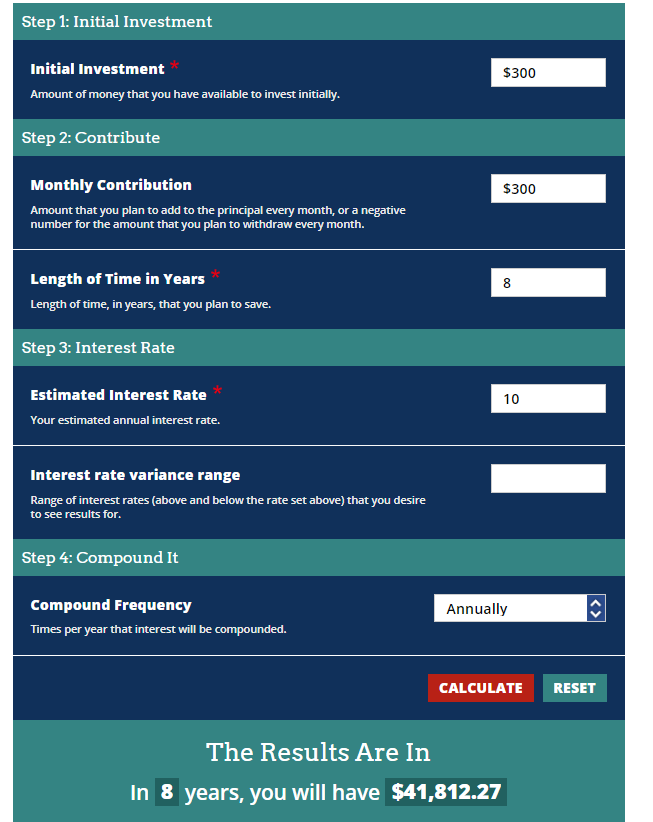
I utilized Investor.gov for the computations (link provided, and screenshots attached for reference):
- Initial investment totals $41,812 over the initial 8 years
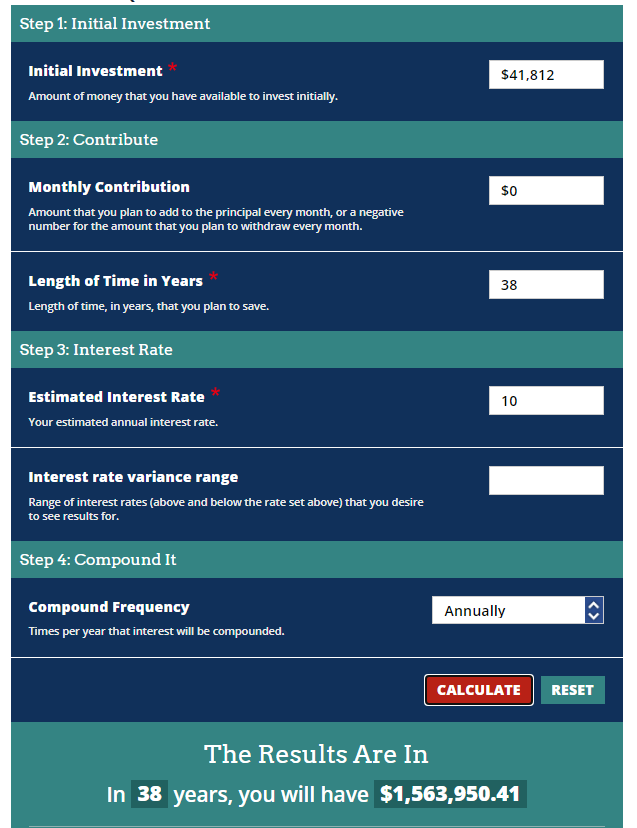
- The subsequent 38 years, from 27 to 65 years, at the same rate of return (10%) and no additional investing other than the initial $41,812, yields $1,563,950
To put this into perspective, amassing $1,563,950 and living off a 6% return provides approximately $100,000/year without depleting the principal.
Attainable Financial Freedom: A Closer Look
The astounding revelation here is that financial freedom appears within reach for anyone willing to set their sights on it.
The example we’ve explored vividly illustrates that saving from 19 to 27, even during the initial years in the job market post-university, is not just a plausible goal but an achievable one.
The window of opportunity during these crucial early years may seem narrow, but as Tony Robbins emphasizes, the power of compounding can transform these efforts into a significant financial foundation.
It’s a journey that, with commitment and discipline, can pave the way for a future where financial worries are replaced with the freedom to live life on your terms.
Like what you’ve read?! Subscribe today by clicking on this link to receive timely notifications on my latest articles!
Disclaimer: This article is not intended as investment advice. The content herein represents my personal investment lessons gleaned from over 12 years of self-directed investing. The experiences and insights shared are purely anecdotal and may not be suitable for everyone. Before making any financial decisions, it is crucial to conduct thorough research and, if needed, seek advice from qualified financial professionals. Investing always carries inherent risks, and individual circumstances vary, so exercise due diligence and consider consulting with a financial advisor tailored to your specific needs and objectives.