
Saudi Arabia, China and Golf throw dark clouds over human rights
By Bernd Debusmann
Two of the world’s worst human rights offenders, Saudi Arabia and China, have recently received pats on the backs rather than criticism in developments highlighting that oil, money and geopolitical power trump human rights, again and again.
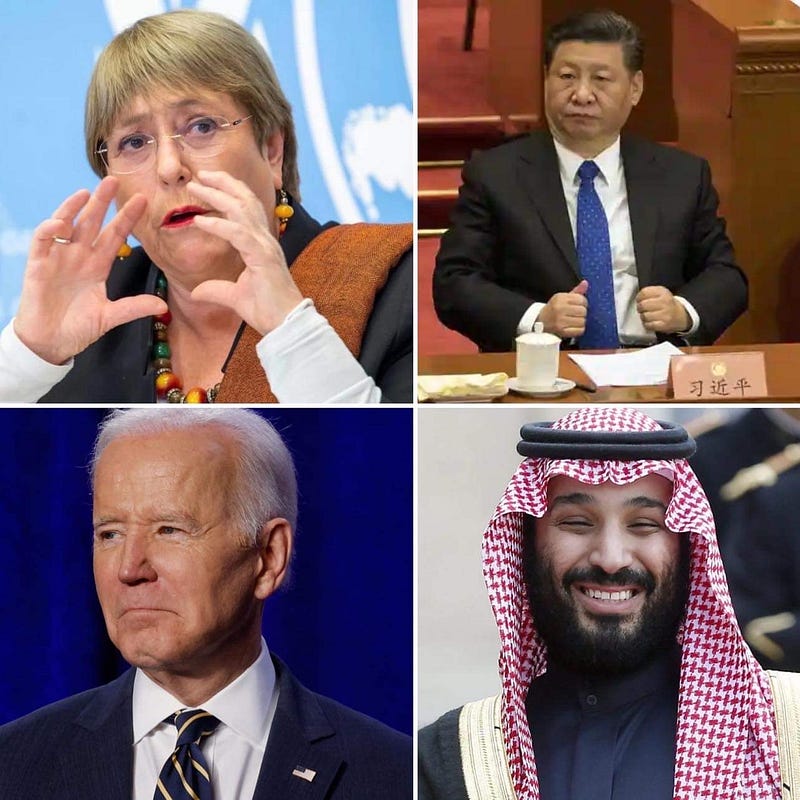
Those involved in drawing attention to a perennial gulf between words and deeds on human rights are U.S. President Joe Biden, Michelle Bachelet, the U.N. High Commissioner for Human Rights, and a group of professional golfers, including star player Phil Mickelson.
Biden is Exhibit #1 of what happens when lofty principles, often proclaimed, collide with the harsh realities of politics and economics. Bachelet is Exhibit #2 of an official who bowed to the immense power of China rather than speaking up in defence of a severely repressed minority.
Saudi Arabia and the man who rules the world’s top exporter of crude oil, Crown Prince Mohammed bin Salman, “got away with it,” in the words of Washington Post columnist David Ignatius. “It” refers to repression of dissidents and the brutal murder of the U.S.-based Saudi journalist Jamal Kashoggi who wrote columns critical of the Saudi establishment for the Washington Post..
Let’s begin with Biden, whose platform as a candidate for the presidency included harsh criticism of Saudi Arabia, its de facto leader, Crown Prince Mohammed bin Salman, commonly referred to as MbS, and Saudi bombing campaigns using U.S. weapons in the war in Yemen.
Here is how Biden put it in a debate by presidential candidates on November 20, 2019: “ Kashoggi was in fact murdered and dismembered and I believe on the order of the Crown Prince…We are going to make them pay the price and make them in fact the pariah that they are. There is very little social redeeming value in the present government in Saudi Arabia.”
The Saudi government has not changed in the intervening years but the United States has, the result of presidential elections and global changes that included a pandemic killing millions, and Russia’s war on Ukraine. It is causing havoc to global supply chains and is seen as a key element in shortages, rising inflation and record prices for gasoline in several countries including the United States.
With Americans in a sour mood, according to polls, Biden’s approval rating sinking, and mid-term elections looming, the word “pariah” has vanished in official references to the world’s top oil exporter which has so far rebuffed American requests to increase production that could reduce gasoline prices.
So, the June 14 announcement that Biden would visit Saudi Arabia described the country “a strategic partner of the United States for nearly eight decades.” Critics of the kingdom, the only country that is named after a family, reacted with outrage. One headline over an analysis of the pariah-turned-strategic partner flip-flop said “Biden plans to visit Saudi Arabia, hat in hand.”
The sub-headline added: “MbS is playing hardball with the United States and the White House is letting him win. Why?”
Much of the answer to that question lies in a date — November 8. 2022, when all 435 seats in the U.S. House of Representatives and 35 of the 100 seats in the Senate will be at stake. The prospects for Biden’s Democratic Party do not look good. Lower gasoline prices and lower inflation would help.
The pariah-strategic partner switch fits the definition of realpolitik: “A system of politics or principles based on practical rather than moral or ideological considerations.” It’s a system which places human rights near the bottom of the priority list.
But human rights are the top (and only) priority for the U.N. Commissioner for Human Rights, a post Bachelet assumed on September 1, 2018. Her term ends in August and she has announced she will not seek a second term.
That decision followed a storm of criticism by human rights advocacy groups over a visit to China which effectively helped the Chinese Communist Party rebuff charges of genocide and repression against China’s Uyghur Muslim minority in the Xinjiang region.
At the end of a six-day visit stage-managed by the Chinese authorities, Bachelet issued a statement that included praise for China’s “tremendous progress” in lifting millions out of poverty since the Communist Party took power in 1949. The government defines poverty alleviation as its key human rights achievement.
But the Universal Declaration of Human Rights, adopted by the newly-founded United Nations in 1948 in the wake of the savagery of World War II specifies much more than poverty alleviation. It specifies 30 rights and freedoms which include the right to be free from torture, the right to freedom of expression, the rights to life, liberty and privacy.
Many of them either do not exist of are severely restricted in China, according to detailed reports by human rights organisations such as Human Rights Watch and Amnesty International.
The U.S. Department of State, which released an extraordinarily detailed report on human rights around the world in April, used blunt language to describe what its intelligence agencies say is happening in the world’s most populous country:
“Genocide and crimes against humanity during the year (2021) against predominantly Muslim Uyghurs and members of other ethnic and religious minority groups in Xinjiang. These crimes were continuing and included: the arbitrary imprisonment or other severe deprivation of physical liberty of more than one million civilians; forced sterilization, coerced abortions, and more restrictions of the country’s birth control policies; rape; torture of a large number of those arbitrarily detained; forced labor; and draconian restrictions on freedom of religion or belief, freedom of expression and freedom of movement.”
That description sounds like the Universal Declaration of Human Rights in reverse and none of it appeared in Bachelet’s statement on her visit. Instead, she “enabled the perception that the U.N. is letting China get away with massive abuses at no cost,” Louis Charbonneau, Human Rights Watch U.N. director, said in an interview.
Getting away with no cost brings us back to Saudi Arabia, whose Crown Prince has twinned his success in making Biden change his position with a multi-million dollar operation to link Saudi Arabia with the sedate sport of professional golf
This came in the form of a new golf tour to rival the long-established PGA (Professional Golfers Association) tour. Underwritten by the $600 billion Saudi Arabia Investment Fund, it is called the LIV tour, for the Roman numerals 54 — the number of holes to be played in each event instead of the traditional 72.
The inaugural tournament took place in mid-June north of London and offered a total purse of $25 million, the largest in golf history. Under LIV rules, every player is guaranteed at least $120,000 just for completing the 54 holes. Star player Mickelson’s contract with LIV was reported to total $200 million.
The PGA tour, which was formed in the late 1960s suspended 17 golfers as soon as LIV kicked off but none of them appeared distraught — or embarrassed for being fiercely criticized for taking part in what critics call “sportswashing” — a company or country’s use of sports sponsorship to improve its reputation.
One of the most trenchant comments on the controversy prompted by the establishment of the LIV tour came from a Wall Street Journal columnist, Daniel Henninger: “Greed, dishonor, scandal and murder are not normally associated with the sport of golf, “he wrote.
“But golf, invented 500 years ago in Scotland, finds itself engulfed in a battle between its reputation for fair play and Saudi Arabia’s oil money.”
It’s not hard to guess which side is winning.
©Writers International LLC