
Exploring My French Canadian Heritage: A Journey Through the Five French Mother Sauces
Sauce two — Velouté
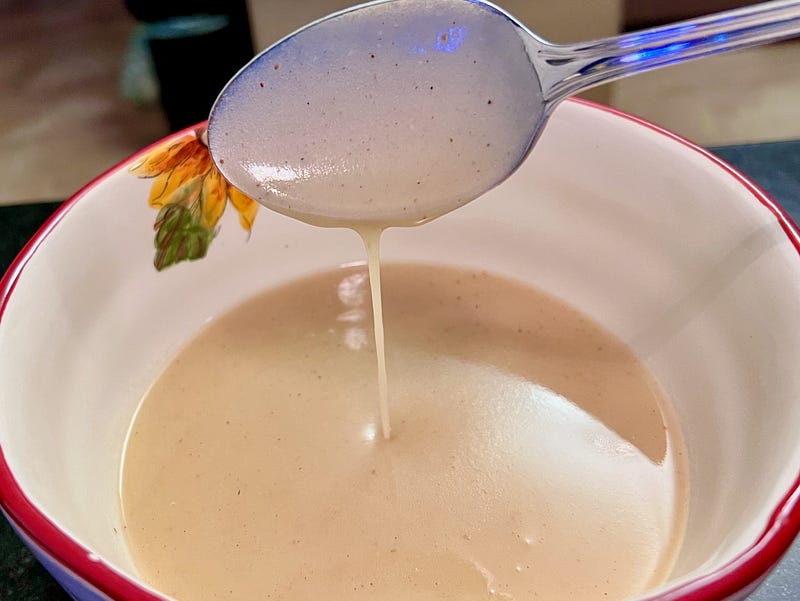
I’ve decided to take on French cooking to reconnect with my French Canadian heritage. This post will update you on my recent challenge to learn the five French Mother Sauces. In my last post, I spoke of Béchamel sauce. Today’s sauce, Velouté, has an exciting story.
Velouté sauce is a classic French sauce and one of the five “mother sauces” in traditional French cuisine. Its name translates to “velvety” in English. The great chefs traditionally made roux-thickened Velouté with clear stocks, such as chicken or fish. It is similar to Béchamel sauce except that Béchamel uses milk instead of clear stock.
Velouté’s origins
Food historians believe Velouté sauce was first created in the 18th century, during the reign of King Louis XIV. This time was the height of French Cuisine’s popularity. A chef of the royal court named Antoine Beauvilliers wrote the first known recipe for Velouté sauce in his 1814 book “The Art of French Cooking.” So while August Escoffier classified the mother sauces, Beauvilliers’ book made them famous.
Although the origin of Velouté seems less controversial than that of Béchamel, it is not without some controversy. First, like Béchamel, there are two schools of thought on dissolving the roux. Many chefs swear by using cold milk for Béchamel and room temperature stock for Velouté. Other chefs swear the milk or stock must be near boiling. Given the recurring theme, I decided to see what the authority on Mother Sauces thought.
I picked up a copy of “The Escoffier Cookbook and Guide to the Fine Art of Cookery” by Auguste Escoffier. It is Escoffier who wrote the book on the Five Mother Sauces. I assumed Escoffier would guide the chefs to use either hot or cold liquids. And he did. Or rather, he made it clear that there are different ways to dissolve a roux. For Béchamel sauce, Escoffier states, “pour the boiling milk on the roux.” YES — I prefer boiling milk also. One for the good guys! For Velouté, Escoffier states… What? “Dissolve the roux in cold, clear stock.”
Well then, at the risk of getting ahead of myself, I looked up “Sauce Espagnole,” the last of the Five Mother Sauces thickened using a roux. Surely it would be the tie-breaker. But no. Escoffier’s recipe for Espagnole sauce states, “Dissolve the dark roux in brown stock.” There is no mention of temperature. It depends on your mood, I guess.
I’m now searching for a copy of “Le Guide Culinaire,” Escoffier’s book in its original language. Some things must have lost their meaning in translation. In any case, having tried using hot or cold liquids many times, I am in the boiling stock (and boiling milk) camp. But be careful — your sauce will set very fast!
Is Velouté the sauce’s name?
I’ve also noticed Velouté is more of a technique than an actual sauce. While all Mother sauces, by definition, serve as the base for numerous daughter sauces, you can make the base Velouté in innumerable ways. Fish Velouté uses fish stock. Chicken Velouté uses chicken stock, and so on.
Velouté sauce remains a staple of French cuisine and a favourite of professional and home chefs. But was Velouté one of those sauces my Grand-Maman used to make?
Given the versatility of Velouté, available in so many flavours based on the stock used, I assume that my Grand-Maman must have often served Velouté. She served us flavourful sauces with every meal, although we called them “gravy.” I thought sauce and gravy must be the same thing. Gravy is how a child would say Velouté, right?
But wait, it seems that Velouté and gravy are different entities. Escoffier says to thicken Velouté with a flour-based roux, whereas you thicken “gravy” using corn starch.
Now I’m sure the neighbours can hear me grumbling; I need to get a copy of “Le Guide Culinaire” in its original French. What did Escoffier call gravy in French? The most obvious translation of gravy to French is “sauce.” Did Escoffier use “Sauce Velouté” and “sauce” to describe different things?
Alternatively, did Escoffier mean you could make many sauces or gravies and level them up using the velouté technique? Maybe Escoffier used velouté as an adjective rather than a name. It’s like saying brown sauce, thick sauce, or velouté sauce. Could it be? If so, it would strengthen my argument about Velouté being more of a technique than a specific sauce. Les amis Français — avez-vous des idées? (My French friends, do you have any thoughts?)
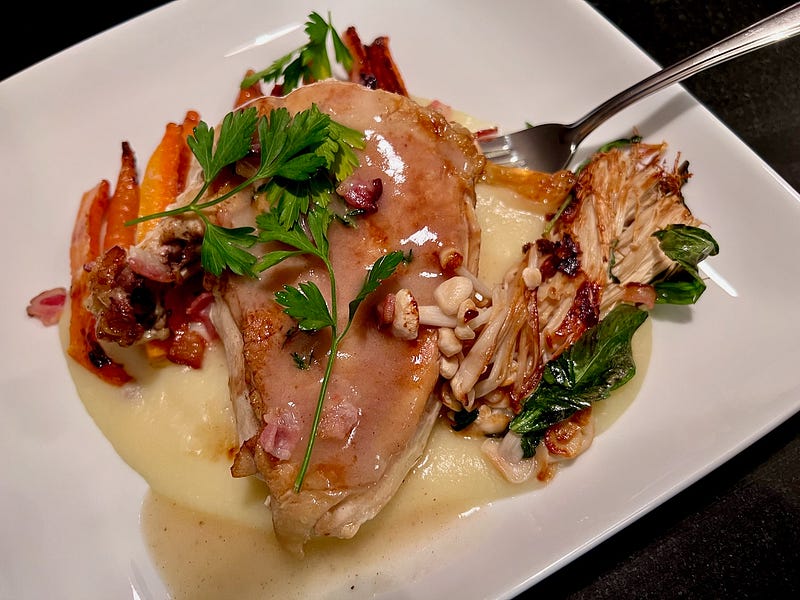
Did my Grand-Maman make Velouté?
I have no idea what my Grand-Maman would have used to thicken her sauces. If she used roux, then I’ve made a sauce similar to hers. But if she used corn starch, at least according to Escoffier, she made gravy, and my exploration of Velouté isn’t very relevant. In one sense, I’m back to square one, connecting with my French Canadian roots.
But my experience so far has been fantastic, and I’m learning so much. All the while I’m researching and cooking, I’m thinking about great childhood memories. Whether or not I’m making the same sauces I ate as a child is unimportant.
The chefs “banter” about hot stock vs cold stock reminds me of my dad and his brothers. They would always argue amicably about the most mundane things. “I tell you, there are three trees in front of that house.” “No, there are four trees!” And I’ve seen them hop in a car and drive 40 km to find zero trees in front of the house.
Perhaps the banter between chefs is the same — they all know it doesn’t matter, but they enjoy poking fun at each other. Maybe all these chefs consider themselves one big happy family. At least, that is what I’m choosing to believe — these are a bunch of chefs expressing mundane sibling rivalries.
While I’ve not figured out any of my Grand-Maman’s recipes yet, I feel much more proficient in sauce-making. Further, my childhood memories are much more vivid. So I’m on the right track.
Remember, cooking is a great way to manage your mental wellness. It’s a creative outlet, helps reduce stress, creates a sense of accomplishment, and provides a sense of purpose and structure.
I use cooking to focus on the here and now instead of worrying about the future or the past. It provides a break from negative thinking patterns. There is something so satisfying about feeling a sauce thicken, then drizzling it on your plate.
Are you feeling stressed? Give cooking a try. Better yet, cook and write about it. I’d love to hear about your exploits.