Eucharist is “the source and summit of the Christian life.” Further, “The other sacraments, and indeed all ecclesiastical ministries and works of the apostolate, are bound up with the Eucharist and are oriented toward it (Catechism, 1324).</p><p id="a6be"><b>St. John Paul said,</b> “The Church <i>draws her life </i>from the Eucharist. This truth does not simply express a daily experience of faith, but recapitulates the heart of the mystery of the Church.”</p><p id="3176">This daily miracle is so <i>central</i> to Christianity that Christ Himself personally frightened away many of His early followers by stating: “<b>Truly, truly, I say to you, unless you eat the Flesh of the Son of man and drink His blood, you have no life in you</b>.” (John 6:53).</p><p id="ec1a">Jesus becomes bread and wine, adds Catholic author <a href="https://www.facebook.com/cwestofficial/">Christopher West</a>, because “God wants to feed us and be inside us, to fuel us. It’s a sign of His humility and mercy that He becomes mere bread.”</p><p id="abb3">While Jesus says, “This is my body that will be given up for you,” today’s abortion movement mirrors Christ’s language arguing for what<a href="https://www.peterkreeft.com/"> Peter Kreeft </a>calls a “demonic parody of the Eucharist,” parroting the words of the Eucharist in a blasphemously new version of the same vow: “This is my body, my choice” to accept or reject a new life, a gift from God.”</p><h2 id="e679">Food is a love language.</h2><p id="d5aa"><b>FOOD is one of God’s love languages</b>, according to Catholic author <a href="https://thecatholictable.com/about-emily-stimpson/">Emily Stimpson Chapman</a>, who loves feeding visitors to her home. The modern world, full of incomplete half-truths, may claim “food is just food,” something we consume for energy and pleasure. Still, if so, Chapman asks, why did God give us so many different things to eat in so many different ways with various looks, smells, textures, and tastes?</p><p id="b474"><b>God gave plants the ability </b>to get all the nutrients they need to survive from soil, and the sun and could have done something similar for humans, she notes, but instead, God introduced us to a never-ending stream of new foods and drinks to look at, smell and taste.</p><p id="ff54">She added: “Food is one of the ways we know God exists and that God is good. All food is a daily reminder of how much God loves us… The most intimate communion I have with God? I eat Him.”</p><p id="e3ce">Chapman’s former neighbor, Catholic theologian <a href="http://www.scotthahn.com/">Scott Hahn</a>, laments that most Americans “have more faith in Tylenol than the Eucharist,” certain a little pill or capsule will relieve more of their aches and pains than the body and blood of Christ. But Chapman reminds herself what God told St. Catherine of Siena: “<b>I am He who is, and they are they who are not.”</b></p><p id="2ad2"><b>Water into blood, water into wine, and wine into blood.</b> Consider these three Biblical miracles: Moses turned water into blood in his first miracle (Exodus, 7:14–25), while Jesus’ first known miracle was turning water into wine.</p><p id="e244">In Jesus’ Greatest Miracle, Richard Hass explains Jesus took these earlier miracle stories full circle: turning wine into His blood. This miracle continues to this day so that we may have life within us. “For the law was given through Moses; grace and truth came through Jesus Christ.” (John 1:17).</p><h2 id="2e65">You are what you Eat</h2><p id="c576"><b>You are what you eat and do.</b> Lay out with the sun worshipers on a sunny afternoon, and your skin will warm and (within a few hours) grow tan (or perhaps red, brown, or some other interesting shade). Watch someone yawn, and you are likely to yawn as well. A similar internal and spiritual transformation seems to occur when Catholics expose themselves to the Blessed Sacrament.</p><p id="56e6"><b>A growing number of Catholics are reviving Eucharistic Adoration</b>, a more than 1,000-year-old practice where a priest places a sacred communion host in a monstrance for others to be n
Options
ear. Our friend Jamie wisely says you can measure the faith of a priest by how reverently he treats the Eucharist in Mass.</p><p id="6b28"><b>A growing number of priests worldwide </b>are reading the book<a href="https://www.ignatius.com/In-Sinu-Jesu-P2750.aspx"> <i>In Sinu Jesu</i></a><i>,</i> based on the answers a monk heard through several years of prayer starting in 2007.</p><blockquote id="69c5"><p><b>“It is in the Eucharist that I wait for them as physician and as remedy. If they are sick in their body or in their soul, let them seek Me out, and I will heal them of the evil that afflicts them,’’</b> <i>In Sinu Jesu</i> (p. 14)…</p></blockquote><blockquote id="2222"><p><b>“Even after 2000 years of Eucharistic presence in My Church, I remain unknown, I am forgotten, forsaken, and treated like a thing to be kept here or there with little regard for My own burning desire to be present to My people…. I am here — really present — available to you at any hour of the day or night… Trust in Me and I will act. I have told you this before: for Me, nothing is insignificant, No detail of your life is too small and no sin of yours too shameful to be brought to me to be abandoned at my feet… I am the Lord of all things in heaven and on earth, and to Me, nothing is impossible.’’ </b>— <i>In Sinu Jesu</i>, page 97–100<b>.</b></p></blockquote><p id="4d9d"><b>Happiest day of John Paul’s life.</b> St. John Paul called the day he made St. Faustina a saint, in 2000, the happiest day of his life. St. Faustina’s diary is 700 pages of conversations between a humble nun and Jesus. A key passage on the Eucharist:</p><blockquote id="8931"><p><b>“… eternal life must begin already here on earth through Holy Communion. Each Holy Communion makes you more capable of communing with God throughout eternity,’’ — Jesus to St. Faustina, (Diary, 1811).</b></p></blockquote><div id="7ca9" class="link-block">
<a href="https://readmedium.com/i-met-the-priest-who-denied-the-body-and-blood-of-jesus-christ-to-joe-biden-972ab7322cc5">
<div>
<div>
<h2>I met the priest who denied Joe Biden</h2>
<div><h3>A “God” moment: winding up somewhere you didn’t intend to go — not knowing why. Much later, you figure out why.</h3></div>
<div><p>medium.com.</p></div>
</div>
<div>
<div style="background-image: url(https://miro.readmedium.com/v2/resize:fit:320/1*ByBaUzQUYhUjnBjsqNyQBQ.jpeg)"></div>
</div>
</div>
</a>
</div><div id="1779" class="link-block">
<a href="https://watch.formed.org/videos/formed-daily-do-this-in-remembrance-of-me?utm_source=ActiveCampaign&utm_medium=email&utm_content=%22Do+this+in+remembrance+of+me%22&utm_campaign=FORMED+Daily+-+10%2F5%2F19+-+%22Do+this+in+remembrance+of+me%22">
<div>
<div>
<h2>FORMED Daily: “Do this in remembrance of me.”</h2>
<div><h3>Every time the Mass is celebrated, we are making present Christ’s sacrifice and gift of himself. Watch the rest of the…</h3></div>
<div><p>watch.formed.org.</p></div>
</div>
<div>
<div style="background-image: url(https://miro.readmedium.com/v2/resize:fit:320/0*ApXEvJdMKTcxxxij)"></div>
</div>
</div>
</a>
</div><div id="ce6e" class="link-block">
<a href="https://serwachjoe.medium.com/membership">
<div>
<div>
<h2>Join Medium with my referral link — Joseph Serwach</h2>
<div><h3>As a Medium member, a portion of your membership fee goes to writers you read, and you get full access to every story…</h3></div>
<div><p>serwachjoe.medium.com</p></div>
</div>
<div>
<div style="background-image: url(https://miro.readmedium.com/v2/resize:fit:320/0*0lAq2j052Kfzzc6K)"></div>
</div>
</div>
</a>
</div></article></body>
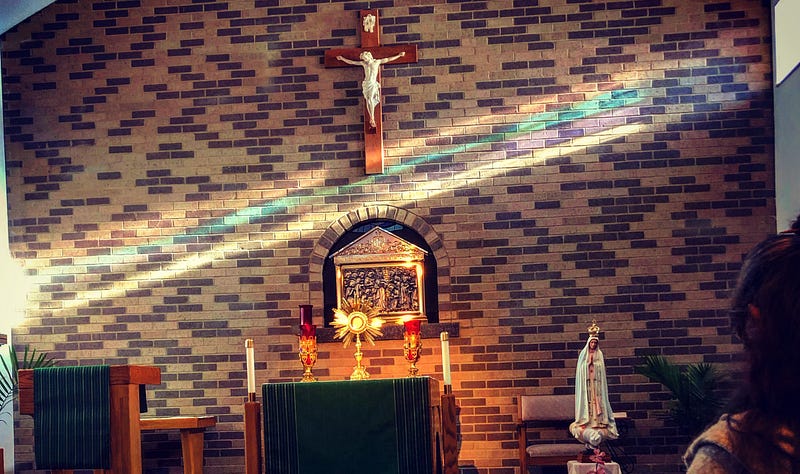
Our chapel during Eucharistic Adoration. Photo by Joseph Serwach.
Satisfy the Hungry Heart
Catholic questions have one answer. Why so much suffering? Why don’t more go to Mass? Why so few personal relationships with Christ? Why do some leave — or stay and tune out?
Most “Catholic questions” can be answered in two words: The Eucharist.
A recent Pew poll shows only 28 percent of U.S. Catholics BELIEVE church teaching about transubstantiation, the real presence — the core teaching of the Church, the one big thing differentiating us from Protestants.
You can’t love what you don’t know. As Fulton Sheen said: “The Greatest Love Story of all time is contained in a tiny white host.”
We are what we eat — and eat what we love: The average American swallows 35 pounds of cheese per year per person, triple the amount we ate in1970. We try to “eat healthy,” but a record 100 million Americans are obese.
The Greatest Miracle Meal ever? For nearly every hour of every day for the past 2,000 years, priests have transformed bread and wine into the Body and Blood of Jesus Christ.
N.Y. Times thought the Eucharist was a statue…
Even The New York Times missed this story: When the Notre Dame Cathedral caught fire during Holy Week 2019, priests ensured they saved “the Body of Christ.” But unfortunately, the Times misidentified the Body of Christ as “a statue,” not realizing Catholics place a higher value on little pieces of bread that literally become the Body of Jesus Christ than all our artwork and statues.
Catholics can do something Jesus’ own Apostles could not do before the Last Supper: consume His Body and Blood to have Jesus within them. Believing that the Eucharist is the Real Presence of Christ is the main difference between Catholics and the rest of Christianity.
Protestants speak of interpreting the Bible literally, but they seem less sure about whether Christ was being symbolic or literal in this tradition that was undisputed by Christians for more than 1,500 years after his death and resurrection. Bishop Robert Barron adds:
“The Eucharist is everything, and 70 percent could care less about it.”
The Catechism of the Catholic Church, laying out the rules of the faith, states: The Eucharist is “the source and summit of the Christian life.” Further, “The other sacraments, and indeed all ecclesiastical ministries and works of the apostolate, are bound up with the Eucharist and are oriented toward it (Catechism, 1324).
St. John Paul said, “The Church draws her life from the Eucharist. This truth does not simply express a daily experience of faith, but recapitulates the heart of the mystery of the Church.”
This daily miracle is so central to Christianity that Christ Himself personally frightened away many of His early followers by stating: “Truly, truly, I say to you, unless you eat the Flesh of the Son of man and drink His blood, you have no life in you.” (John 6:53).
Jesus becomes bread and wine, adds Catholic author Christopher West, because “God wants to feed us and be inside us, to fuel us. It’s a sign of His humility and mercy that He becomes mere bread.”
While Jesus says, “This is my body that will be given up for you,” today’s abortion movement mirrors Christ’s language arguing for what Peter Kreeft calls a “demonic parody of the Eucharist,” parroting the words of the Eucharist in a blasphemously new version of the same vow: “This is my body, my choice” to accept or reject a new life, a gift from God.”
Food is a love language.
FOOD is one of God’s love languages, according to Catholic author Emily Stimpson Chapman, who loves feeding visitors to her home. The modern world, full of incomplete half-truths, may claim “food is just food,” something we consume for energy and pleasure. Still, if so, Chapman asks, why did God give us so many different things to eat in so many different ways with various looks, smells, textures, and tastes?
God gave plants the ability to get all the nutrients they need to survive from soil, and the sun and could have done something similar for humans, she notes, but instead, God introduced us to a never-ending stream of new foods and drinks to look at, smell and taste.
She added: “Food is one of the ways we know God exists and that God is good. All food is a daily reminder of how much God loves us… The most intimate communion I have with God? I eat Him.”
Chapman’s former neighbor, Catholic theologian Scott Hahn, laments that most Americans “have more faith in Tylenol than the Eucharist,” certain a little pill or capsule will relieve more of their aches and pains than the body and blood of Christ. But Chapman reminds herself what God told St. Catherine of Siena: “I am He who is, and they are they who are not.”
Water into blood, water into wine, and wine into blood. Consider these three Biblical miracles: Moses turned water into blood in his first miracle (Exodus, 7:14–25), while Jesus’ first known miracle was turning water into wine.
In Jesus’ Greatest Miracle, Richard Hass explains Jesus took these earlier miracle stories full circle: turning wine into His blood. This miracle continues to this day so that we may have life within us. “For the law was given through Moses; grace and truth came through Jesus Christ.” (John 1:17).
You are what you Eat
You are what you eat and do. Lay out with the sun worshipers on a sunny afternoon, and your skin will warm and (within a few hours) grow tan (or perhaps red, brown, or some other interesting shade). Watch someone yawn, and you are likely to yawn as well. A similar internal and spiritual transformation seems to occur when Catholics expose themselves to the Blessed Sacrament.
A growing number of Catholics are reviving Eucharistic Adoration, a more than 1,000-year-old practice where a priest places a sacred communion host in a monstrance for others to be near. Our friend Jamie wisely says you can measure the faith of a priest by how reverently he treats the Eucharist in Mass.
A growing number of priests worldwide are reading the bookIn Sinu Jesu, based on the answers a monk heard through several years of prayer starting in 2007.
“It is in the Eucharist that I wait for them as physician and as remedy. If they are sick in their body or in their soul, let them seek Me out, and I will heal them of the evil that afflicts them,’’In Sinu Jesu (p. 14)…
“Even after 2000 years of Eucharistic presence in My Church, I remain unknown, I am forgotten, forsaken, and treated like a thing to be kept here or there with little regard for My own burning desire to be present to My people…. I am here — really present — available to you at any hour of the day or night… Trust in Me and I will act. I have told you this before: for Me, nothing is insignificant, No detail of your life is too small and no sin of yours too shameful to be brought to me to be abandoned at my feet… I am the Lord of all things in heaven and on earth, and to Me, nothing is impossible.’’ — In Sinu Jesu, page 97–100.
Happiest day of John Paul’s life. St. John Paul called the day he made St. Faustina a saint, in 2000, the happiest day of his life. St. Faustina’s diary is 700 pages of conversations between a humble nun and Jesus. A key passage on the Eucharist:
“… eternal life must begin already here on earth through Holy Communion. Each Holy Communion makes you more capable of communing with God throughout eternity,’’ — Jesus to St. Faustina, (Diary, 1811).