
Satire, Freedom, Irony & Us: Replaying Grand Theft Auto V
Featuring Aaron Suduiko of With a Terrible Fate
This article was originally published on Wonk Bridge
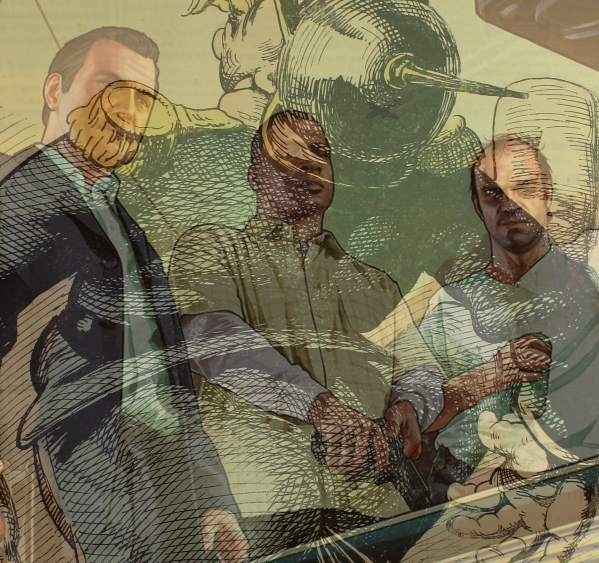
There’s a discussion to be had that Rockstar Games’ Grand Theft Auto V is the most indicative and seminal entertainment product of the 2010s. Its achievements are legion, both tangible and abstract, PAL and NTSC; as much of its gold is in the air of the mine as in the seams:
- It’s the 3rd top-selling video-game of all-time, and the best-selling narrative oriented entertainment product of all-time, with 110 million packaged and individual copies sold worldwide and over $6 billion in revenue accrued.
- It spawned one of the most rabid online modding sub-cultures ever to spring up around a narrative-oriented game
- Most abstractly of all — and this shall prod the asp of our argument — GTA V apotheosised, via the vast popularity of the product itself, the series’ pursuit of its unmistakable moral philosophy, to the point of cultural latency, in which it through its size it gained the ability to affect and entrench the attitudes it presents as much as reflect them. The real-world imprint of events like Gamergate, which sprung up in the wake of this leviathan, are so real that one of the principals in that saga, Sargon of Akkad a.k.a Paul Benjamin, is now a noted figure in the UK Independence Party.
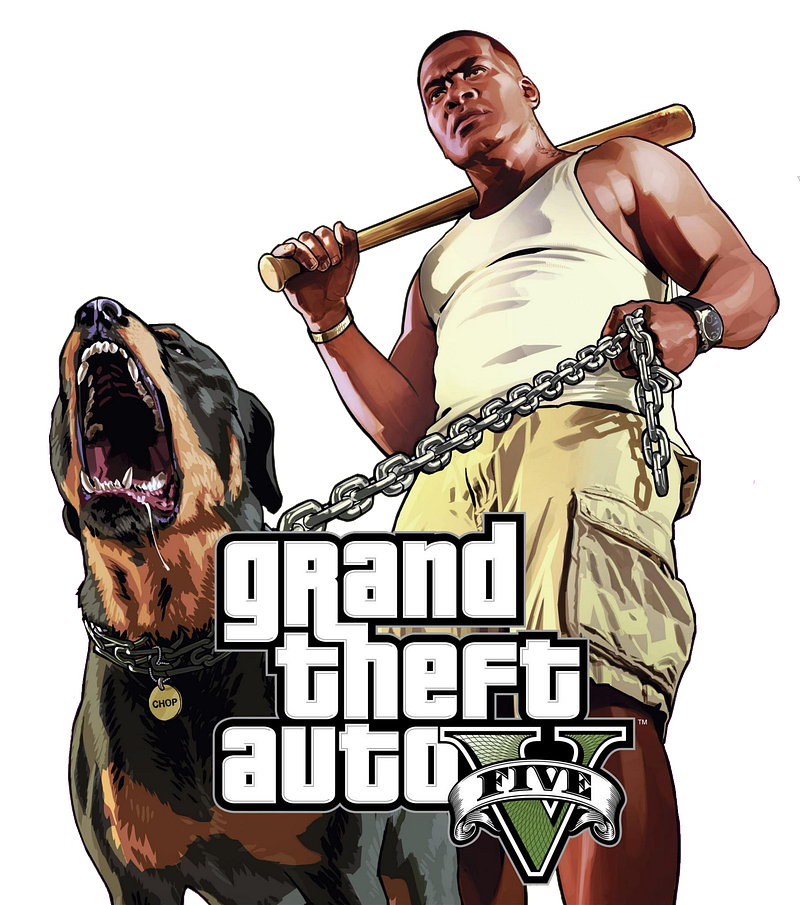
And Grand Theft Auto V’s plethora of connectors to the collective life and times of the 10s does not end there. It nurses any number of additional babes of the decade at its Los Santosian teat.
There are those aforementioned mod communities, which in and of themselves give a fascinating account of the way in which, in the 10s, the internet guided the once-per-generation migrations of young creativity into an environment entirely cloistered and abstract.
Then there’s the fact that it’s the highest-profile game to be linked via Gamergate to gaming culture’s much-maligned underground, that unseen and much-storied land of Prester John, with all of its movements otherwise associated pejoratively with apathetic strains of masculinity (the alt-right and anti-feminism through Benjamin etc.), and in an era in which those exact masculine stereotypes came under such pronounced scrutiny within the #metoo movement.
Some of the concepts to which it can be credibly related are simply too confounded by sludgy conjecture to explore seriously — at least as far as my abilities go — but Grand Theft Auto V nevertheless was wise to the winds of a tumultuous decade, a decade in which the living had reasonable cause to envy the (seemingly) sancrosanctly scripted and the internal order of even this most lawless of great franchises. In what it depicts, in what it stimulated and enabled, in the way in which it bore irony to its point of apotheosis and veritably created a working model of internet polity, GTA V told, and in some cases foretold, key chapters in the story of the 2010s.
Is Satire Dead?
Max: Do you think that satire is dead? Or “what do you think of the state of satire?” is probably a less leading question. The picture I have in my head is, if it is true, the notion that satire has its intended effect only on a reasonable audience. If the audience become sufficient polarised, aggrieved and extreme in and of itself, then satire loses its space to be effective. Do you think that accurately represents the decade we’re starting to see the end of?
Aaron: It’s funny…I’m not sure of the root cause, but it is interesting to think about, though I’m putting it simplistically for the moment, that parody — politically charged parody, the kind that anyone would care about — is so challenging to a polarised, quick-to-offend world that the gut reaction many people would have is simply to be offended in a very non-reflective way, and not take the further steps to wonder, for example “Is this show trying to offend me? And if it is, why would it be doing that?”
Within the cyberdomain, I see this all the time: septic comment sections of any nature [in which] people will get dragged really quickly into pissing matches between simplistic doctrines, and this will be decisive over any kind of critical inquiry parody could be prompting.
Irony is a creative urge as well as an emotional response…
Imitating to parody, or imitating to exploit? Two cousins of abundant visual similarties — complete similarity in some cases, including many of the most and least artistically accomplished works of parody— and the lack of clarity as to which of the two we are engaging with is rooted in a 10s cultural procession in which Grand Theft Auto V is bound up, though the game neither encapsulates nor self-consciously appears to depict it: the running out of a generational lease on the form that is satire.
As per Betteridge’s law of headlines (which, it should be noted, does not always extend to subtitles), the answer to the concerned moniker of this section is “No,” satire is not dead, but it’s certainly possible that its usefulness may have expired in the present generation (or perhaps that it’s living on in some symbolically indicative Dantean limbo). Grand Theft Auto V, in popularity and the extremity of its pursuit of satire, offers us a sweeping proving ground for this grand hypothesis. Its relation to satire, and what it suggests about general social relations to the form, are its clearest comment on the decade in which it emerged.
Postmodernism, which according to certain birth certificates is now older than universal franchise, rode in on the promise of disestablishment. In its steadfast opposition to grand narrative, in its preference of sophist’s logic owing to said logic’s theoretical ability to prevent the continued oppression of out-groups, irony was its principle weapon, and by the principles of intellectual osmosis, the postmodern creed originally espoused by _______ [1] has found itself reigning further and wider with each passing decade in the domains of popular art and entertainment. Even “safe” forms of entertainment were to be adjudged by their capability to subvert, tear down old and avowedly useless bourgeois ideas — to challenge at all times.

There comes a point, however, where no more tearing down can be done, and to repeat that Lewis Hyde aphorism so beloved of David Foster Wallace, himself an inveterate ironist (the irony [2]), “irony [becomes] the song of a bird that has come to love its cage.” It becomes toxic matter, making land freed of prior superfluous real estate unfit for future use, its inversions of meaning so numerous and subjectivised (and so so open to manipulation) that irony itself, by being so self-directed, begins to crucially obstruct reconstruction and proper communication, instead of helping to deliver it.
And if we boot up Grand Theft Auto V and hear now the songs of prisoners in jolly confinement, then it may because, in taking the blueprints of its predecessors to the following logical extreme, it may have encountered a key contradiction, as “we” might’ve as the peoples of this decade: that GTA became the hypocrisy, or part of the hypocrisy of Western moral standard, it was originally intended through ironic means to disparage and explode.
At some stage in one’s embedding within an ironic mode of (non)-belief, through the ease and notional “ neither-here-nor-there” freedom it offers, the mere performance of certain key features of the human estate — passion, convinction, engagement, all that — becomes infinitely more appealing, even more worthwhile seeming, than the sacrifice demanded through actualising them truly. If we are to shortly get to the first way in which Grand Theft Auto V resembles the internet, then this is the way in which it also resembles the internet which must be ranked before the first.
Grand Theft Auto V: A Wi-Fi Stagecoach & the New Frontier
The first way in which Grand Theft Auto V resembles the internet, whose cultures it supposedly reflects, is that it is beautiful. The otherworldly beauty of the internet as a concept is scarcely conceivable among the cacophony of its many competing utilities and the occasionally homely and defaultedly untouchable nature of its interface.
Los Santos is how the internet might look were it a sensorily immersive interface — a landscape conforming to reality while also being pleasurably surreal in its degree of hyper-realisation, temperate pushing towards the tropical in general climate but not so much that it incurs any users’ serious discomfort, in which anything imaginable is a possibility (and then some). Indeed, GTA V could not be our decade’ seminal cultural article, were it not potent as a metaphor for the use of the web by the later-generational Millennials:
- A free zone in which the degree, type and richness of engagement is entirely contingent on the user’s/player’s desire. A New Wild West, governed not by rule of force but rule of consumptive appetite.
- Use of reflexive ironies as sales techniques, sales-techniques-that-are-not-but-nevertheless-still-are: like a satire of in-game phone-culture that still doubles as an advert for the beauty and utility of phone-use
- A space that can only be notionally policed, a sandbox world whose allowance of violence demonstrates that violent, depraved conduct is one result of an imposition of no limits whatsoever (that turns the average web user into Trevor, in essence)
Sandbox technologies, of which social media is one every bit as much as an open world game, tend to relay everything as metafiction, often to such a vertiginious degree that one begins to feel nauseated by the number and speed of the reflections. Grand Theft Auto V depicts your life as it might be under the most outrageous circumstances, and thus it is false, although it being reflective of a truth in the player’s personality (generally masked by at least a notional compassion) must reprove this falsehood, making it true and not etc..
In the sandbox, the ‘true’ self then begins to move in order to give service to the curated self, who is without many exceptions a cruel master — the likes of Instagram gives its orders in the form of curated behaviours (in which the real individual modifies their behaviour to get closer to the constructed ideal). Grand Theft Auto V makes its demands via its intoxicating simulation of a freedom from fear and moral need, which it has always prided itself on providing. Given a moment, perception easily turns one’s happy conception of a given medium’s infinite possibilities into the anxiety of something completely without law, in which your appetites are given cause and means to stake their claim on you.

Such unfettered freedom, and the desire for it to be shaped to cater more to the user’s personal taste, is one catalyst behind the astonishing world of GTA V mods. The modding community — which for the uninitiated involves deliberately modifying the game script in order to produce a more customisable result, for the sake of online commentary or multiplayer — wears a lighning-vibrant coat of colour. Whether the results are amusingly inane, cinematic and eschatological, or grisly [WARNING: includes violent CGI content], they are unabashedly so.
Grand Theft Auto V’s modding community must by some distance be the most prolific and varied for an ostensibly narrative-oriented game, and demonstrates the undoubted latent positives of both the sandbox conceit and the ironical (and so appropriate, in this case) concept of playing a game other than the one you actually bought, remade via your own hot-wiring.
And it tells of another tale, one alluded to in-game, of the ultra-immersive video-game as Plotinus’ retreat — of a real world that is, burnished to an indeterminate degree by perceiving it as such, in unsaveable misdirection or else in flames utterly, in which the only sensible action is retreat into an otherworldly realm in which our comfort is sensible and the laws, though extreme in certain ways, are our own to set [3]. It is not merely a factor of the player-owned-and-administrated modding community — it seems to be shared within the game proper’s philosophy, too.
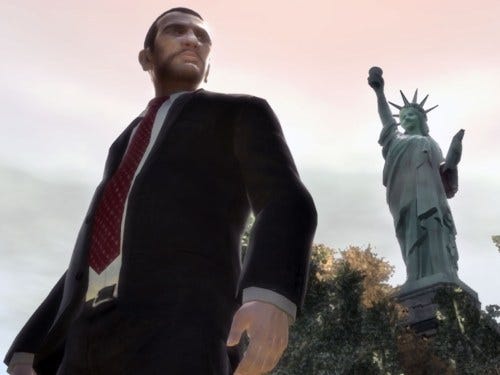
One way in which Grand Theft Auto V followed a prevailing theme rather than predicting or scouting one is in its cynical presentation of post-Recession capital. Grand Theft Auto IV, developed prior to the Great Recession and prior really to the deleterious connection in the collective imagination of the aggression of neoliberalised capital to its exploitative tendencies, was notably ingenuous in its assertion of the basic principles of the American Dream. It had a bent towards the redeeming virtues of wealth such that Adam Smith, the Progressives and Cheneyan exceptionalists all might have found themselves nodding in vigorous approval with it (before they noticed its disdain for good Christian virtue, of course).
Grand Theft Auto V animates, quite explosively and immersively, the counter-theme that has resounded so much more tiresomely, though truly, from the 12-inch barrels of so many mounted thinkpieces and raps of the 10s: that money has no intrinsically redemptive power. Michael finds that no heist can part his weariness, or fulfill his relationships with his family; for Franklin no amount of ill-gotten gain can refine the acquisitive forward drive which seems to be his only means of relation to the world into some more worthwhile emotion. To borrow an old saying from a colonial bygone, neither of them leaves from port with the wealth of the Indies — neither of them can fairly expect to return with it.
To continue our grand theft orato by taking Ryan Hollinger’s estimable engine for a spin, it is that GTA V neither couches itself in rags-to-riches optimism, nor steers itself via the unflinching solidarity of the social realist approach (the two most common modes of reaction-through-culture to times of leanness and depression), and rather seems to make a concession of the lack of worthwhile worldly pursuit and the value of imaginative escape elsewhere, that marks it uniquely of our decade.
Aaron: Make believe comes of nothing, wouldn’t you say? You can see mods and similar acts as a differing iteration of the creative urge, not coming of nothing per se, [but] deeply responsive to another statement or creative act that came before it. They’re following the creative urge for a means of self-actualisation, but following it too to respond to and push against that which you encounter in various aspects of your life, or consumption.
Max: I think you’ve put your finger on something there, and I use that expression quite deliberately. I think something that will be more considerably remarked upon with the process of hindsight is the sensory aspect to this. The fact of building a Lego house or a soup-serving initiative in a neighbourhood has a tactile communicative quality to it that intrinsically relates it to a world beyond the act itself — it’s difficult to lose yourself to a deleterious extent within it. To lose yourself and exclude yourself within a non-tactile interface, owing to the intoxication of creativity immediately actionable through it, is to agree to a contract of distance from other actions. And I think we’re only beginning to see the potential negative effects of that take hold.
The censors were wrong when they presumed that our games would send us to the mall or to school with AK-47s in hand and identified that as their latent legacy of greatest risk. What insidious effects our interface-primary culture may yet prove to have will, if they exist, be considerably more subtle in the onset, though not necessarily in the result.
How GTA V (Fore)Told the Stories of Our Decade
If Grand Theft Auto V is in fact a parable, intended or not, of the internet, then it is a fundamentally pessimistic one, of an enthusiastic partisanship against humanity in general. Its internal reasoning is made of up of narrow and stodgily adhered-to precepts (“get money = get power”, “relationships and moral exchanges are to be judged on behalf of their transactional value only”, “equivocation and reflection assert weakness”) and mixed with a general hopelessness and lack of curiosity towards the other, hence the many one-dimensional decorative characters in the game world that seem designed for no reason other than to attract the player’s ire. The exact same reduction, in other words, as one would undergo when experiencing a genuine turn against humanity.
The universal disgust Grand Theft Auto V seems to feel for the human spirits it renders is notably exact in the way it pre-emptively mirrored the tide of public sentiment in the West across the 10s about “people”. It is also notably the opposite of the series’ most warm-bodied installment, San Andreas, whose setting it shares and whose portrayal of a South Central familia was handled with neither reactionary judgement nor the patronising excesses of liberal generosity — its lone truly abject moment bewildered in its dissonance against the game’s tone, as it expressly exploited the wanton attitude towards evil that the remainder of the narrative, crime and bloodletting aside, tended to abjure.
We of the 10s are a people of many value dichotomies — those among us who do not carry these conflicting, incompatible and unpleasant cross-purposes of principle will know many who do. Grand Theft Auto V depicts many of those dichotomies, and not all that many of those it depicts does it depict with scholarly distance. Some of them it seems to relish.
Grand Theft Auto V, Trump, & Selective Humanity
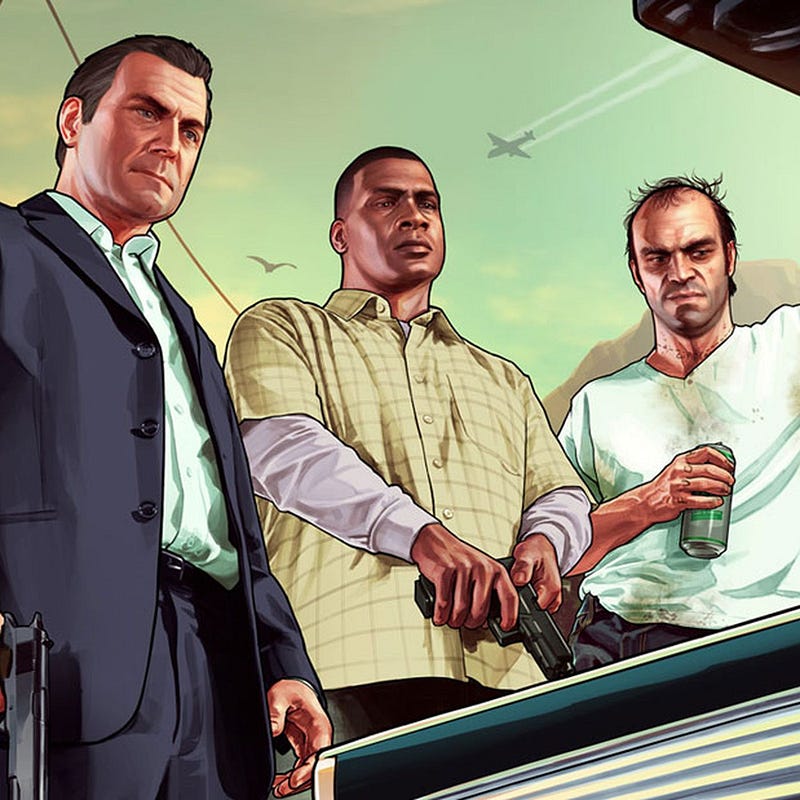
In its broad repulsion from the human estate, Grand Theft Auto V possesses a selective humanity mirroring that which has taken hold in the Early Digital, the same kind of suspicion (or superstition, if that were a truer word) of the motives of others that pervades until eventually solipsism gains influence in the house and the only company one can bear is one’s own and that of an in-group that satisfies one’s prejudices. A humanism, notionally speaking, but a humanism of one. The other is to be ignored, run-over (literally) or sold to. The most militant and well-adapted personality type in this kind of arena is the huckster, the thief who uses a bank and briefcase, which perhaps not incidentally is a summative profiling of the present president.
Curiously, on that same note, Grand Theft Auto V even seems to invite its players to extend that same mistrust to its avatars: for their actions, for the fact of their motivations not being commensurate relative to those actions, and for their cruelty, we are invited even to hold our ‘heroes’ in contempt. Their respective lack of ‘character’ proper is of no presumed interest to the gamer who merely wishes to exploit their value as Virgils in this rendered under/overworld. “Some people are people more than others”.
Grand Theft Auto V, Early Digital Irony & the Noble Misanthrope
Like the decade’s deepening bank of deep greens, its black-bloc ANTIFAs, its fashes of either persuasion, its Jimmy de Santas and its Sargon tankies sheltered by their commentariat avatars, all of whom are generally repulsed by both human force and human tenderness, Grand Theft Auto V sees misanthropy as an aim that, if it is not noble, is at least worthwhile. Its supplicatory negotiation of racial politics, on the other hand, suggests that it sees selective bias based on demographic factors as something base, appropriately enough [4].
Like the decade itself, Grand Theft Auto V has lost track of satire by letting itself be ruled (or consumed, if mere rulership is not dramatic enough for you) by the ironies that provide skeleton to its themes. It occupies the inanity, tendency to exploitation, leisurely violence, alienation and paranoia it aims to satirise so completely that its satirical and ironical bent is indistinguishable from what might easily be the intent to simply exalt in these things, for their shock value, their sensation, and their currency in the public imagination. It certainly doesn’t bristle against the circumstances it depicts, as its brother (and sister?) installments have done markedly.
This kind of irony, in which one criticises a position while occupying an identical or equivalent position, is a curiously prevalent kind of irony, not unique to the Early Digital era necessarily but certainly definitive of it. It must rank among the most by-definition useless variants of ironic stuff available.
Grand Theft Auto V & Misogyny

With particular egregiousness (and with commensurate use in the collective debate about such things) GTA V is denotative of at least one side of one of the decade’s most theatrically vaunted debates; the status of the Western woman and the misogynstic content of the current social voice. I say ‘theatrically’ not to undercut the seriousness of the extent or matter of said discussions, but rather to emphasise the degree to which said discussions have often been based on a certain performed feminism, not a lived-out one that is willing to sacrifice on its principle’s behalf.
Much like the culture of contemporary hip-hop, Grand Theft Auto V holds properties in both the kinds of misogyny the West seems willing to tacitly permit so as to not risk causing collateral offence (or obstruction of pleasure), and those which it is proud to take a stand against. This both-sides carpetbagging is reflected inanely in the feminised aspects of the Los Santos universe depicted “satirically” (along with everything and everyone else in it), and, more affectively to the storyline, in the form of the dearth of notably functional female characters.
To criticise Grand Theft Auto V for being notionally ‘testosterone-drenched’ or ‘male’, which it is, is a weak point by itself, especially as its hatred is so much more pervasive than that, but perhaps not so weak with respect to our other point above — that, under its “fuck everybody” galoshes, GTA V doesn’t feel the need to specify whether or not it argues for what it shows, or whether or not it was designed to exploit just these ills.
Certainly, with respect to Gamergate and the harrassment of Quinn, Sarkeesian & Wu — who, in risking ridicule and criticism on such a scale as to be almost terroristic, turned courageously to face the worst punishment known to an era of civilised irony — we can see the work’s freeform approach to moral conduct, and out-group hostility, drafted from the game itself onto external, much more reality-affective social channels (Twitter, in this case).
Simply a Game
Though its portrayal of humanity seems not altogether inaccurate (it’s safe to wonder how many of us have come to resemble poorly developed characters in a second rate Hollywood plot), the world as depicted through this game’s satirical clutches seems oriented around a plea of desperate misunderstanding. Perhaps this frenetically colour-saturated muddle is the clearest reflection we can view while attempting to use the shiny shell of Grand Theft Auto V’s carcass in order to try and see ourselves.
Where ironic reflection stops and amoral suggestion begins to enforce is an impossible line to map definitively, much as it is something unique to each one of the hundreds of millions who’ve played the work — but it is hard to deny the wealth which Grand Theft Auto V contains, and how thoroughly its glowering gyre contains so many currents that would come to direct the decade that mostly succeeded it, in which technology of at least the most notional brilliance conveyed to us partisan tidings, open-return cyber-retreats for one-and-one-only, and the carcass of our old irony-oriented method of gathering and proving knowledge to ourselves, in which, frankly, who knows what is knowing?
Beyond that, I have neither the grounds nor the instinctive desire to extend the tone of this criticism to Grand Theft Auto V as a technological achievement, on which its considerable cultural cache rests in self-evidence. The game is as full as the internet it supposedly emblemises, and as empty as our common use of it.
This article is a prologue to Wonk Bridge’s coming series offering a retrospective of technology in the 10s. Follow us for more
[1] This omission is intended, and is a somewhat self-conscious nod towards the fact that having no nucleus of organisation or policy-origination was a key part of postmodernism’s radically democratic ethos.
[2] It should be said that David Foster Wallace is something of a Saint John of the Cross, or maybe a St. Augustine, when it comes to irony as a prevailing cultural mode, so prodigiously did he employ it, and yet so often did he expressly appear to be trying to vault beyond it, into realms of more unobstructed or composited feeling. His struggles with it, not only as a literary paradigm but as a mode for living, strongly vouch for the central thesis of this article: that the art we pursue for meaning is both reflective and affective of us in the sensibilities it inspires.
[3] Gaming disorder is a recognised condition, to be neither under- or overstated in its severity; as with any other activity design to stimulate the brain’s reward circuits and release dopamine, a true excess of gaming activity can physiologically “turn off” the brain to more tactile pleasures and interests. It’s unlikelihood of turning your life into Harry Goldfarb’s is no reason for its dismissal outright.
[4] This “supplicatory” approach ends up actually being radical in its way, as Franklin is completely free of any sense of pride in the practice of gangbanging he initially pursues. His is a class-oriented aspiration to be fulfilled through crime, a departure from the tendency for gangster characters to be self-consciously mythologized within or beside the scope of their narrative (despite the counter-fact that virtually every notable black denizen of Los Santos depicted is nevertheless in some way associated with crime).


