
EXISTENTIALISM
Sartre: The Integrity Switch
The theory of Bad Faith, and what it means for work and relationships.
That sinking feeling. You know you shouldn’t be doing this, but you are doing it anyway. You have no choice — at least for now — you reason to yourself.
But that feeling persists — what if?
Jean-Paul Sartre believed that thanks to consciousness, human beings are free to make choices about their lives. In every waking minute of the day we are faced with possibilities that ultimately determine what becomes of us.
Sartre wrote, “man is nothing else but what he makes of himself.” Every moment of the present presents choices to make our future.
But Sartre knew that freedom — real freedom — terrifies people. We hate choice when it’s truly meaningful. I can happily browse rows and rows of shampoo bottles in a store, that’s easy. But what I do with my life? That’s hard.
When we act in what Sartre called “bad faith” (“mauvaise foi”), we indulge in habit of deceiving ourselves into thinking we don’t have the freedom to make choices. This is because we fear the consequences of doing what we really want to do.
We make ourselves part of a system, going with the flow, and place ourselves at the mercy of the circumstances we placed ourselves in. Bad faith is a mode of character that we hide in to preclude meaningful choices.
It saves us from the short-term pain of making a difficult choice but gives us a long-term feeling of guilt. We are buying time from choice with bad faith, but losing the time to live as we would want to. We pretend to have an essence like a passive object — like a machine, subject to the laws of cause and effect, rather than a conscious human being.
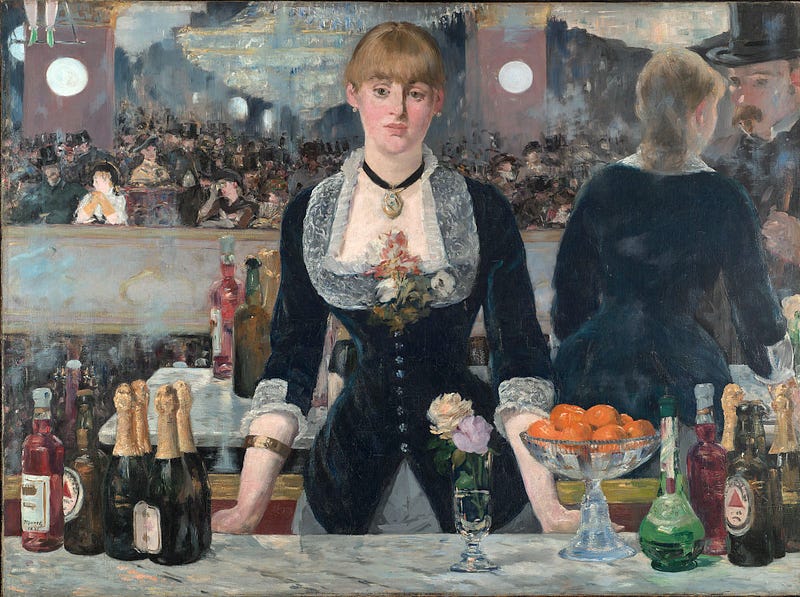
Sartre used the example of a waiter he observed in a café. The waiter acts out people’s idea of a waiter. He chooses to make a machine of himself through the spectacle of his behaviour. Sartre describes his behaviour as being like an automaton, being the waiter that he assumes people expect him to be.
The waiter, according to Sartre, is,
“Trying to imitate in his walk the inflexible stiffness of some kind of automaton while carrying his tray with the recklessness of a tightrope walker by putting it in a perpetually unstable, perpetually broken equilibrium which he perpetually re-establishes with by a light move movement of the arm or hand. […] He is playing at being a waiter at a café.”
Bad faith is very common, especially when people conform to an idea of what they think they should be. But in doing so they are freely choosing to lie to themselves about the possibilities they can freely choose.
Sartre wrote, “What the public demands of them […] they realise it as a ceremony; there is the dance of the grocer, of the tailor, of the auctioneer, by which they endeavour to persuade their clientele that they are nothing but a grocer, an auctioneer, a tailor.”
We take on these guises because of social and economic expectations (either perceived or real) to conform to ideas of what we are, rather than embracing our freedom to be however we may want to be.
“Society demands the [the grocer] limit himself to his function as a grocer, just as the soldier at attention makes himself into a soldier-thing.”
To act in this way is a perfectly legitimate way to lead your life, but for Sartre it is inauthentic. Living in bad faith is living out an excuse and the feeling that we’re not acting authentically will follow us around.
The unhappy waiter reasons to himself that he needs the money, it’s just reality, he doesn’t have a choice. But there will be those moments of what Sartre called “negative ecstasy” when the waiter will know he is wasting his life.
Professionalism
In our relationships we are accomplices in bad faith. Take “professionalism”. What does it even mean to be professional? If being professional is being respectful, then let’s call it that.
I suspect “professionalism” is really when we use jargon when we can be clear with each other, we don’t get to the real point; when we don’t show emotion or conviction, not really being true to ourselves; when we act out a charade of being that sales rep, that marketer, that accountant or doctor. Is to be “professional” just like being the waiter Sartre describes?
Work matters become proxies for relationship matters, if you don’t get on with that colleague, you could just talk about it, human to human. We instead play petty games over email or act passive-aggressive in meetings, those staged symposia of inauthenticity.
If in acting in bad faith we act as if we are a thing with no consciousness, then it is no surprise if we treat other people as things. People are not a means to an end, they are not a tool to get you where you want to be.
I read somewhere that happiness is knowing that other people know you love them. The more people that know that you love them, the happier you are. Charles Bukowski wrote,
“We’re all going to die, all of us, what a circus! That alone should make us love each other but it doesn’t. We are terrorized and flattened by trivialities, we are eaten up by nothing.”
I’m not advocating going into work and telling each other how much we love each other, but at least treat our fellow human beings with the decency and respect they deserve. To do that is to act with integrity.
By devoting yourself to that career you hate because you “need to feed your family” you’re pretending to yourself that you have no choices, but in doing so you are making a choice. Why not transform that career from within? You cannot escape it. You are, as Sartre said, condemned to be free.
We can choose love, or we can choose to be eaten up by nothing.
Thank you for reading.