
Sapphire’s Mystic Fire: Semitic Roots Meet Psychedelic Visions
Bridging the Biblical and Visionary Realms of Beauty
Proto-Semitic Roots
The word “sapir” (שָׁפִיר) in Biblical Hebrew is the progenitor of the term “sapphire”. Its Proto-Semitic root is špr, meaning “to be beautiful, to shine”. This root is found in various Semitic languages, such as Arabic (“safir”) and Aramaic (“sappīrā”).
The Reverberation of Eden in Sacred Pages
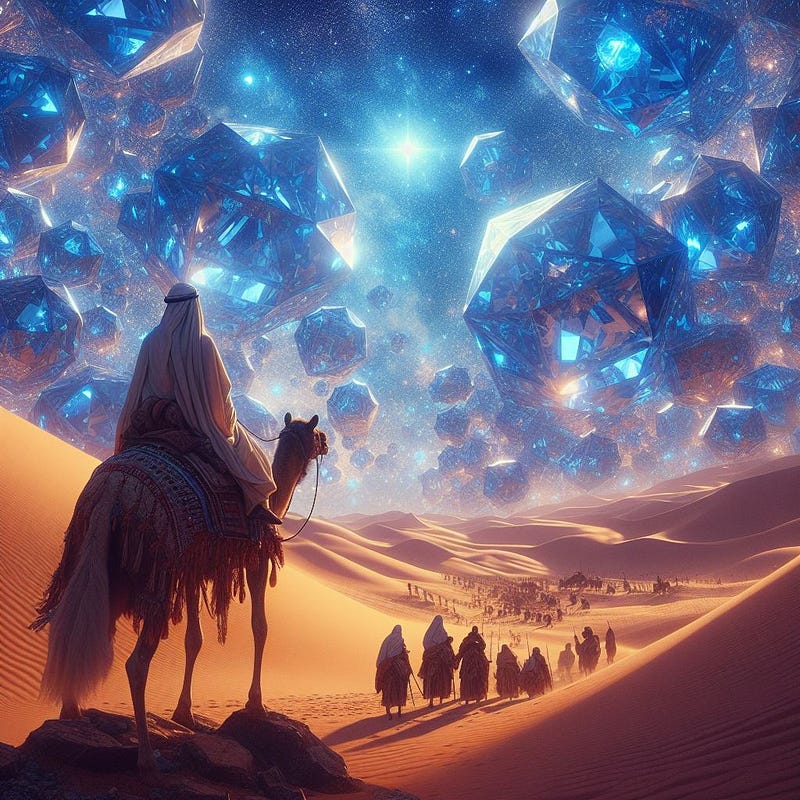
The biblical descriptions of the gardens of Eden echo this idea of effulgentness. The use of Sapir evokes the transcendent splendour of a realm where “stones and mountains shine with blinding beauty”. Here the inner light seeps through matter, a foretaste of the mystic visions of archetypal worlds studded with crystal trees and liquid gem rivers.
Unveiling the Azure Gemstone in Scripture
The word “sapphire” adorns the pages of the Bible, gracing its readers with its celestial blue brilliance. This precious stone, mentioned in both the Old and New Testaments, is often used as a symbol of beauty, brilliance wisdom, and heavenly glory.
Exodus 24:10:
“And under his feet was as it were a paved work of a sapphire stone, and as it were the body of heaven in his clearness.”
This verse paints a vivid picture of God’s majesty, with the sapphire representing the purity and splendour of His throne.
Exodus 28:18:
“And the second row shall be an emerald, a sapphire, and a diamond.”
The sapphire is included among the precious stones adorning the breastplate of the high priest, symbolizing the divine wisdom and guidance bestowed upon him.
Job 28:16:
“The topaz of Ethiopia shall not equal it, neither shall it be valued with pure gold.”
The sapphire’s value is extolled in this verse, highlighting its rarity and preciousness.
Ezekiel 10:1:
“Then I looked, and, behold, in the firmament that was above the head of the cherubims there appeared above them as it were a sapphire stone, as the appearance of the likeness of a throne.”
The sapphire’s association with the throne of God is further solidified in this verse, underscoring its celestial and heavenly nature.
Revelation 21:19:
“And the foundations of the wall of the city were garnished with all manner of precious stones. The first foundation was jasper; the second, sapphire; the third, a chalcedony; the fourth, an emerald.”
The sapphire is one of the twelve foundation stones of the New Jerusalem, symbolizing the eternal and glorious nature of God’s kingdom.
Incandescent Memories of a Primordial Fire
These cosmic visions are not mere fancies but reflect an ancestral memory of the incandescent origins of the universe. As Heraclitus foretold, in that primordial age “this cosmos was but a raging fire”, an era when matter and energy danced undivided. The gems hidden in the earth’s depths hold memories of these stellar origins when every atom was a spark of the original cosmic conflagration.
The Kaleidoscopic Play of Light and Shadow
Beyond illusory separations, the phenomenal reality is painted as “a play of consciousness, an eternal dance of light and shadow”. This mystic vision of creation as a kaleidoscopic interplay of lights and shadows resonates with the Talmud conception:
“We do not see things as they are, we see them as we are.”
The Diamond of Primordial Consciousness
In this eternal dance, šāpîr is the diamond that cuts through illusions to reveal the sacred embers burning at the heart of every being — the living light of the Eternal Present that permeates all superficial divisions. Its adamantine brilliance guides us to rediscover ourselves as sparks of that same primordial cosmic pyre.
The Ardor of Mystic Union
This awakening to the inner light culminates in the mystic ecstasy described as “the extinction of the ego to reunite with the All”. It is a state of spiritual ardour, the Hindu tapas, in which all duality dissolves into an ecstatic union with the Absolute. As narrated by mystics of every latitude, it is the experience of merging into an ocean of cosmic bliss, the ego dissolved in that primordial flame dancing in the void.
“The Self and the Sun Are One”
Beyond the veils of name and form, there is nought but “the fire: creative and consuming flame of pure awareness”. This image of the primordial fire as the ultimate essence echoes the ancient gnosis: “The Self in human beings and the Sun are one”. A vision that unveils the illusion of separations, transcending the different planes of existence to realize the unity of life in the eternal presence of that single flame.
The Warp of Divine Light
In this eternal cosmic play of Maya (illusion), there is no distinction between forms — matter and energy are the warp and weft of a single divine tapestry. A tapestry woven by creative imagination with the threads of light of the One Being, intertwined to generate endless worlds. Šāpîr is the invitation to recognize that primordial blaze giving life to the entire creation — atoms and galaxies, stars and planets — all arising from that single unborn flame.
Huxley and the Gem of Mystic Vision
It was Aldous Huxley who posed the crucial question: “Why are gems precious?”. Behind the value attributed to crystals and precious metals, he glimpsed the same mystic perception of transcendent beauty — akin to that “inwardly seen by those who have the vision”. The uniform descriptions of the paradises of every tradition confirm this vision.
Adamantine Mirrors of the All
For Huxley, every gem is “a faithful portrait of the qualities of the visionary world”. Their crystalline purity reflects the harmony of the All, of which we hold ancestral memory. In an expanded state of consciousness, this substantial beauty re-emerges in all its splendour, dissolving the veils between spirit and matter, inside and outside, self and world.
The Gardens of Eden and the Stones of Fire
In the shamanic visions induced by psychedelic substances, Huxley saw reflected the paradisiacal landscapes of the mystics — “cosmic gardens where stones and mountains shone with blinding beauty”. Fiery gems burned in the Gardens of Eden, projecting their light upon matter — almost anticipating Einstein’s insight that “everything is condensed energy”.
The Veil of the One Among the Many
Beyond the innumerable illusions of multiplicity, warns Huxley, there is only the One — an overwhelming light composing the fabric of Maya (Illusion). Yet this supreme flame of “unspeakable wonder” burns “forever here, perennially now” — the unborn and deathless Sun shining behind all suns, before time. It is that same flame that šāpîr urges us to unveil, burning at the heart of our being.
Quotes from Aldous Huxley’s “The Doors of Perception”
Immersion in Luminosity:
“I looked at the white sheet of paper on the table. It was no longer white. It was a pale aquamarine, luminous with an inner light. It was not a mere superficial brightness, but a luminosity that came from within, as if the sheet itself were a source of light.” (Chapter 1)
Transformation of the Ordinary:
“The carnation petals … were no longer simply colored. They were the luminosity itself, a luminosity that pulsed and vibrated, as if they were made of pure light, of a light that pulsed with a life of its own.” (Chapter 2)
Visions of Aura and Energy:
“There was a luminous aura around each object, a halo of trembling light, as if everything were enveloped in an atmosphere of luminous energy.” (Chapter 3)
Light as Divine Essence:
“Light had become the most important thing in the world. It was the very substance of reality, the only thing that mattered. Everything else was just a shadow, a pale imitation of this divine luminosity.” (Chapter 4)
And…so?
In exploring precious gems like the sapphire, Huxley touches the same mystic chords that vibrate in the inquiry into the Hebrew word šāpîr. Both reveal a vision in which outer beauty is the mirror of a deeper spiritual reality, a reflection of that unborn flame that animates the entire cosmos.
In this interweaving of light and darkness, matter and spirit, šāpîr and precious stones become guides to awakening consciousness to our divine essence — that all-cutting diamond that reveals the sole priceless gem: the eternity burning in the heart of every atom.
Huxley’s descriptions of the luminous aura and pulsating light surrounding objects parallel the ancient symbolism of the sapphire representing the heavenly throne and divine wisdom. The transformation of the ordinary into vessels of pure luminosity echoes the biblical reverence for the sapphire’s celestial brilliance.
In this way, the journey through the etymology of “sapphire”, (Its Proto-Semitic root is špr), and Huxley’s psychedelic visions converge, reminding us that true beauty transcends the material realm, reflecting the radiance of the sacred that permeates all existence. Both become pathways to recognize the eternal light shining within and around us.
What do you think about my article?
Feel free to leave a comment.
Thank you for reading.