Santorini: The Most Beautiful Martyr
From Bliss to Cognitive Dissonance: Roaming through Mythical Atlantis
Voyage Across the Aegean Sea
Ours was only one of the six massive ferries crossing over the Aegean Sea from the port of Piraeus in Athens that day, and it was filled to capacity: 2,500. I quickly did the math and muttered to myself in dismay, 15,000 passengers! That’s a twofold increase in Santorini’s population, in one day!
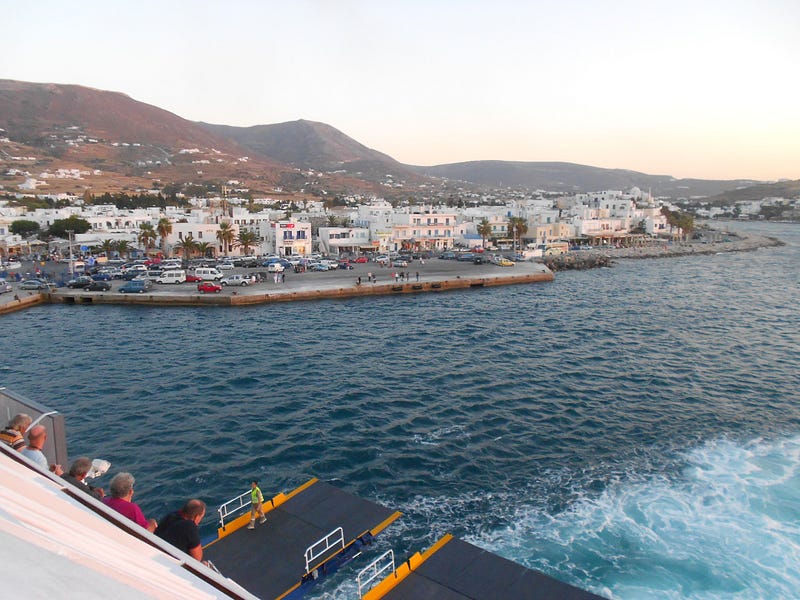
As we made our way past a seemingly interminable string of islands parading before our glistening eyes, we stretched our necks out into the salty breeze of the Cyclades to watch as small groups of travelers casually descended onto the shores of Hydra, Kythnos, Crete, and Rhodes. All along the deck, onlookers leaned against the rail, looking down at vacationers as they finally began their journey, and occasionally made eye contact with one another while smiling in a kind of anticipatory delight, knowing their turn would soon come too.
But as the ferry docked, the scene was drastically different from the fantasy that was expanding in my mind; the previous stops left me unprepared for the jostling crowd that mobbed the shores of Athinios Port, or simply the “new port”, as the locals call it.
Arrival on the Shores of Santorini
Walking down the ramp, there was a sense of bewildered anxiety that I mistook for excitement as I was thrust forward by the momentum of the unyielding crowd. My head was throbbing from the 6-hour ferry that made me sea-sick, and the serpentine road etched into the rust-red caldera was bursting with traffic, reminding me of the painful throbbing vein on my forehead.
At the port, I was absorbed and assimilated by the large blob of squirming and excited travelers as efficiently as The Borg. The ground vanished under a swarm of bare legs; floating above our sweaty foreheads were a range of billboards advertising car rentals and shuttle bus companies, but I could not fathom the logistics that could turn this chaos into the idea I had of a vacation: this did not look like a “getaway” at all.
If you look up the aerial view of the 73 km2 island on Google Earth, the white belt of hotels and residences that line the outer rims of the calderas doesn’t seem capable of containing the surreal overflow we were all faced with, yet somehow it did.
A Brief History of Santorini’s Tourism Industry
Confronted with the aftermath of the 2010 economic crisis, tourism became Santorini’s Deus Ex Machina, helping many of the 25,000 permanent residents stay afloat when most Greeks had difficulty paying their basic utility bills. As we finally made it up the caldera and moved past the traffic jam, I began to see why this island that was once one of the poorest and most isolated suddenly gained this kind of celebrity status.
Santorini was named after the Santa Irini cathedral in the old village of Perissa, but Thera remains its official name. As he steered his beautiful wooden sailboat (aptly named “Santa Irini”) towards Nea Kameni for a guided tour of the 130 meter high volcanic crater, the captain proudly tells me it was previously named Kallístē (pronounced “Kah-lee-stee”),
“It means the most beautiful!”
Visit to the Famed Volcano
Starring at the ominous dark round mass at the center of Santorini’s crescent, the reason for its famed beauty became obvious: the threat that is thought to have led to the decline of the Minoan civilization and that gave birth to the myth of Atlantis still looms. The scorched and barren uninhabited volcanic island is a tribute to the fragility of all life, showing us the beauty that can arise from destruction: Nea Kameni was created by repeated eruptions, the last of which occurred in 1950.
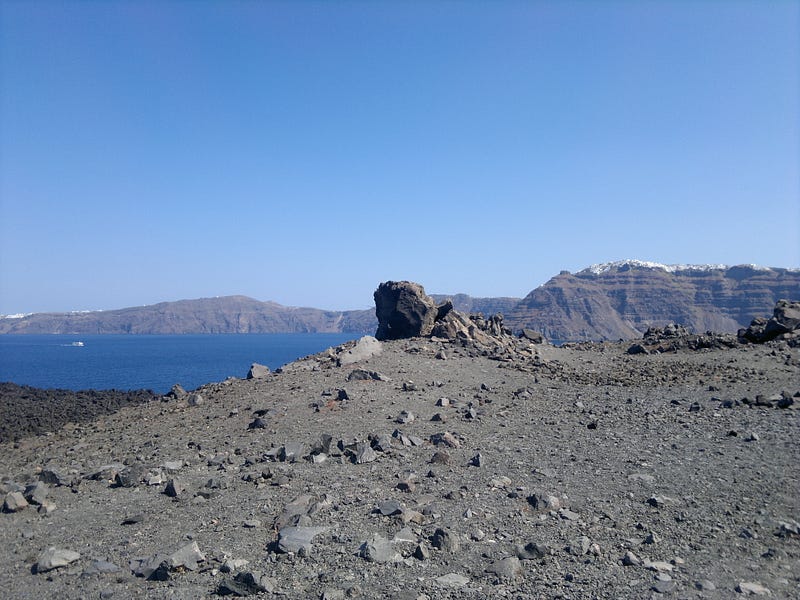
Trekking along the gravelly path that led to the rim of the crater, the many fumeroles (the openings in the earth’s crust that emit sulfur dioxide) and monitoring instruments scattered along the way attested to this looming threat. It certainly is one of the main reasons 2 million of us flock Thera every year, to witness this ephemeral beauty; this is why it saw a 60% increase in visitors between 2012 and 2017. But outside of the obvious financial rewards of the few, this came at a tangible and immediate cost to the majority: traffic jams, overcrowding on streets and at facilities, not to mention an immense strain on local infrastructure.
The Martyr
The island is struggling to provide enough water and energy to all of its visitors, and the lack of proper waste management is an ongoing problem since every plan for a landfill site has so far been rejected by the residents, who understandably don’t want it near their homes. To add to this, there are preventable environmental disasters that bad faith and bad policies catalyzed, like the shipwreck that has been left sitting near the coast for 17 years, leaching toxic chemicals into the sea. This cruise ship named MS Sea Diamond capsized on April 5th 2007, and although all 1,195 passengers were successfully brought to safety, Santorini still hasn’t.
“Be a Traveler, not a Tourist”
That’s the first principle of the Save Oia campaign that the residents of the village-turned-touristic-hotspot launched in an attempt to educate the public about the effects of over-tourism, of the abandon that causes environmental destruction and frustration, ultimately making their home unsustainable. The campaign aims to preserve the village’s cultural identity, its authenticity and values.
A Greek-blue plaque, strategically placed along Main Street, the busy cobblestone corridor in the most popular village of the island, reads
“RESPECT. It’s your holiday…but it’s our home. We welcome you. Please respect Oia”
Cognitive Dissonance
Our apartment was located on the opposite side of the busy inner coastal strip of the village of Oia, which means our view was composed of fields teeming with fruiting opuntias, olive, pomegranate, and figue trees, as well as constant sandstorms blowing into the sparsely populated coast, punctuated by casual backyard chatter of local residents.
On the first few days, this seemed like a problem, and I instead gawked at the strip of extravagant hotels and apartments overlooking Nea Kameni. This is the trait of a tourist, and it took the end of the trip to become a traveler and appreciate the authenticity of my unpopular location.
After four days of buzzing around among mobs of eager tourists looking for photo ops and hand-painted novelties, the reality of it all started to sink in: this sea-side bustle isn’t an occasional sight, it’s everyday life for this small community. In every direction I looked, tourists overtook the scene, overbearing, outnumbering, the mass a landmark in its own right, a testimony of Thera’s unfortunate plight.
I wondered what happened to the peacefulness and civility I saw on my way here, on the Cyclades’ sister islands. Environmental destruction may be blood on the hands of government lacking intervention and poor implementation of policies, but as tourists we must not absolve ourselves from this ‘crime’; we must take responsibility for our actions even if we aren’t around long enough to witness and experience the consequences.
Travel is meant to reveal something to you, about yourself or the world, and this means interaction with a city’s and country’s history is what will leave a lasting impact: not the historical landmarks or the best cocktail bar, but the pure unvarnished experience of a citizen.
Finding the Original Thera
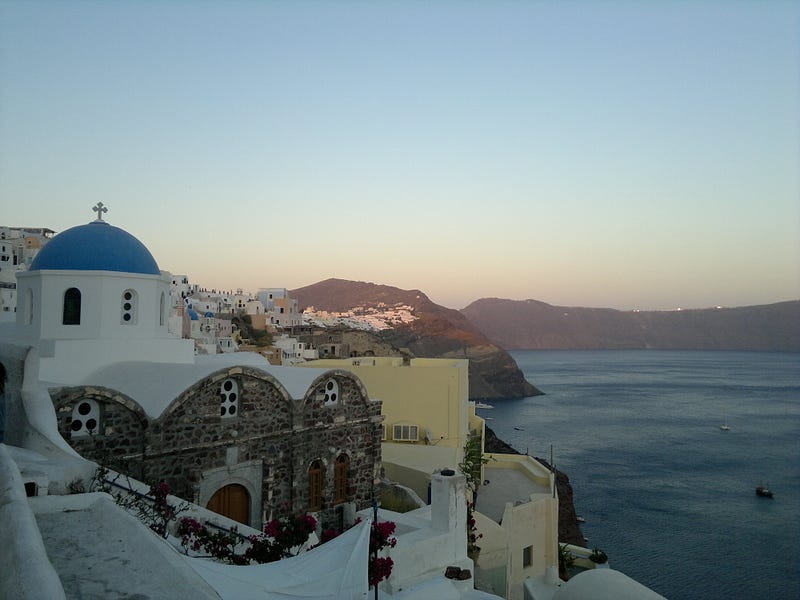
Building this self-sustaining community took time: the beloved traditional houses were built with the limited materials that were available at the time, pumice stone and volcanic ash. These houses cascade into the caldera, and are meticulously fitted into one another like a jigsaw puzzle. Back then, it took ships up to two days to reach the island, while it now takes them only 6 hours.
To see what has remained of the ‘original’ Thera, we have to look away from the busy touristic attractions, and learn to appreciate its blissful simplicity.
But the contradiction lies here: being a traveler means regaining some of our humanity and realizing that sometimes a place can be better off without us. While I am forever grateful for this indelible journey, a big part of me whishes I never went, that my foolish sense of entitlement didn’t blind me to the weight of my contribution to Santorini’s now year-long problem.
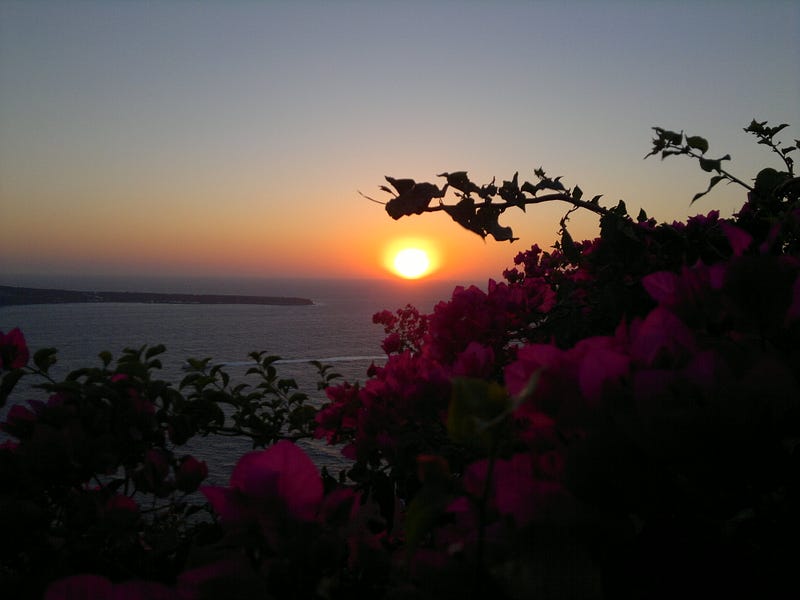
Did I loudly cheer at the epic sunset with the hundreds of people overcrowding Oia Castle, reducing the experience to a mere yelling contest? No, but like an accomplice, I was there, a body adding to the mass touristic complacency. “The most beautiful” is a title well-earned, and one worth preserving.