
San Gimignano: Personal Reflections on Medieval Skyscrapers & Vernaccia Wine
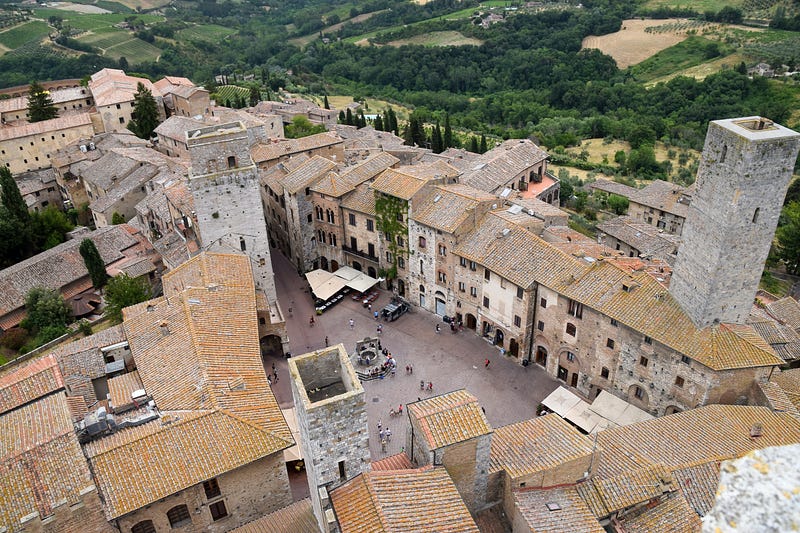
In the undulating landscapes of Tuscany, where vineyards stretch as far as the eye can see, there lies a town that defies the typical Italian skyline. San Gimignano, often described as the medieval Manhattan, is a place where history soars as high as its famed towers and flows as gracefully as its renowned wine, the Vernaccia.
As I entered the gates of San Gimignano, the sight of its fourteen surviving towers filled me with a sense of wonder. These towers, once numbering over seventy, were built by wealthy families during the 12th and 13th centuries, each vying to showcase their affluence and influence. The height of the towers was both a display of wealth and also a symbol of power in an era where familial feuds and rivalries shaped the social fabric here.
Walking through the town’s cobbled alleys, I was drawn to the Piazza del Duomo. Here, the juxtaposition of the Romanesque Collegiate Church and the tall towers create a picturesque scene. The church’s frescoes, depicting scenes from the Old and New Testament, are a reminder of the town’s religious heritage, providing a serene contrast to the secular power represented by the towers.
The ascent up the Torre Grossa, the tallest of these structures, is a journey in itself too. Climbing the narrow, worn-out steps, I felt transported back in time. Each step seeming to echo the ambitions of a bygone era. Reaching the summit, I was greeted with a breathtaking panorama of San Gimignano and the Tuscan countryside — a patchwork of olive groves, vineyards, and rolling hills.
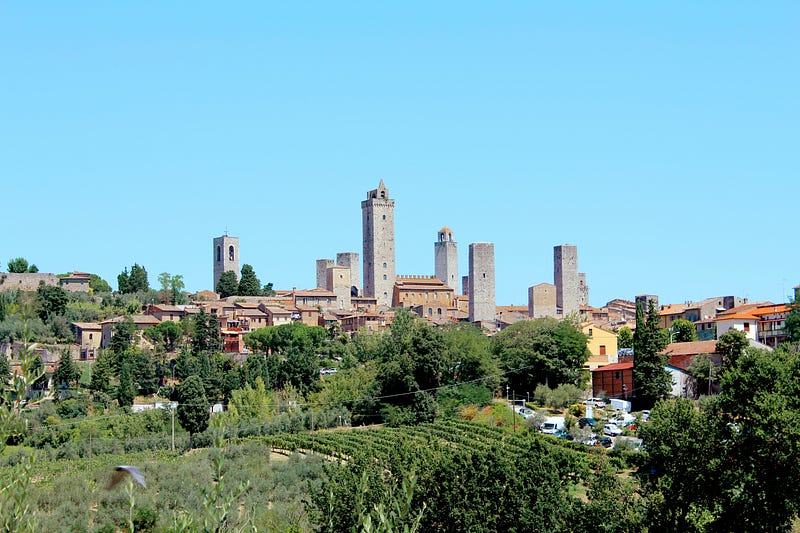
San Gimignano’s story, would be incomplete without mentioning its contribution to the world of wine — Vernaccia di San Gimignano. This wine, distinct with its straw-yellow hue and floral aroma, has roots in the region that go back centuries.
As I visited a local vineyard, the connection between the land and this wine became apparent. The sandy, clay-limestone soil, combined with the ideal Tuscan climate, creates the perfect conditions for the Vernaccia grape to thrive.
Tasting Vernaccia in a rustic vineyard setting was an experience that transcended the simple act of wine tasting. It was an exploration of flavours that spoke of the region’s history and culture. With its crisp acidity, hints of citrus, and a subtle almond aftertaste, the wine seemed to capture the essence of San Gimignano’s landscape.
Beyond the towers and the wine, San Gimignano also harbours a rich artistic heritage. The Civic Museum, housed in the historic Palazzo del Popolo, is a treasure trove of artworks. The frescoes and paintings by artists like Filippino Lippi and Benozzo Gozzoli narrate stories of a past era, and providing insight into the medieval mindset.
Exploring the town’s daily life added another layer to my understanding of San Gimignano as well. The local artisans, with their crafts and trades, providing a glimpse into the town’s living heritage. From pottery to textile work, these crafts showcases pieces of a continuing tradition.
As the day turned to dusk, the shadows of the towers grew longer, casting a spell over the town. The streets, now quieter, resonated with a peaceful ambiance. Sitting in a secluded corner of the Piazza della Cisterna, sipping a glass of Vernaccia, I reflected on the day’s experiences.
San Gimignano revealed itself not just as a town of towers and wine but as a canvas of history. It is a place where the aspirations of medieval lords echo in the silence of the towers, and the legacy of generations linger in the taste of the wine.