San Francisco Dreaming
On sunny or overcast coastal days
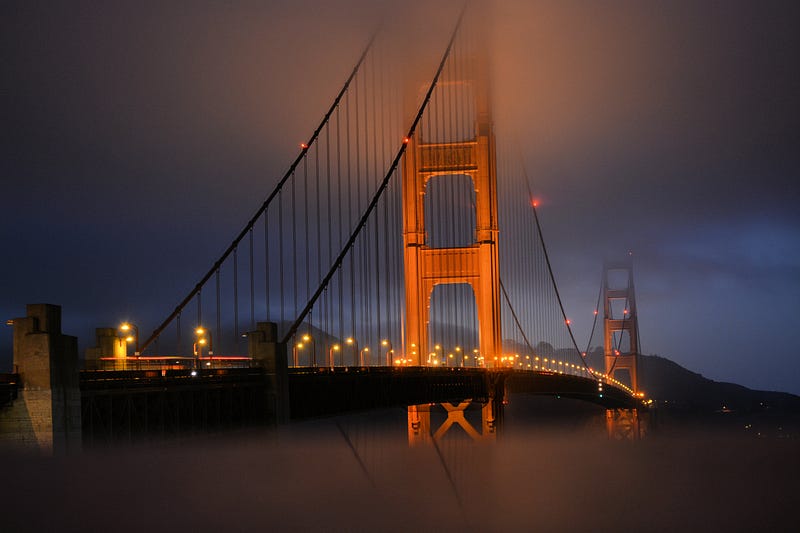
A few nights ago, I finished reading Vendela Vida’s new novel We Run the Tides. Set in Sea Cliff, where all denizens compete for the best view, or any view, of the Golden Gate Bridge, the novel asks many questions: whom would you lie for? How can you disappear without really trying? And best of all, how do teenaged girls ever negotiate safely their own peerage?
Not ever having been a girl, all I can offer is that parenting two such lovely/trying beings through the waves of adolescence made me miss some of the boys I grew up with who wanted to fight because of such comforting things as hair length, David Bowie, and who was going to escort Denise Gosling to the Christmas dance.
When I finished Vida’s work, though, I had the oddest feeling: it wasn’t so much that I wished it hadn’t ended (though I could have continued the story of “Eulabee” and her erstwhile best friend “Maria Fabiola” for at least another 100 pages), as that I wished that San Francisco hadn’t ended — that I could live there, or at least be visiting. I longed to read more about the setting itself, a longing I usually get after teaching Joan Didion or even when I force my Film and American Culture class to watch Zodiac. What is it about this city, and why do I want to be standing close to its bay, or looking up one of those sacred trolley hills?
I’ve visited many times, and on one of these, my younger daughter — she was thirteen at the time — and I saw The Black Crowes at the Fillmore. She told me that she didn’t care if I smoked some of the pot that wafted straight up our noses. I passed.
So yesterday, I must have ordered seven books about SF, hoping that one, at least, will give me that feeling again. And then, I remembered that the last time I was out there, I bought a treasure from City Lights bookstore: a new copy of Lawrence Ferlinghetti’s A Coney Island of the Mind. On that trip, we actually saw the tall man walking past us with a friend. I wish I had stopped him, but what would I have said:
“Hey man, I’ve taught your poetry to my Modern Poetry class at Presbyterian College for the last thirty years?”
And then what?
So I wrote about the experience instead:
The book is now in its 46th printing, but I took a step further and outbid someone on eBay for a Third Printing. $81 later, and I have my prize, and so rather than moan or dream, I immersed myself last night in Ferlinghetti’s carefully constructed imagination — of a place, a time, and a state of mind that bring me into his kindred wake.
I could go on about the images, crashing, falling, but I want to focus instead on the very first poem of this volume, the famous “In Goya’s greatest scenes we seem to see….”
In it, the poet studies “the people of the world” who “suffer “ and “rage,” and “groan” about
“…all the final hollering monsters of the ‘imagination of disaster’ they are so bloody real it is as if they really existed And they do Only the landscape is changed….”
He then relates that “We are the same people/only further from home…” traveling down fifty lane freeways with “strange license plates/ and engines/that devour America.”
I think of the 1950’s and the suburban sprawl that enticed Americans to leave the city…to get away, and so move to places that are made homogenous by the whiteness of being.
And then I think of today, when, while some are trying to get a decent wage and protest the violence against Black Lives, others — the counter-protesters — assert that “All Live Matter,” as if they ever did.
Ferlinghetti, at City Lights, published and championed the lives and work of writers like Kerouac, Ginsberg, and so many others who challenged the state, or at least the status quo.
“Up in the San Francisco where the forest meets the bridge I thought I saw you standing there…”
So says Foxygen, and so I remember watching Ferlinghetti fade form my view. Who will champion the artists now, in the wake of his death? Who will lead us to a new city, or this old one where colors and genders and desires all find a home?
I took comfort in reading these poems in my own comfortable home, even though they cast a set of images that, reeled in, make me wince for our land, just as they make me long for a home that isn’t mine.
I’ll keep reading and longing. My copy of Tales of the City should be arriving any day, and while Ferlinghetti is no more, at least we have his vision: a state of mind that transcends any particular place, though we know it’s San Francisco that’s truly his.
One day, I’ll get back there and stand at his bookstore, “dreaming of the lost America of love.”
My most recent story about Ferlinghetti’s connection to a band I love is found here:
© Terry Barr 2021