avatarJeremy Roberts

Summary

James Drury reflects on his experience in the 1962 western film "Ride the High Country," directed by Sam Peckinpah, discussing the film's critical acclaim, his role as the villain, and his interactions with fellow cast members, including Warren Oates and director Peckinpah.

Abstract

The web content details an interview with James Drury, renowned for his role as the villain Billy Hammond in the classic western "Ride the High Country." Drury recounts the film's significance, its cast's camaraderie, and his personal rapport with Peckinpah, who later gained a reputation for his erratic behavior. Drury also highlights the talents of his co-stars, particularly Warren Oates, and acknowledges the film's enduring legacy despite its initial lackluster reception in the United States. The interview provides insight into the making of a western classic and the relationships formed during its production, as well as Drury's own career trajectory from television's "The Virginian" to his later work.

Opinions

  • Drury views "Ride the High Country" as his most critically acclaimed film, which has remained in circulation and is highly regarded by audiences.
  • He describes the filming experience as "magical," praising the cast's chemistry and the director's vision, particularly noting the performances of Mariette Hartley, Warren Oates, John Anderson, John Davis Chandler, and L.Q. Jones.
  • Drury remembers Sam Peckinpah as a focused director during the making of "Ride the High Country," contrasting with his later reputation for problematic behavior under the influence of alcohol.
  • He recalls Peckinpah's unpredictable nature, mentioning the director's habit of surprising actors with "Sunday punches," although Drury himself was not subjected to this treatment.
  • Drury speaks fondly of Warren Oates, with whom he developed a close friendship, and commends Oates' ability to portray complex characters in his film roles, especially those directed by Peckinpah.
  • The interviewer, Jeremy Roberts, and Drury both acknowledge the film's lasting impact, with Roberts noting its preservation in the National Film Registry and its influence on subsequent westerns.

Sam Peckinpah’s ‘Ride the High Country’ according to dirty rat James Drury
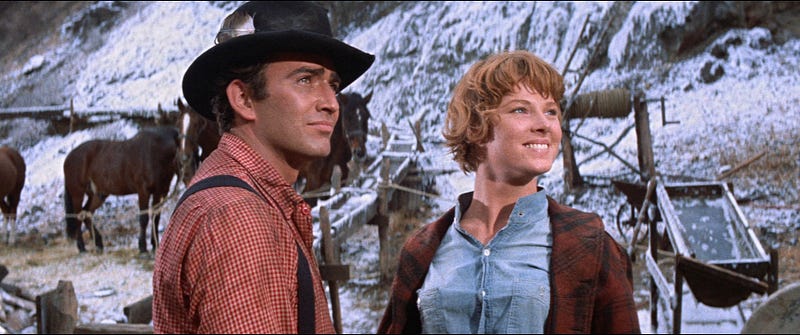
Nefarious gold miner Billy Hammond [James Drury] and guileless bride-to-be Elsa Knudsen [Mariette Hartley] on location in the Santa Monica Mountains for “Ride the High Country,” Sam Peckinpah’s second film behind the camera following the little-seen “Deadly Companions.” Shot on a tight 26-day budget where soap suds were substituted for snow, the elegiac western served as Randolph Scott’s swansong and Joel McCrea’s last great role. Earning the top honor at Cannes, “Ride the High Country” was regrettably treated apathetically in the USA and lost money upon its May 9, 1962, issue. The matter was belatedly rectified with its 1992 preservation in the National Film Registry housed within the Library of Congress, although Peckinpah, Scott, and McCrea had sadly already passed away. Image Credit: screengrab / Cinematographer Lucien Ballard / Metro-Goldwyn-Mayer / IMDB

Cowboy James Drury, a mainstay of 1960s television as the titular hero of NBC’s The Virginian, participated in another legendary project — albeit as the villain in the 1962 western Ride the High Country. A previously unexcavated interview finds Drury reminiscing on nonconformist director Sam Peckinpah, charming scene stealer Warren Oates, the principled Joel McCrea, and avoiding Sunday punches.

The James Drury Interview, Part Three

What is your most critically acclaimed film?

I was freelancing and got the major role of Billy Hammond in MGM’s Ride the High Country [1962], directed by Sam Peckinpah and starring Randolph Scott and Joel McCrea. It became a classic western that has always remained in circulation. People think the world of it. Right after that I started The Virginian and got to be the hero [television’s debut 90-minute western was transmitted for an awe-inspiring 249 episodes between 1962 and 1971]. I had no time for any other projects until the late ’60s when I did an occasional movie for television and several theatrical releases, but nothing ever of the caliber of Ride the High Country. I played a dirty rat who shot McCrea at the climax, and he shot me.

McCrea has one of the most poignant death scenes captured on celluloid.

It was great. The whole movie was magical. We had such a wonderful cast — in addition to Mariette Hartley — John Anderson, John Davis Chandler, Warren Oates, and L.Q. Jones were my brothers [the Hammonds]. That’s a cast that draws your attention. They were all fantastic actors.

Was Peckinpah an unpredictable maverick in real life? How was he towards you?

We had no problems whatsoever. Sam was interested in making very important pictures. Years after our collaboration, he got into the sauce and drank a lot of vodka during the day. He would get real mean to people and cause a lot of trouble.

Sam was just a wonderful, practical, and inspired director. I’d known Sam since 1958 when I appeared in one of the first scripts he wrote and directed for television — a Rifleman episode [In season one “ The Marshal” introduced Paul Fix to the regular cast alongside Chuck Connors and Johnny Crawford. Future Peckinpah stock company alums R.G. Armstrong and Warren Oates are also along for the ride]. Every day was a wonderful experience on Ride the High Country. Everybody got along.

I have interviewed Warren’s biographer Susan Compo regarding Warren Oates: A Wild Life [2009].

That’s a good description of Warren. I knew him for many years [Their debut encounter may have occurred when they first worked together on “The Marshal” episode of The Rifleman. Oates guest starred in four Virginian episodes between 1963 and 1966 — “Stopover in a Western Town,” “A Slight Case of Charity,” “One Spring Like Long Ago,” and “Ride to Delphi”]. Warren played some of the most interesting characters in film. He did more great work with Sam after Ride the High Country [i.e. Major Dundee, The Wild Bunch, and Bring Me the Head of Alfredo Garcia]. Warren told me that he had gotten weary of Sam because you had to watch him. Sam would come up behind you, stand next to you, Sunday punch you, and knock you right on your butt. Maybe Sam was mad at you, or maybe he was mad at somebody else. Oh, gosh. The things that people do.

Did Peckinpah Sunday punch you?

No, Sam wasn’t like that at all on Ride the High Country. That behavior must have started later.

Did you and Warren become friendly?

Absolutely, we were very good friends. Anytime I was somewhere where Warren was, we would get together.
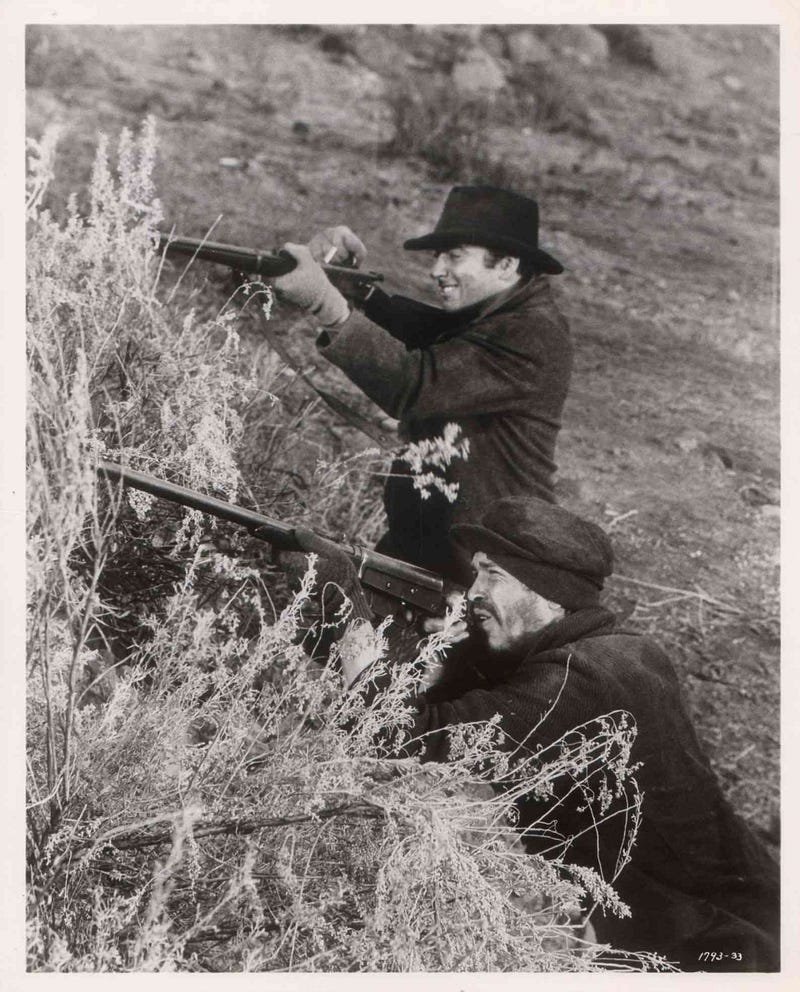
Clutching a Remington Model 8 semiautomatic rifle, scruffy Henry Hammond [Warren Oates] and James Drury ambush Randolph Scott, Joel McCrea, Mariette Hartley, and Ron Starr on mountainous terrain in director Sam Peckinpah’s masterpiece “Ride the High Country,” distributed on May 9, 1962. Image Credit: Western Movies Forum France user Lasbugas / Metro-Goldwyn-Mayer
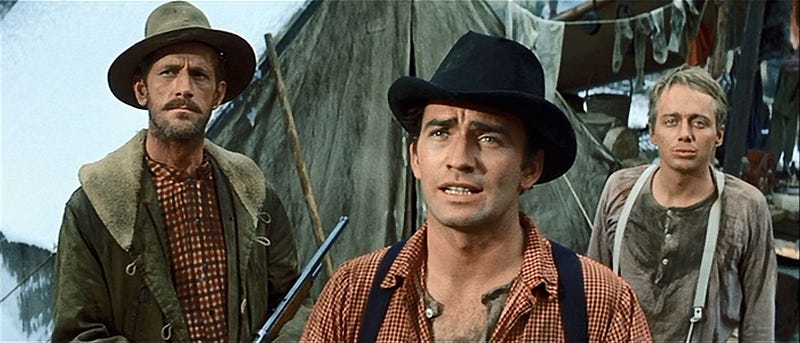
Rotten brothers Elder Hammond [John Anderson], Billy Hammond [James Drury], and Jimmy Hammond [John Davis Chandler] guard their mining camp tent in “Ride the High Country.” Image Credit: screengrab / Cinematographer Lucien Ballard / Metro-Goldwyn-Mayer / IMDB
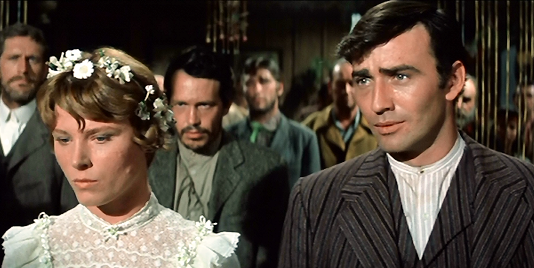
In her film debut, crestfallen bride Mariette Hartley prepares to officially join hands with drunken gold miner James Drury in “Ride the High Country.” In the background John Anderson, Warren Oates, and Sylvus Hammond [L.Q. Jones] look uncomfortably menacing. Image Credit: screengrab / Cinematographer Lucien Ballard / Metro-Goldwyn-Mayer / IMDB
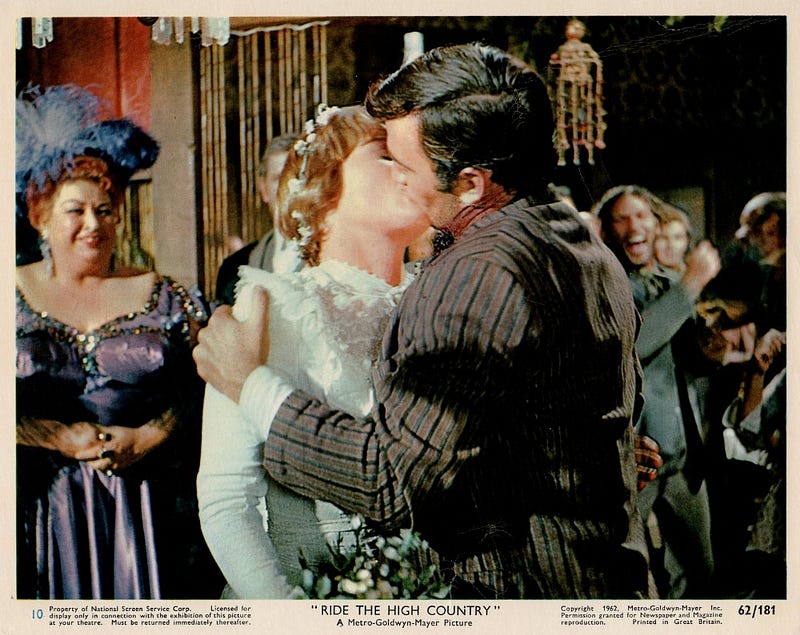
Coarse Gold mining camp saloon owner Kate [Jenie Jackson] is mighty pleased when Mariette Hartley and James Drury kiss passionately in a lobby card from “Ride the High Country.” L.Q. Jones, still kicking at age 93, appears over Drury’s right shoulder with his fist in the air. Image Credit: Western Movies Forum France user “Abilene” / Metro-Goldwyn-Mayer
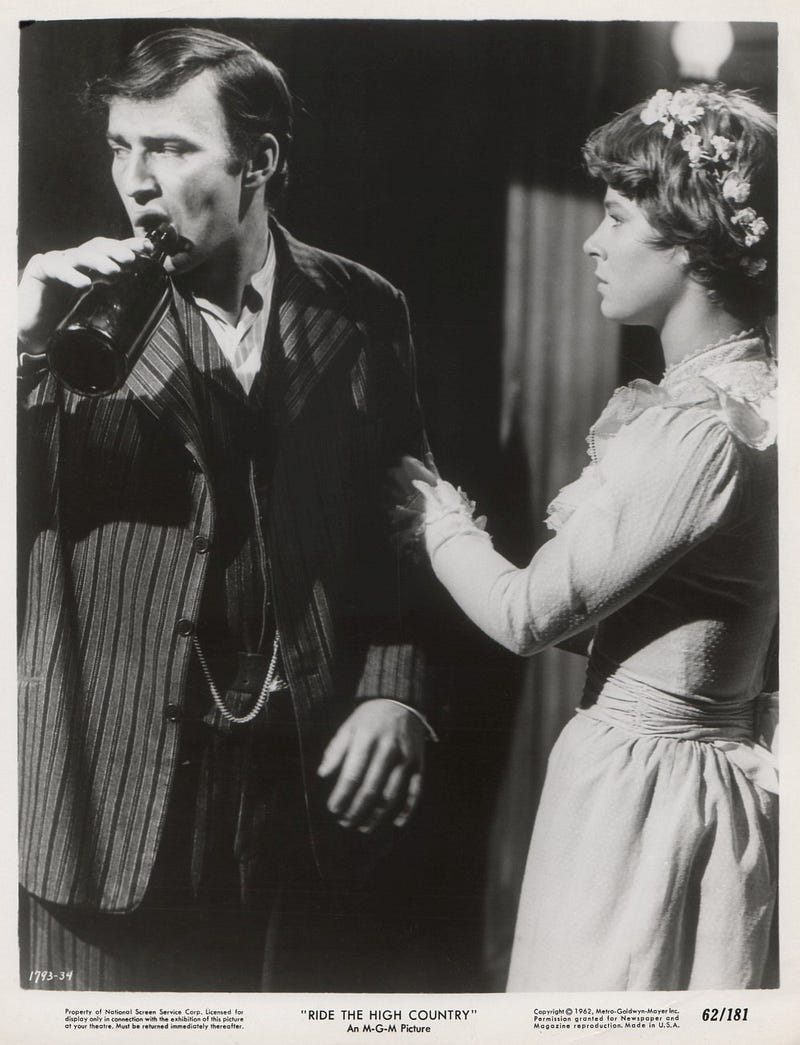
Mariette Hartley learns the hard way that her new husband James Drury is a no-good thieving drunk in a lobby card from “Ride the High Country.” Image Credit: Western Movies Forum France user Lasbugas / Metro-Goldwyn-Mayer
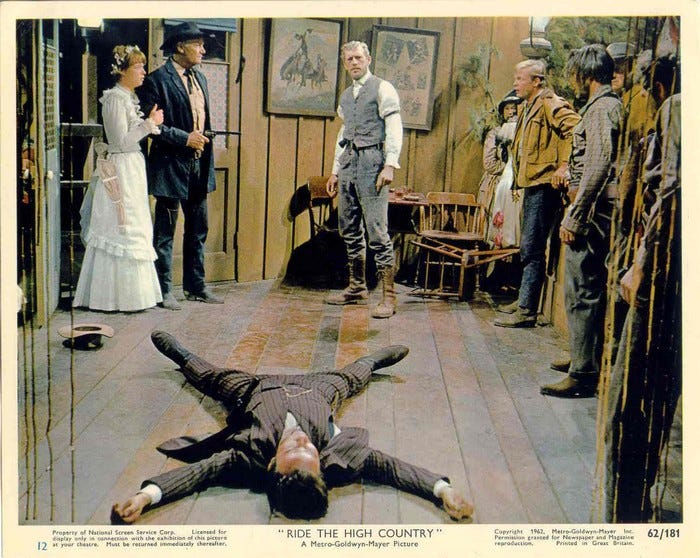
Mariette Hartley is saved in the nick of time by quick-triggered former lawman Steve Judd [Joel McCrea] as Billy Hammond [James Drury] is spread-eagled, knocked-out cold to be precise, on a saloon floor. Elder Hammond [John Anderson, background center] is none too pleased. Wild West show assistant Heck Longtree [Ron Starr] sports the tan jacket and ultimately demonstrates true affection for Hartley’s character in Sam Peckinpah’s “Ride the High Country.” Image Credit: Western Movies Forum France user “Abilene” / Metro-Goldwyn-Mayer
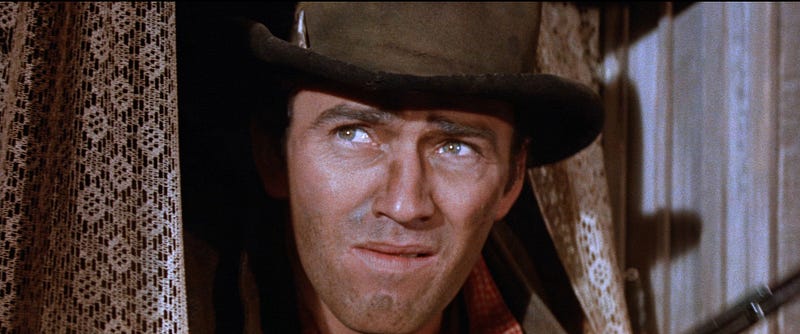
Billy Hammond [James Drury] has cold-bloodedly murdered Elsa’s father Joshua Knudsen [R.G. Armstrong] and covertly peaks through a window awaiting Randolph Scott, Joel McCrea, Mariette Hartley, and Ron Starr’s return in “Ride the High Country.” Drury continued meeting fans at events across the United States and contributing on-camera interviews for the INSP network’s vintage screenings of “The Virginian” until his death of natural causes on April 6, 2020. He was 12 days shy of his 86th birthday. Image Credit: screengrab / Cinematographer Lucien Ballard / Metro-Goldwyn-Mayer / IMDB

© Jeremy Roberts. All rights reserved. Part three of the James Drury interview, conducted on May 14, 2013, in advance of a Memphis Film Festival appearance, was condensed and edited for clarity upon its 2020 debut in this “Jeremy’s Classic Western Roundup” column. Transcription courtesy of Kate McCullough. To touch base, email [email protected] and mention which story led you my way. I appreciate it sincerely.

Movies
Film
Western
History
Entertainment
Recommended from ReadMedium