avatarJonathan Poletti

Free AI web copilot to create summaries, insights and extended knowledge, download it at here

6050

Abstract

f toned, tanned perfection. He was shorter, and never a bodybuilder. His line was, “I’d rather lift girls than weights.”</p><p id="f41d">He was ultra-friendly, and presided over the beach becoming a welcoming experience for most everyone. He was often arranging people into amazing aerial extravaganzas. A writer for the <i>Saturday Evening Post <a href="https://books.google.com/books?id=s_seAQAAMAAJ&amp;q=%22muscle+beach%22+russ&amp;dq=%22muscle+beach%22+russ&amp;hl=en&amp;sa=X&amp;ved=0ahUKEwijvfyHhdrjAhXrV98KHQFoAKQQ6AEIPDAD"></a></i><a href="https://books.google.com/books?id=s_seAQAAMAAJ&amp;q=%22muscle+beach%22+russ&amp;dq=%22muscle+beach%22+russ&amp;hl=en&amp;sa=X&amp;ved=0ahUKEwijvfyHhdrjAhXrV98KHQFoAKQQ6AEIPDAD">notes</a> in 1957 that one could see “stunts there that you’d never see in a circus or on the stage…”</p><p id="cfb0">Jack LaLanne, later a well-known fitness guru, <a href="https://webcache.googleusercontent.com/search?q=cache:FVlafSVNeUAJ:https://www.latimes.com/archives/la-xpm-2001-jun-06-me-7136-story.html+&amp;cd=1&amp;hl=en&amp;ct=clnk&amp;gl=us">recalled</a> Saunders as “very unselfish” and “always trying to help people…a role model for young people.”</p><p id="91ac">It occurs to me that Saunders was a real Jesus—and the beach community his church. He was nearly a Busby Berkeley in his complex acrobatic arrangements of women—with a woman, improbably, on the bottom holding up a group, as if to affirm her strength.</p><p id="cf87">He’s in many photos, half-naked with women. Their heads can be lodged near his groin! But, in the period parlance, he was <i>“unthreatening.”</i></p><p id="7903">He was just beautiful.</p><figure id="7733"><img src="https://cdn-images-1.readmedium.com/v2/resize:fit:800/1*a3PMZiV7A6VlhglljatSbA.jpeg"><figcaption></figcaption></figure><figure id="57b4"><img src="https://cdn-images-1.readmedium.com/v2/resize:fit:800/0*2Ju2M5c9qq57dwI0.png"><figcaption></figcaption></figure><h1 id="d114">Saunders left no gender information in the public—and nobody comments on the lack.</h1><p id="ff6f">It becomes another exercise in queer vagueness. His obituary cites no marriage or children. Patti Taylor, a dancing teacher who became his regular acrobatics partner, was sometimes called ‘Patti Saunders’ in 1950s news coverage.</p><p id="040f">But, as Muscle Beach gets a lot of media attention, she’s seen dancing with a lot of men. The two do have a certain charisma—the male relinquishing his position as the base of the hierarchy.</p><figure id="2866"><img src="https://cdn-images-1.readmedium.com/v2/resize:fit:800/1*dC0ifopzh_DKiH0BZwTF9A.png"><figcaption>Bottom to top: Patti Taylor, Russ Saunders <i>(Santa Monica History Museum Collection (36.2.3175))</i></figcaption></figure><h1 id="9ab8">And all the while—Saunders was working with Salvador Dali.</h1><p id="c622">“I didn’t even know who he was at the time,” Saunders <a href="https://www.latimes.com/archives/la-xpm-2001-jun-06-me-7136-story.html">recalls</a> in 1984 to the <i>L.A. Times</i>. “I was working for Warner Bros Studios and tested in front of this guy with a cane and a waxed mustache. I got paid $35 a day to pose.”</p><p id="2947">That would seem to be most all of what he ever said in public about the relationship. In 1980, though Saunders stopped by an L.A. art store and chatted up the clerk, Terry Walstrom, who <a href="https://www.jehovahs-witness.com/topic/5129662540808192/my-conversation-crucified-man">reproduces</a> the dialogue years later. That sourcing isn’t great, but the account seems to make sense. He had Saunders say he met Dali in 1945, when Dali was in Hollywood working on his famous dream sequence <i>Spellbound.</i></p><p id="30b8">Saunders is quoted to say:</p><blockquote id="09a5"><p><i>“I answered an ad in the newspaper for male models to pick up extra cash between films. It was for Salvador Dali. He needed a man of excellent physical proportions he could hang on a cross and experiment with various lighting schemes. He took one look at me and my resume’ and I was hired.”</i></p></blockquote><h1 id="372c">They sure get along, which isn’t how Dali normally is with people.</h1><p id="1484">A profile in <i>Life</i> magazine in 1945 <a href="https://books.google.com/books?id=3EkEAAAAMBAJ&amp;pg=PA66&amp;dq=dali+spellbound+hollywood+party&amp;hl=en&amp;sa=X&amp;ved=2ahUKEwiCnZLy5-bvAhXYZc0KHTJ0BwAQ6AEwAHoECAAQAg#v=onepage&amp;q=dali%20spellbound%20hollywood%20party&amp;f=false">notes</a> that, to avoid conversation with people, he’ll often pretend not to know English.</p><p id="9769">The magazine reports: “In private conversation he is a somewhat shy, likable man with a kindly disposition, an inquisitive, intelligent face and an air of childlike gravity.”</p><p id="9578">Saunders is cast as Dali’s genius in the first painting for a new religious ‘renaissance’ that Dali is envisioning. “People are tired of ugliness,” he says in a 1956 <a href="https://www.jstor.org/stable/30098833">profile</a> of his Christian art. “It is not possible to continue the destructive themes of Picasso.”</p><p id="7d36">He adds: “My revolution is very close to Catholicism!”</p><p id="0363">The painting Dali plans was inspired by an oval image of crucified Jesus as drawn by John of the Cross, the Spanish saint. Then Dali adds in his own mystic vision, he’d <a href="https://www.dalipaintings.com/christ-of-saint-john-of-the-cross.jsp">write</a>—a “cosmic dream” about which the nucleus of the atom. He says: “This nucleus later took on a metaphysical sense; I considered in ‘the very unity of the universe’, the Christ!”</p><p id="8cdb">The impression I get is something related more to the human genitals—male and female—if vaguely.</p><figure id="4c3d"><img src="https://cdn-images-1.readmedium.com/v2/resize:fit:800/0*PhXNWCPTwP4qDtK0.jpg"><figcaption></figcaption></figure><figure id="3ccb"><img src="https://cdn-images-1.readmedium.com/v2/resize:fit:800/0*mmodhRF_0kLTbjvZ.jpg"><figcaption>John of the Cross, sketch of Jesus crucified; Salvador Dali, <a href="https://www.w

Options

ikiart.org/en/salvador-dali/study-for-christ-of-st-john-of-the-cross-1951">Study for ‘Christ of St. John of the Cross’</a></figcaption></figure><h1 id="13f5">Typically, the crucified messiah would be withered and wasted, bloodied and shamed.</h1><p id="ddde">But for Dali there was to be no blood, no nails, or a crown of thorns. There’s just a “beautiful” man.</p><p id="e2c7">The art critic José C. Nieto <a href="https://www.google.com/books/edition/Mystic_Rebel_Saint/FdExj0cUziEC?hl=en&amp;gbpv=1&amp;dq=%22Dali%27s+purely+aesthetic+Christ+on+the+cross+shows+no+struggle.%22&amp;pg=PA106&amp;printsec=frontcover">writes</a>:</p><blockquote id="04b5"><p><i>“Dali’s purely aesthetic Christ on the cross shows no struggle. His Christ is rather a piece of polished and beautiful marble, symmetrically and aesthetically fixed on the cross to produce a crucifixion artistically gorgeous and perfect.”</i></p></blockquote><p id="54c9">A new Jesus for a new age—forged in the California sunshine.</p><p id="f4d2">Modeling in his bathing trunks, Saunders found himself tied to a cross and dangling from the ceiling, while Dali imagines him as Jesus hanging in space.</p><p id="aa70">As Walstrom’s reconstructed dialogue continues, Saunders recalls Dali:</p><blockquote id="0b0c"><p><i>“He was very pleasant as a conversationalist and host. He was surrounded by sensuality, debauchery, and extravagance that put Hollywood self-indulgence to shame. He was great friends with Picasso and his conversations about the atom bomb were out of this world. I had the time of my life. I flew back and forth for parts of three years working with Dali on this project.”</i></p></blockquote><figure id="45f3"><img src="https://cdn-images-1.readmedium.com/v2/resize:fit:800/0*isBvTrtqZytXElSL"><figcaption>Salvador Dali, “<i>Christ of Saint John of the Cross” (1951)</i></figcaption></figure><h1 id="ea32">There were more Jesus paintings to follow.</h1><p id="04a1">In 1954, Dali released <i>Crucifixion (Corpus Hypercubus) </i>in 1954. In 1955, he had <i>The Sacrament of the Last Supper,</i> and in 1958, <i>The Ascension of Christ.</i></p><p id="946a">It was New Age passion play about a post-War messiah, an Atomic Age Jesus.</p><p id="4bd9">And in the background of all of them—there’s a beach.</p><figure id="1dd0"><img src="https://cdn-images-1.readmedium.com/v2/resize:fit:800/0*0S37xIjhBJgzyFXe.jpg"><figcaption></figcaption></figure><figure id="c812"><img src="https://cdn-images-1.readmedium.com/v2/resize:fit:800/0*3R7mPmNwxvobG178.jpg"><figcaption></figcaption></figure><figure id="c952"><img src="https://cdn-images-1.readmedium.com/v2/resize:fit:800/0*g1_r4zkRnRNfx_7r.jpg"><figcaption></figcaption></figure><figure id="5a1a"><img src="https://cdn-images-1.readmedium.com/v2/resize:fit:800/0*ndcBTMTH60_6f9jP.jpg"><figcaption></figcaption></figure><figure id="788c"><img src="https://cdn-images-1.readmedium.com/v2/resize:fit:800/0*lvb6y1RavAAedFON.jpg"><figcaption></figcaption></figure><h1 id="cfd3">The “Christ of Saint John of the Cross” painting was not well received.</h1><p id="991a">Dali’s reputation would soar in later years but at the time he was considered somewhat negligible. The work was purchased by the Glasgow Museums for £8,200—far less than Dali had wanted. And he even threw in the copyright!</p><p id="7e57">He’d be asked on occasion to expound on the painting’s ‘meaning’.</p><p id="1ef7">“My Christ floats,” he <a href="https://www.jstor.org/stable/30098833">explains</a> in 1956—evidently feeling the Jesus in the painting is ‘floating’—since he saw the messiah floating in a dream.</p><p id="79dd">Why no face showing? Dali replies:</p><blockquote id="9a4c"><p><i>“He has no face in my dream. Besides, we cannot imagine what the face of Christ looked like. Artists in the past usually painted His face as an impersonal, idealized image. The Christ of most modern artists is expressionistic and ugly. I wanted my Christ to be unimaginably beautiful.”</i></p></blockquote><p id="f351">On the painting’s arrival at the museum, reviews were sort of bad—like the museum visitor who slashed it in 1961.</p><figure id="52bc"><img src="https://cdn-images-1.readmedium.com/v2/resize:fit:800/0*FmGFVXPnvRda36I3.jpg"><figcaption></figcaption></figure><figure id="655f"><img src="https://cdn-images-1.readmedium.com/v2/resize:fit:800/0*UU3yi1Z_HEquKIre.png"><figcaption></figcaption></figure><h1 id="7ab5">By the time the 21st century rolled around, the painting was seen as a national treasure.</h1><p id="4a06">And, really, a global icon. “It’s become an image that speaks to the whole world,” an art historian <a href="https://www.dailymotion.com/video/x30xd2b">says</a> in a BBC documentary.</p><p id="4f27">For whatever sexual profile either Dali or Saunders had, their work together was read as religiously acceptable to Christian people.</p><p id="5dbe">I can’t shake the feeling that there’s something subliminally sexual about this Jesus they made together. The crucifix hangs like a divine phallus over the world. Jesus’ face, downturned, is placed over his groin. Is there an idea of sexuality being left behind, as a higher consciousness is acquired?</p><p id="701b">It’s not <i>unsexual</i>, exactly.</p><p id="6a20">“I am looking for the vision which gives me direct access to a divine orgasm,” Dali <a href="https://www.google.com/books/edition/Salvador_Dali/JwXqAAAAMAAJ?hl=en&amp;gbpv=1&amp;bsq=I+am+looking+for+the+vision+which+gives+me+direct+access+to+a+divine+orgasm&amp;dq=I+am+looking+for+the+vision+which+gives+me+direct+access+to+a+divine+orgasm&amp;printsec=frontcover">says</a>, in one of his many mystic utterances.</p><p id="e9bf">Dali continued painting images from the Bible—like his 105 <a href="https://www.artsy.net/show/baterbys-art-gallery-salvador-dali-biblia-sacra-dali-and-his-bible?sort=partner_show_position">illustrations</a>, <i>Biblia Sacra</i>, in 1969. But somehow, <i>Christ of Saint John of the Cross </i>has a special charm. It’s like he gave an ‘orgasm’ to the world.🔶</p></article></body>

Salvador Dali’s Queer Jesus

The surrealist found his messiah in a handsome Hollywood stuntman

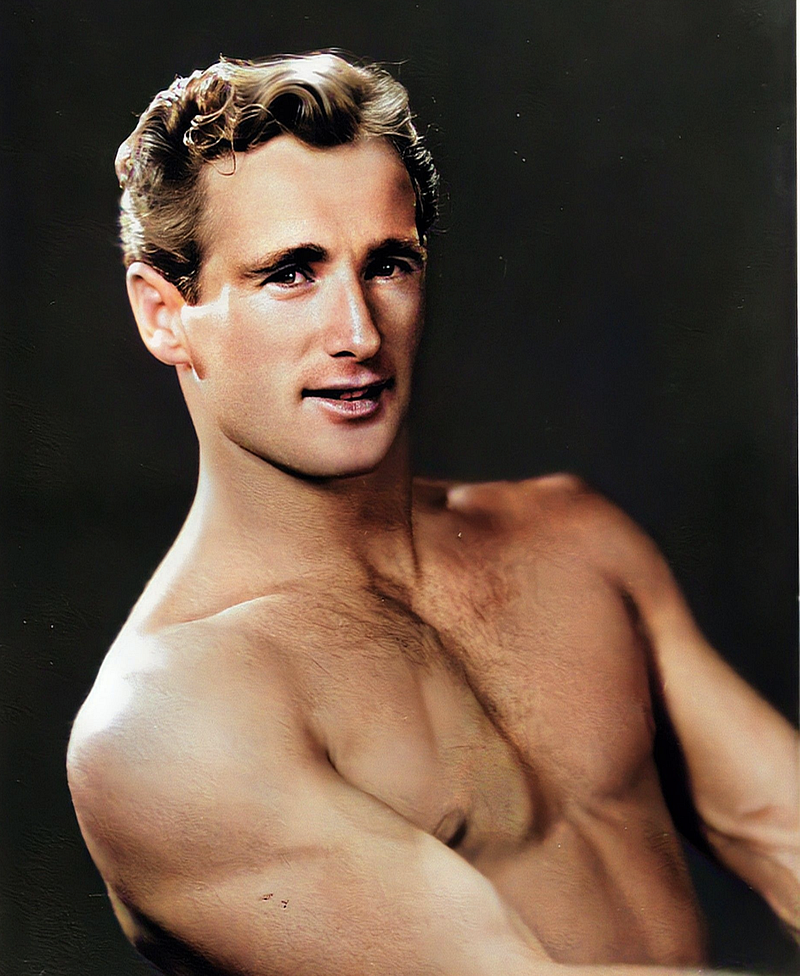
In 1945, a stuntman in Hollywood, named Russ Saunders, auditioned to model for a painter he’d never heard of—named Salvador Dali.

The famous Spanish surrealist painter was looking to make a painting that would be a big religious statement. After the Atomic Bomb, he planned to light up the world with a new Jesus.

This image, he’d explain, would leave behind the “ugliness” of previous efforts. He wanted a messiah “as beautiful as the God that He is.”

When Dali saw Russ Saunders—he hired him.
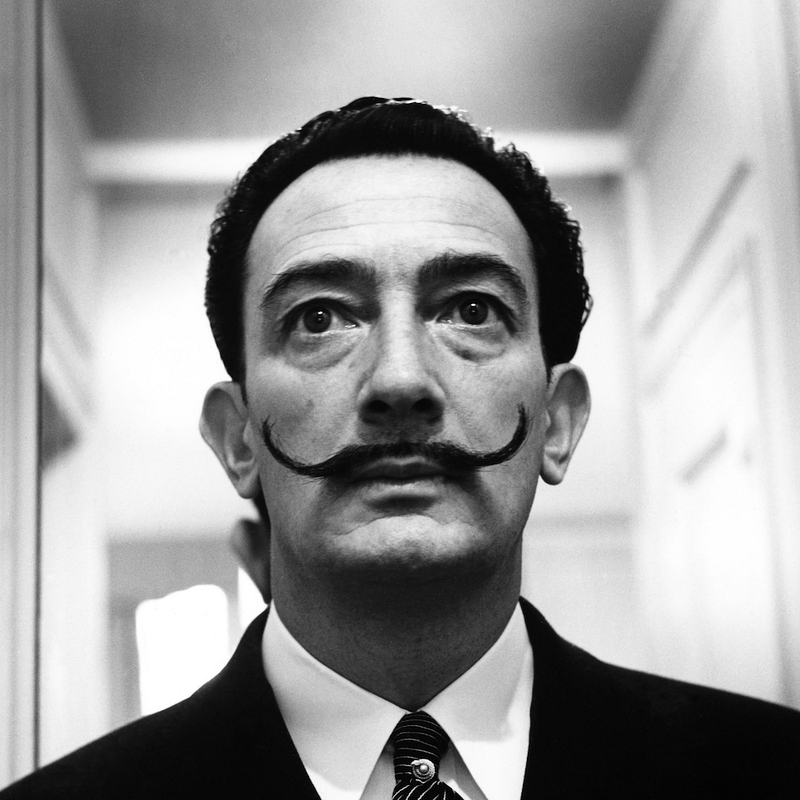
Salvador Dali; Russ Saunders (colorized)

The resulting Jesus painting will be called the ‘greatest religious painting of the 20th century’.

The collaboration is typically given a fleeting mention, if it’s mentioned at all. But I go in looking for details. Born in 1919, the youngest of eight, Saunders was raised on a farm outside Winnipeg.

‘Russ’, as Russell was called, was gifted from his boyhood with magical mobility. An obituary notes: “His first recorded stunt was jumping from a barn roof while holding two chickens in each hand, convinced that he would fly.”

By age twenty was a diving and gymnastics champion, and seemed intent on new forms of movement, laced with comedy. “He was an excellent downhill skier and developed a front somersault while on one ski,” notes a profile.

He applied for the Royal Canadian Air Force, but was rejected for color-blindness. He went to Hollywood — to be in black & white movies.

He seems to have thought to be an actor.

He does get a part in The Great Profile, as a member of an acrobatic troupe that plays briefly. I spot Saunders for a split-second.

He’s better known at the beach. A kind of fitness community was forming on what comes to be called ‘Muscle Beach’, in Santa Monica.

The ‘scene’ becomes famous, and credited as a key inspiration for the gym and fitness culture which would sweep the world. It was—shockingly—athletic male bodies on display, and it became a sort of post-war queer playground.

Scotty Bowers, the legendary Hollywood escort, recalls it in his memoir, Full Service: My Adventures in Hollywood and the Secret Sex Lives of the Stars.

“It was the time when smooth-skinned, hormone-filled musclemen were all the rage. As long as they wore even the skimpiest of black or white briefs or a posing pouch, and as long as they pumped iron, they were considered ‘athletes’ and not pornographic models.”

The scene birthed ‘queer icons’ from straight men whose beauty was suddenly recognized

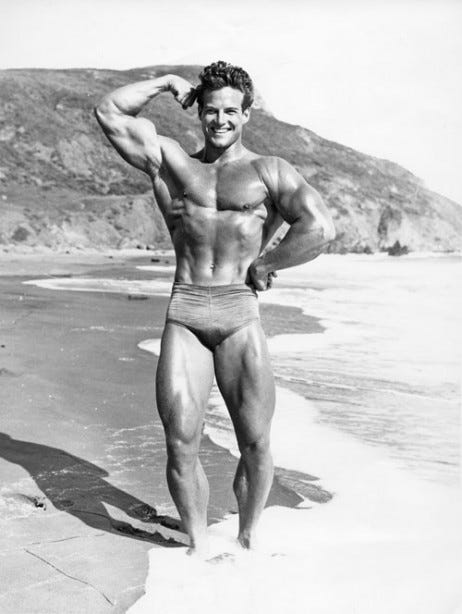
Like Steve Reeves, a bodybuilder who became a star of Italian movies. “He’d just walk down the beach and throngs would follow without knowing who he was,” recalls George Eiferman, another fixture of the scene. “God gave him a one-in-a-trillion body.”

Though Bowers notes that he once sent Reeves to trick for the gay director George Cukor—purely, he adds, “for the cash.”

If gays had long been used to the idea—and sometimes using people for it—a new possibility was dawning on the culture? The beautiful male.
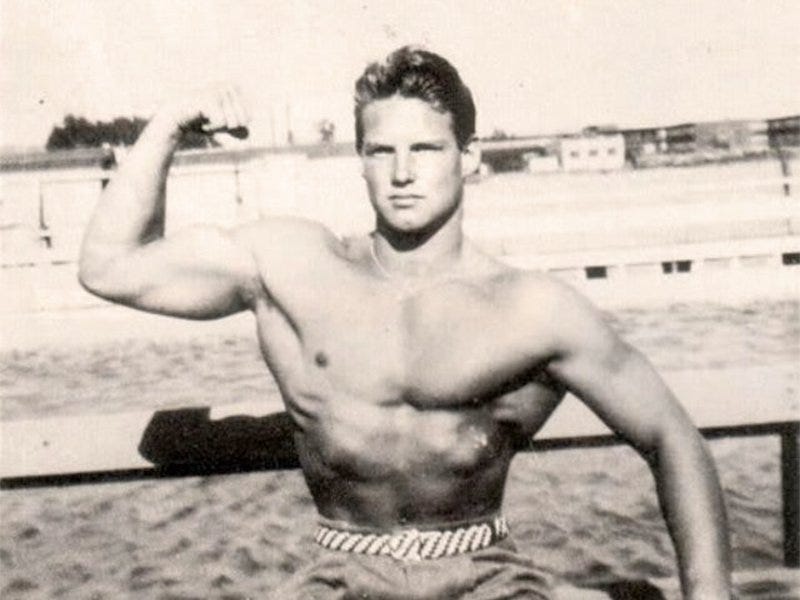

Steve Reeves

Women were seen working out with weights.

The media can hardly believe it. This was a highly unusual use of the female body. And with men on view as sexual objects—it was all new.

There’d be talk, of course. A 1959 book on the scene quotes a nearby gym owner recalling the bodybuilders who were becoming stars:

“Well, a large section of them are sexually abnormal. They primp the way a woman primps, and for the same reason.”

Anxiety built over time, and in 1958 the beach was shut down, purportedly over ‘sexual misconduct’ involving two underage girls. As the scholar Elsa Devienne notes, the city had long wanted to “put an end to what they considered a morally bankrupted facility.”

And while it lasted, she notes, “the athletes had to present their activities as familial, heterosexual, and respectable.”

And there was Russ Saunders to help out—offering his bright new kind of masculinity

Physically he was a vision of toned, tanned perfection. He was shorter, and never a bodybuilder. His line was, “I’d rather lift girls than weights.”

He was ultra-friendly, and presided over the beach becoming a welcoming experience for most everyone. He was often arranging people into amazing aerial extravaganzas. A writer for the Saturday Evening Post notes in 1957 that one could see “stunts there that you’d never see in a circus or on the stage…”

Jack LaLanne, later a well-known fitness guru, recalled Saunders as “very unselfish” and “always trying to help people…a role model for young people.”

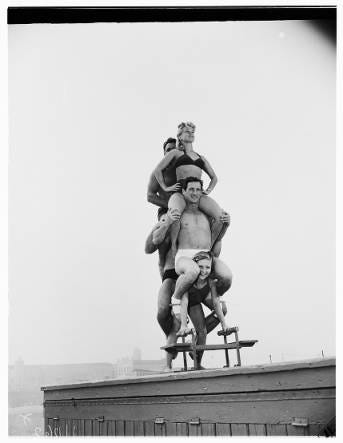
It occurs to me that Saunders was a real Jesus—and the beach community his church. He was nearly a Busby Berkeley in his complex acrobatic arrangements of women—with a woman, improbably, on the bottom holding up a group, as if to affirm her strength.

He’s in many photos, half-naked with women. Their heads can be lodged near his groin! But, in the period parlance, he was “unthreatening.”

He was just beautiful.
Saunders left no gender information in the public—and nobody comments on the lack.

It becomes another exercise in queer vagueness. His obituary cites no marriage or children. Patti Taylor, a dancing teacher who became his regular acrobatics partner, was sometimes called ‘Patti Saunders’ in 1950s news coverage.

But, as Muscle Beach gets a lot of media attention, she’s seen dancing with a lot of men. The two do have a certain charisma—the male relinquishing his position as the base of the hierarchy.
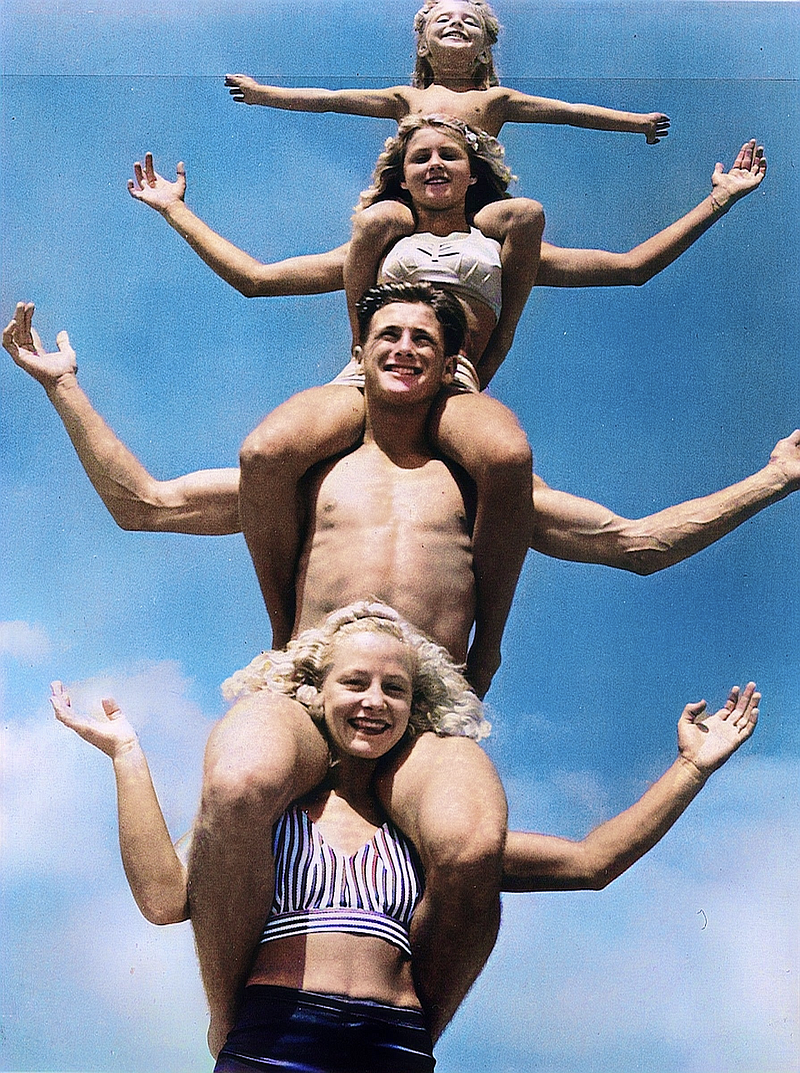
Bottom to top: Patti Taylor, Russ Saunders (Santa Monica History Museum Collection (36.2.3175))

And all the while—Saunders was working with Salvador Dali.

“I didn’t even know who he was at the time,” Saunders recalls in 1984 to the L.A. Times. “I was working for Warner Bros Studios and tested in front of this guy with a cane and a waxed mustache. I got paid $35 a day to pose.”

That would seem to be most all of what he ever said in public about the relationship. In 1980, though Saunders stopped by an L.A. art store and chatted up the clerk, Terry Walstrom, who reproduces the dialogue years later. That sourcing isn’t great, but the account seems to make sense. He had Saunders say he met Dali in 1945, when Dali was in Hollywood working on his famous dream sequence Spellbound.

Saunders is quoted to say:

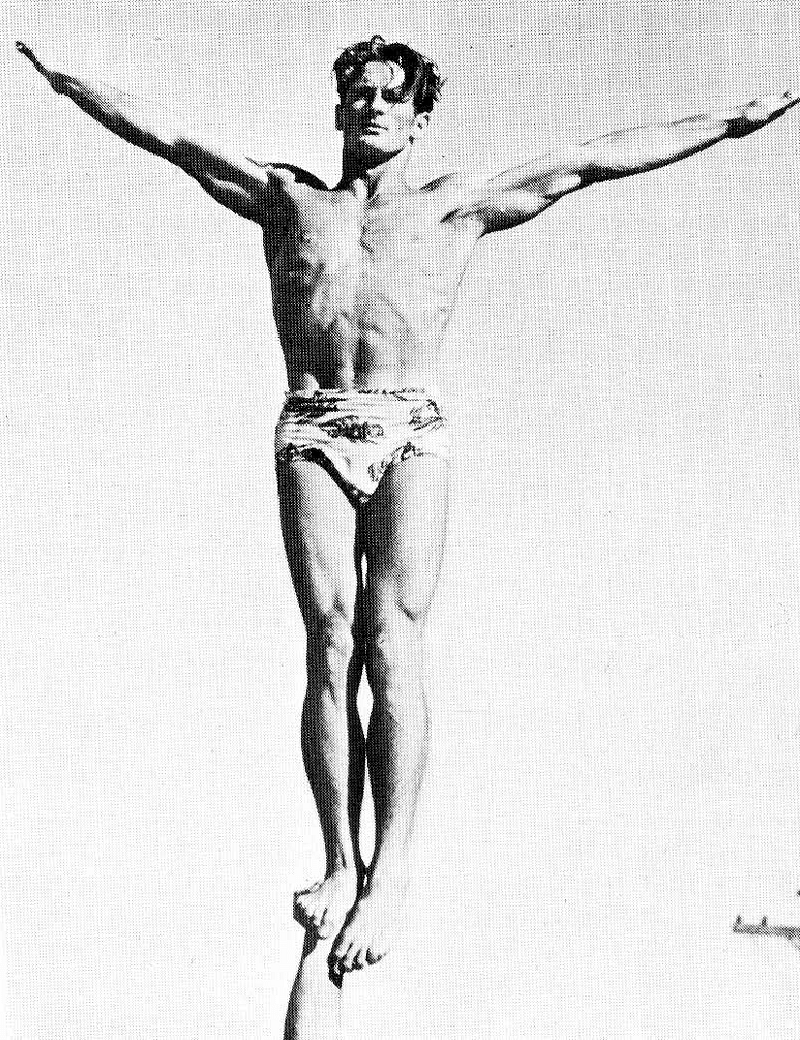
“I answered an ad in the newspaper for male models to pick up extra cash between films. It was for Salvador Dali. He needed a man of excellent physical proportions he could hang on a cross and experiment with various lighting schemes. He took one look at me and my resume’ and I was hired.”

They sure get along, which isn’t how Dali normally is with people.

A profile in Life magazine in 1945 notes that, to avoid conversation with people, he’ll often pretend not to know English.

The magazine reports: “In private conversation he is a somewhat shy, likable man with a kindly disposition, an inquisitive, intelligent face and an air of childlike gravity.”

Saunders is cast as Dali’s genius in the first painting for a new religious ‘renaissance’ that Dali is envisioning. “People are tired of ugliness,” he says in a 1956 profile of his Christian art. “It is not possible to continue the destructive themes of Picasso.”

He adds: “My revolution is very close to Catholicism!”

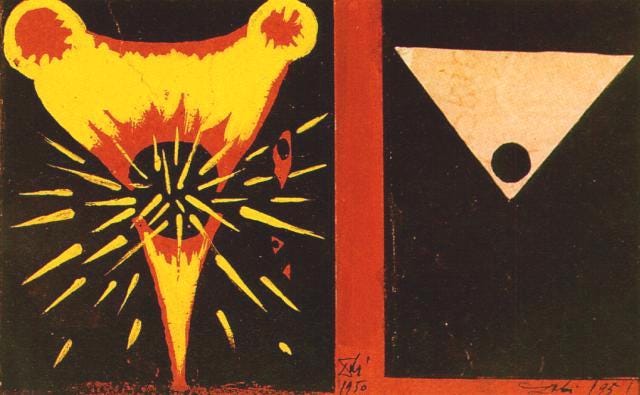
The painting Dali plans was inspired by an oval image of crucified Jesus as drawn by John of the Cross, the Spanish saint. Then Dali adds in his own mystic vision, he’d write—a “cosmic dream” about which the nucleus of the atom. He says: “This nucleus later took on a metaphysical sense; I considered in ‘the very unity of the universe’, the Christ!”

The impression I get is something related more to the human genitals—male and female—if vaguely.
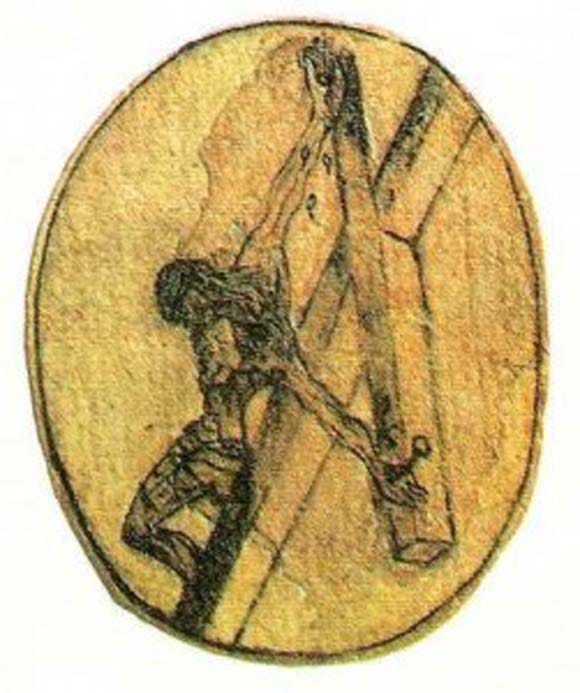
John of the Cross, sketch of Jesus crucified; Salvador Dali, Study for ‘Christ of St. John of the Cross’

Typically, the crucified messiah would be withered and wasted, bloodied and shamed.

But for Dali there was to be no blood, no nails, or a crown of thorns. There’s just a “beautiful” man.

The art critic José C. Nieto writes:

“Dali’s purely aesthetic Christ on the cross shows no struggle. His Christ is rather a piece of polished and beautiful marble, symmetrically and aesthetically fixed on the cross to produce a crucifixion artistically gorgeous and perfect.”

A new Jesus for a new age—forged in the California sunshine.

Modeling in his bathing trunks, Saunders found himself tied to a cross and dangling from the ceiling, while Dali imagines him as Jesus hanging in space.

As Walstrom’s reconstructed dialogue continues, Saunders recalls Dali:

“He was very pleasant as a conversationalist and host. He was surrounded by sensuality, debauchery, and extravagance that put Hollywood self-indulgence to shame. He was great friends with Picasso and his conversations about the atom bomb were out of this world. I had the time of my life. I flew back and forth for parts of three years working with Dali on this project.”
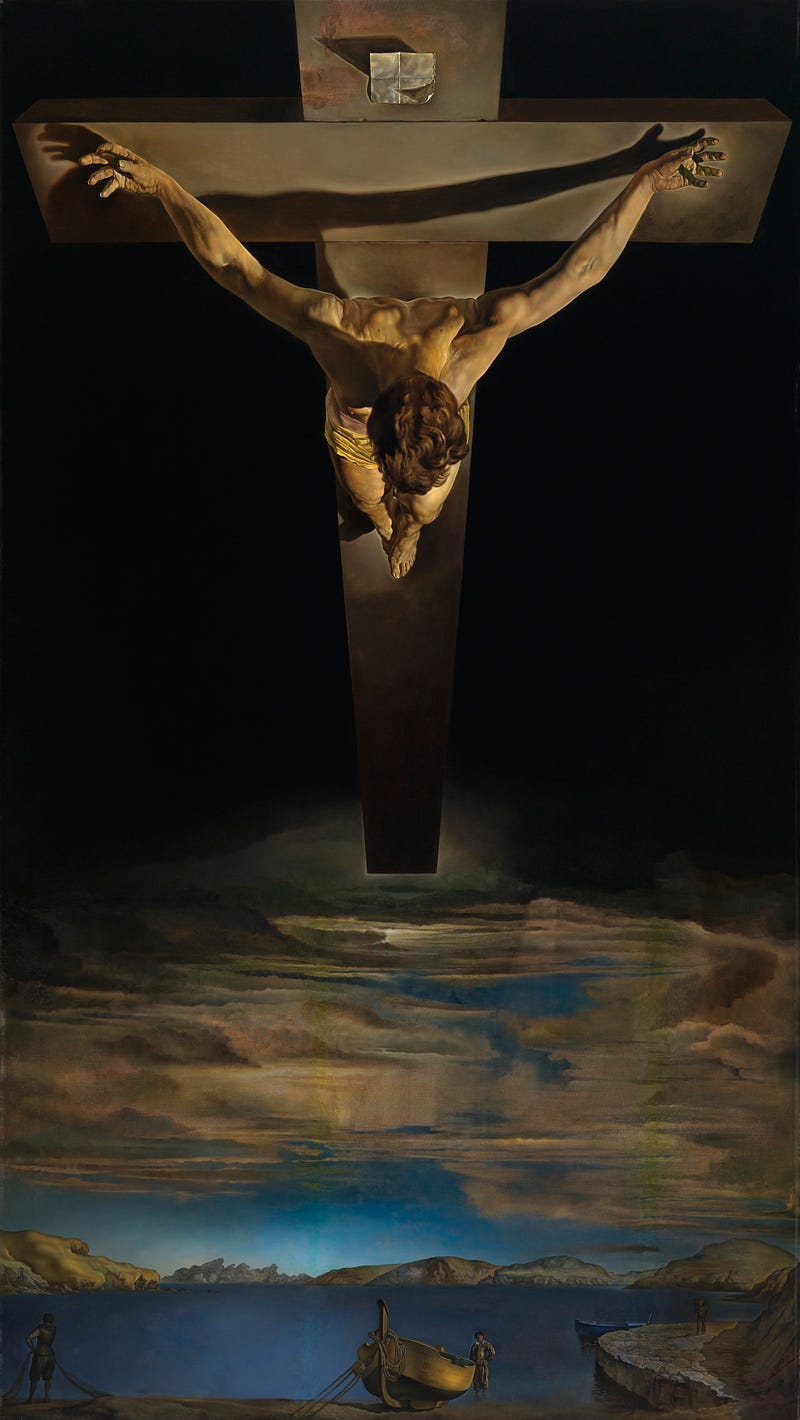
Salvador Dali, “Christ of Saint John of the Cross” (1951)

There were more Jesus paintings to follow.

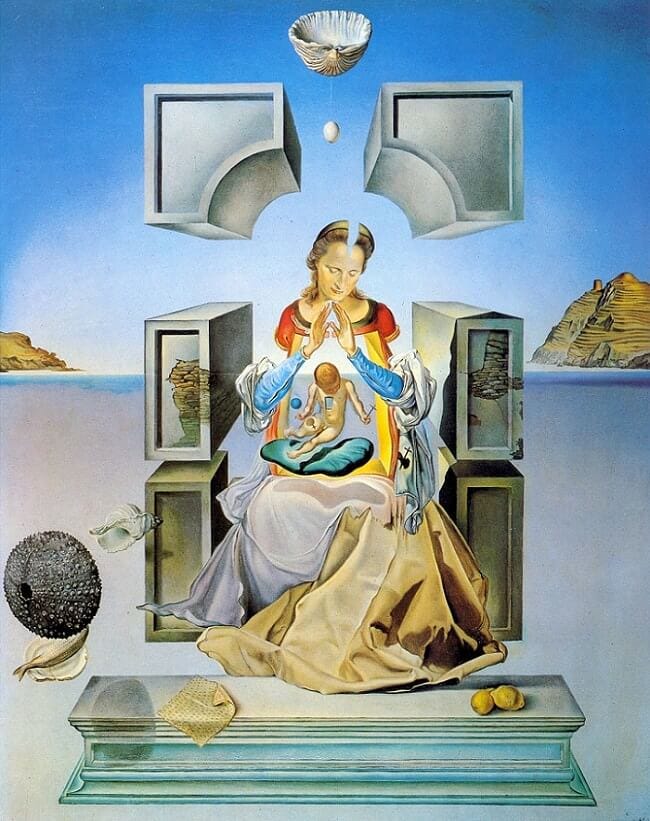
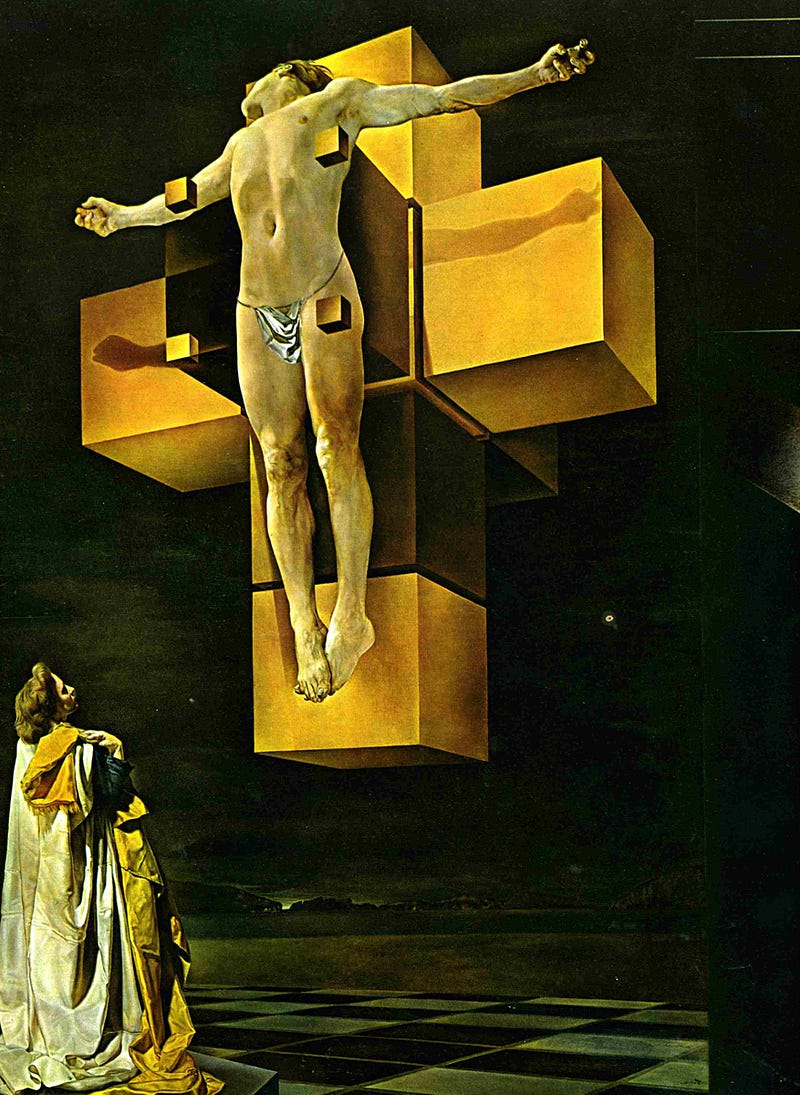
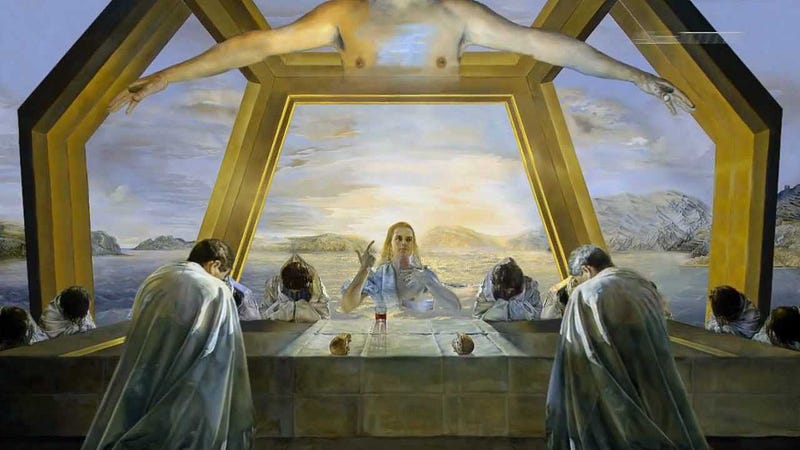
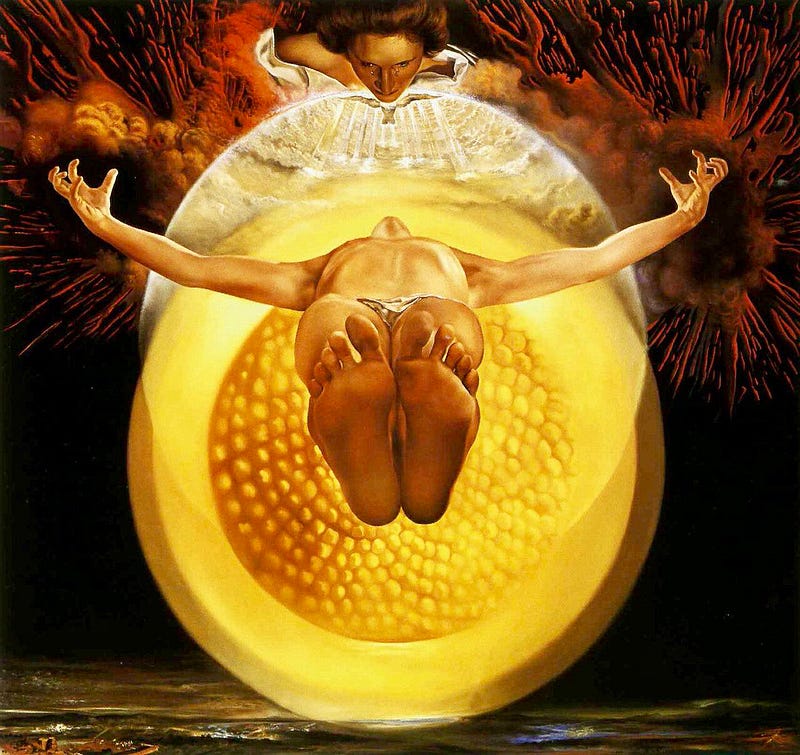
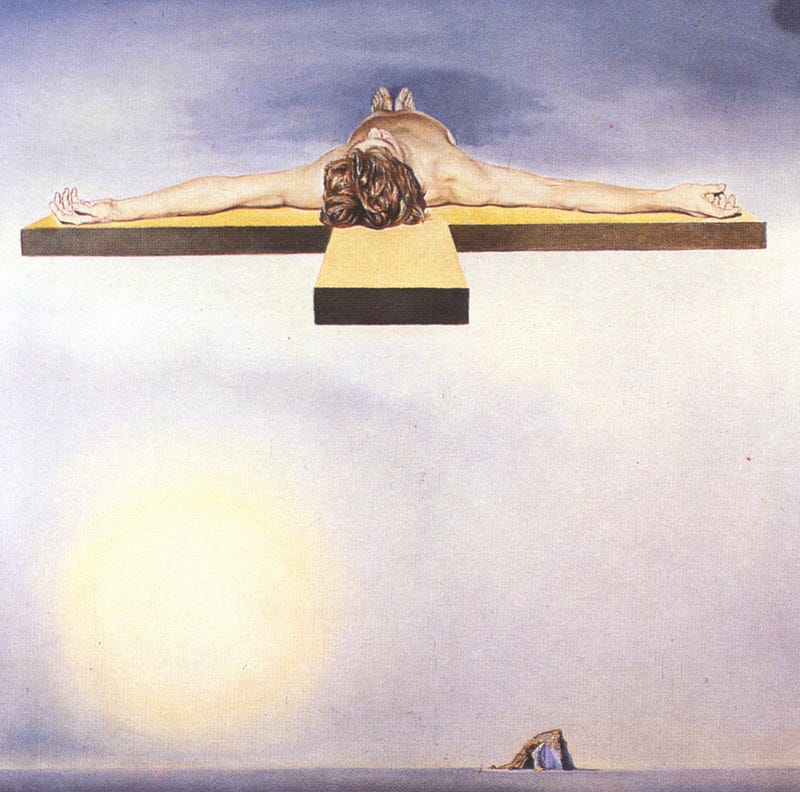
In 1954, Dali released Crucifixion (Corpus Hypercubus) in 1954. In 1955, he had The Sacrament of the Last Supper, and in 1958, The Ascension of Christ.

It was New Age passion play about a post-War messiah, an Atomic Age Jesus.

And in the background of all of them—there’s a beach.
The “Christ of Saint John of the Cross” painting was not well received.

Dali’s reputation would soar in later years but at the time he was considered somewhat negligible. The work was purchased by the Glasgow Museums for £8,200—far less than Dali had wanted. And he even threw in the copyright!

He’d be asked on occasion to expound on the painting’s ‘meaning’.

“My Christ floats,” he explains in 1956—evidently feeling the Jesus in the painting is ‘floating’—since he saw the messiah floating in a dream.

Why no face showing? Dali replies:

“He has no face in my dream. Besides, we cannot imagine what the face of Christ looked like. Artists in the past usually painted His face as an impersonal, idealized image. The Christ of most modern artists is expressionistic and ugly. I wanted my Christ to be unimaginably beautiful.”

On the painting’s arrival at the museum, reviews were sort of bad—like the museum visitor who slashed it in 1961.
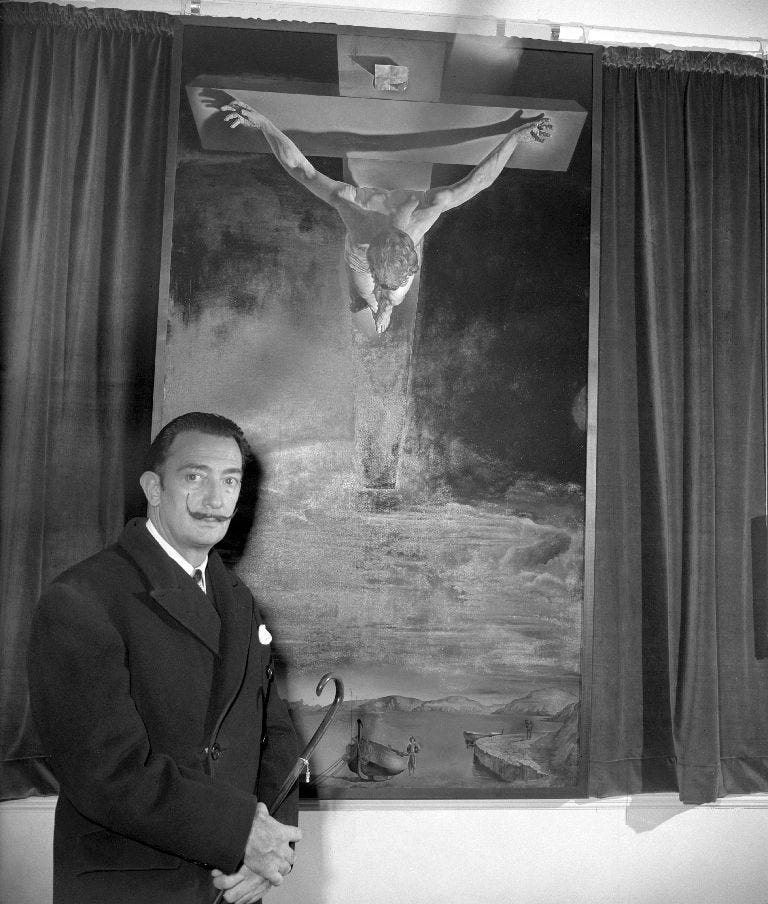
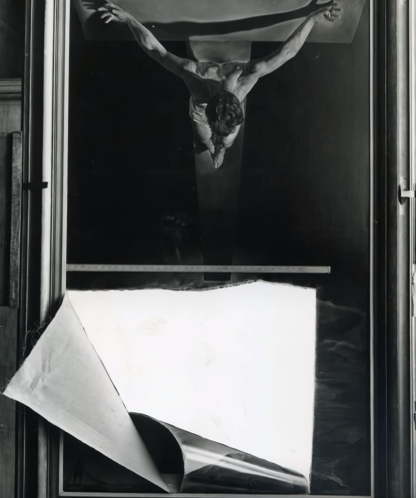
By the time the 21st century rolled around, the painting was seen as a national treasure.

And, really, a global icon. “It’s become an image that speaks to the whole world,” an art historian says in a BBC documentary.

For whatever sexual profile either Dali or Saunders had, their work together was read as religiously acceptable to Christian people.

I can’t shake the feeling that there’s something subliminally sexual about this Jesus they made together. The crucifix hangs like a divine phallus over the world. Jesus’ face, downturned, is placed over his groin. Is there an idea of sexuality being left behind, as a higher consciousness is acquired?

It’s not unsexual, exactly.

“I am looking for the vision which gives me direct access to a divine orgasm,” Dali says, in one of his many mystic utterances.

Dali continued painting images from the Bible—like his 105 illustrations, Biblia Sacra, in 1969. But somehow, Christ of Saint John of the Cross has a special charm. It’s like he gave an ‘orgasm’ to the world.🔶

Art
Religion
History
LGBTQ
Christianity
Recommended from ReadMedium