
CINEMA — MYTHS AND MEANING🎥
Saloons, Brothels, and Shootouts #1
The politics and morality of Western movie myths
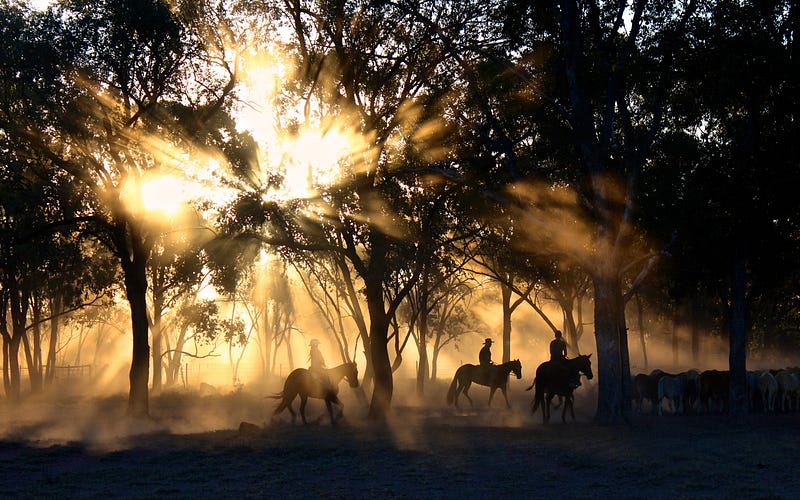
Covered in a myriad of forms over the last hundred years of American cinema, it is difficult to find a fresh approach for discussing the Western. Deservedly so, the genre remains one of the most studied and argued about in film history.
In our childhood fantasies, the cowboy as depicted on film, was the first of the superheroes, saving the day and riding off in the sunset with the rescued damsel. When studied deeper though, the Western serves to deliver so much more. Westerns in their best form display symbolic references to the times they were made in. Occasionally, they possess a prescience for future generations.
In this series exploring the myths of Western cinema, I will cover four unique narratives that serve as templates to the Western film experience. They are in no particular order; The Avenger, The Gunfighter, The Lawman, and The Outlaw.
As always there is one exception to this group, and I would be remiss if I didn’t discuss first, the one that started it all as a bonafide movie franchise. There were Westerns made before Stagecoach, but of course, it was John Ford who would set the tone for many movies to come. With the release of Stagecoach and the introduction of the Western icon John Wayne, film-goers’ expectations were primed for more classic scenes that only a Western can deliver. Filmically, this movie is stunning and brings a new era of location shooting blazing onto screens.
Ironically, Stagecoach is more character study than the action-packed movies that followed in its wake. This narrative at first seems a reflection of a slowly changing American consciousness. But, when viewed through the lens of today’s political climate, the motion picture serves as a startling mirror image for current conditions in America.
As the title suggests, Stagecoach is the unfolding story of nine travelers from Arizona to New Mexico, and their haste to avoid being set upon by Apache warriors led by Geronimo. The treatment of the Native Americans in this film and subsequent efforts by Ford is nothing short of deplorable. The Western genre will spend many years wrestling with its demons of inequality and racism, as will the society that mirrors them today. The treatment of women, class discrimination, and the divide between North and South are on full display in their naivete.
When we focus on the character study of these strangers who are thrust together by circumstance, what begins to unpeel in this redemption drama is quite surprising. There is a duality to each character that plays out in various scenes, but nowhere is the contrast more evident than inside the fast-moving coach as it rolls across the open frontier plain.
One one side of the coach we have the saloon girl Dallas, or prostitute, who has been exiled from town by the local temperance society, “The Ladies Law and Order League”. She is also shunned by fellow riders and treated indifferently by the rest, except for two men. Her crime is of being a temptress, and in society’s view even on the Western frontier, the blame is never with those that gaze upon her.
Beside Dallas sits the embezzling banker Gatewood, a man who would control every moment of the journey if allowed. He bellows on about the need for America to proclaim businessmen as necessary leaders while he is attempting to abscond with payroll deposits stolen from his bank. Rather than exiled, he is running from his wife, the leader of “The Lady’s Law and Order League”.
To his left at the other window is the Union officer’s pregnant wife Lucy Mallory, en route to reunite with her injured husband. During the trek across the rugged landscape, Dallas is shunned by her. Mallory quietly endures her unchosen company to the first stop where she believes her husband is. She dismisses Dallas’s act of kindness as beneath her standing, but she politely accepts the assistance from good Major Hatfield, a former Confederate officer turned gentleman gambler.
Hatfield who sets his attention on the fair Mallory from the moment they meet sits directly across from her. As a Southern gentleman, he claims to have come along for the lady’s protection, though his true motives are unclear.
The meek whiskey purveyor Samuel Peacock is opposite Gatewood in the other seat’s middle. He worries constantly, only wishing to return safely to Kansas and the bosom of his family. Peacock is permissive to everyone, the only real gentle soul in the coach. References to him as a Christian man from the midwest, are a counterpoint to every other male passenger on the trip.
Disgraced doctor Josiah Boone, a booze-soaked physician, carries on sampling the whiskey salesman’s inventory. His contrarian views to the banker, the temperance league that also banished him from town, and his suspicion of Hatfield are vocal and poignant. He sits at a window opposite Dallas, his fellow evictee.
Out front, the stage driver Buck is an inept but lovable fool, doing this unforgiving job just to keep his growing Mexican family fed, another poorly stated reference to a lingering societal issue. Riding shotgun is Marchall Curly Wilcox, who is tagging along to arrest the escaped outlaw, The Ringo Kid. When the Kid, played by John Wayne in his first feature role, is picked up along the road and forced to sit on the floor in the middle of the coach, the tension between characters becomes palpable.
Interestingly, Ford creates two crossed triangles with the passengers’ interactions inside the coach. The first consists of the two women at opposite windows, and Peacock the midwestern salesman. In society, each is ineffectual and weak, forced to endure the bickering from the other three. The other triangle involves Gatewood between the two women, Hatfield and Doc Boone who sit across flanking the whiskey salesman. The force of their characters will drive the narrative, helped along by the sudden arrival of Ringo, sitting below on the coach floor.
One of the finest character actors of his time, Thomas Mitchell plays Doc Boone, and it’s his character who unveils relevant information about his fellow passengers. When he is evicted and chased from town at the same time as Dallas, she asks what she has done to deserve the Lady’s Law and Order League’s scorn. Boone takes the young woman by the arm and gently guides her away saying, “We’re the victims of a foul disease called social prejudice, my child”, indicating the ‘Class System’ has followed settlers from Britain to the open frontier.
The continuously inebriated doctor is our guide to the unknown character of the people he is sharing the ride with, and the conscience of civilization’s western movement. Boone remembers mending a broken arm for someone in Ringo’s family. TheKid reveals it was his brother who was recently murdered. The Kid has escaped from prison to avenge his family. We never learn what his original crime was, but he will stop at nothing to meet Luke Plummer and his villainous brothers in Lordsburg, the stagecoach’s final destination.
Doc manages to antagonize the former Confederate Major Hatfield, intimating that his coach mate once shot a man in the back. He infuriates Hatfield further by referring to the Civil War as a “rebellion” rather than a war for Confederacy. As the film’s social conscience, Boone shuts down Gatewood’s assertion that the country needs more freedom for banks and businesses and less government, knowing full well that the banker is nothing more than a common thief. Doc comforts freezing Mr. Peacock as the climate gets progressively colder. He is kind to the ostracized Dallas, and he becomes a sober doctor once again to deliver Lucy Mallory’s baby. Doc Boone is a centrist in an alcoholic’s body, the voice for the masses, and champion for the weak and defenseless.
As this morality play unfolds in Stagecoach, each cast member’s role becomes clearer as their character is exposed. Hatfield and Gatewood represent the lingering remnants of America’s past. For both men, it is the failed attempt to protect their way of life. Hatfield wears the fading confederate identity like a badge of honor, and Gatewood harbors resentment for the rise of the middle class, which when this film was released in post-depression America, was a clear reference to FDR’s “New Deal”.
The outlaw Ringo Kid and Dallas the call girl, oddly become the moral backbone that the others lack. The Kid insists repeatedly throughout the trip that Dallas is given her dignity, and even though she has been treated poorly, it is her that cares for Mallory’s newborn while the mother convalesces. As for Peacock, could he be the embodiment of the good in humanity? A Judaeo-Christian ideal is quietly on display in the middle of the fracas.
Buck the stage driver and Marshall Curly act as a Greek chorus, figuratively and literally driving the film forward to its inevitable climax. By the time the stagecoach completes its harrowing passage through Apache territory, the character development is complete. Sadly, John Ford’s depiction of natives as inept savages reminds us of today’s struggle for racial equality. There is no window into the character of a once-proud people. They are depicted as inferior in prowess and moral content.
How little we’ve learned from such a long journey. Stagecoach as a narrative is more a reflection of American history than perhaps even John Ford realized.
When we finally reach the end of the Stagecoach road, the sudden appearance of the calvary to ward of the “savages”, is almost a prediction for America’s eventual entrance into World War II. Until the last moment, the stagecoach riders had been left exposed and alone in their fight to survive.
In the end, greed in the form of Gatewood is incarcerated, the so-called gentleman Hatfield is killed by a bullet in the back, seemingly before he can shoot Lucy Mallory with his last bullet to spare her from the ravaging Apaches. Is this an act of chivalry, or could Hatfield have other motives by befriending the wife of a Union soldier?
The only other injuries inflicted are to riders who are the weakest of the group, the innocents. Buck takes a bullet in his arm, and Peacock is impaled with an arrow in his chest. They are collateral damage in the struggle for superiority. Both men survive with the aid of the good doctor.
Doc Boone has now been seen as the one to confront the three who would harm others, Gatewood, Hatfield, and even Luke Plummer before leaving the saloon to face Ringo. He is also a savior to all who are good in this story, the wounded Peacock and Buck, the mistreated Dallas, and Lucy Mallory with her newborn child.
In turn, Mallory is thankful for the nurturing hands of a “lower class” woman, and the Marshall is willing to accept the word of an outlaw, The Kid, that he will return to face his fate and be returned to prison. Ringo must avenge his family in the final showdown, while Dallas waits helplessly for her savior to return.
Frontier justice is served as Ringo takes down the man that killed his family. The Kid only wants a quiet life with the woman he has fallen in love with, Dallas. But, he’s willing to pay the price for escaping jail. Satisfied that no more violence will come to the region from Ringo’s feud with the Plummers, he agrees with the help of Doc Boone to let the lovers escape to the Kid’s ranch. It would not be surprising to learn that Casablanca took a cue for its famous final scene from the ending of Stagecoach.
The peaceful life without interference is a sentiment that will be referenced again in one of John Wayne’s last films. The themes of social injustice, politically changing times, and the moral struggles amidst the open frontier will be repeated and restudied throughout the history of Western Cinema.
I hope you will join me for part #2 in my study of The Western Myth. As always and for now, thanks for sharing your time. You can learn more about my writing here, or read my previous reviews which are listed at;


