
Salmorejo, Andalusia’s Well-Kept Secret
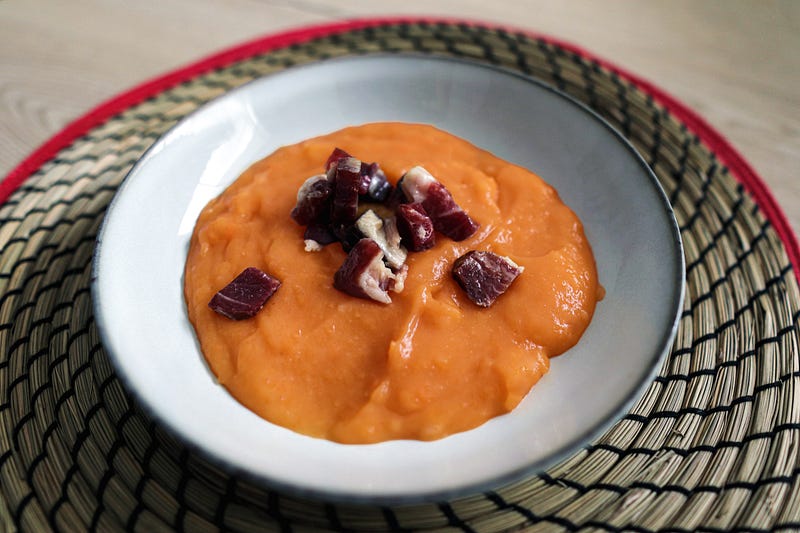
When my wife and I moved to Spain, we quickly realized two things: One, Spaniards are as passionate about their food as they are about everything else. Two, we had *a lot* to learn about Spanish gastronomy.
We arrived here in record heat during the summer months, and our culinary exploration began with one of the few dishes we could stomach in the heat: cold soup.
To those not born or having lived in Spain, the mention of “Spanish cold soup” immediately brings to mind the image of gazpacho — ripe tomatoes, cucumbers, onions, and garlic, blended with a liberal drizzle of extra virgin olive oil, a pinch of sea salt, and sherry vinegar to taste.
A native, however, would be quick to ask: “Which Spanish cold soup do you mean?”
Meet salmorejo—gazpacho’s heartier, lesser-known cousin. It’s the soup you crave when you’re really hungry in the dog days of August.
Like gazpacho, salmorejo comes to us from the sunlit kitchens of Andalusia, the most southern province of Spain bordering Portugal on the west and the British-governed isle of Gibraltar in the south.
Salmorejo is the thick, velvety, comforting Spanish cold soup born from the practical marriage of ripe tomatoes and stale bread.
The bread is soaked in water, then drained and torn into pieces. The tomatoes are washed, de-stemmed, peeled, and hand-mashed against a strainer to separate them from their seeds. With the seeds discarded, the juice and pulp are transferred to the blender with the bread.
Just a few more steps and the salmorejo-making is done: Salt, garlic, extra virgin olive oil, and sherry vinegar are added. Then, the mixture is blended to smoothness and rested for 1–2 hours in the fridge, so the flavors meld together and the soup cools.
Once cooled and properly rested, the salmorejo can be served as is or, for extra heartiness, garnished with diced hard-boiled eggs and Iberian jam.
(To those familiar with Italian cooking, the two main ingredients of salmorejo will bring to mind the recipe for pappa al pomodoro. While pappa al pomodoro is also prepared from stale bread, it’s often made with canned tomatoes and — unlike salmorejo — it’s cooked.)
All of this is to get you to try salmorejo if you haven’t.
It’s a recipe that pushes the limits of just how rich and creamy a soup can turn out without any cooking (apart from dipping the tomatoes in water to make them easy to peel) and without the use of dairy.
It’s also a way to use up in-season tomatoes and stale bread that’s so delicious, you can’t help but celebrate the ingenuity of Andalusian home cooks, who once took a few ingredients and turned them into a dish so plentiful, the whole of Spain’s now making it on repeat all summer.
Salmorejo Recipe
The quantities in this recipe are enough for 2 people. (To feed a family of 3, multiply by 1½. To feed 4, multiply by 2.)
Ingredients
- 1 lb (450 g) tomatoes; ripe, plump, and in-season
- 1 cup bread; stale and torn up
- 1 clove garlic
- 2 tbsp (30 ml) olive oil; extra virgin
- 1 tbsp vinegar; sherry vinegar
- 1 pinch salt
Steps
- Soak the bread: Tear up the bread in a bowl and add water. Set aside and proceed to the next step.
- Peel the tomatoes: Core the tomatoes. Cut a cross on the skin on the opposite side. Blanch the tomatoes to make them easy to peel, then peel them. (To blanch the tomatoes, dip in boiling water for 15–30 seconds, then fish out and plunge into an ice water bowl to chill and stop the cooking process.)
- De-seed the tomatoes: Place a fine-mesh sieve over a bowl or pot. Rub the peeled tomatoes against the sieve, aiming to press out as much juice as you can. Keep the pulp and discard the seeds. Pour out the juice into the blender and throw in the pulp.
- Mix the ingredients, then blend them: Drain the bread and squeeze out the water. Add the bread to the blender, along with peeled garlic, salt, extra virgin olive oil, and sherry vinegar. Blend briefly; till smooth.
- Refrigerate: Transfer the salmorejo to a jar or bottle. Refrigerate for a minimum of 1–2 hours before serving. (The longer the soup rests, the better it will taste; the ingredients need time to meld.) Refrigerated, salmorejo will keep for 3–4 days.
- Serve: Plate and garnish. Traditionally, salmorejo is garnished with Iberian ham and a diced hard-boiled egg. (For convenience, the egg can be boiled ahead of time and stored in the fridge.)
Thanks for making it this far! I’m new to Medium, and your feedback helps me understand what readers like yourself like—so I can write more of it. If this story resonated with you, let me know by giving it a clap, leaving a comment, or sharing it with your friends.


