
Sally’s Wedding
Our mental healthcare system is broken
I’ve heard people say that going on Facebook depresses them. They see other people’s happy lives and exotic travels and wonder if their own measure up. I don’t usually have that experience, though. I like to live vicariously through my Facebook friends, seeing faraway places and “doing” exciting things I don’t have the time or brio to get around to on my own.
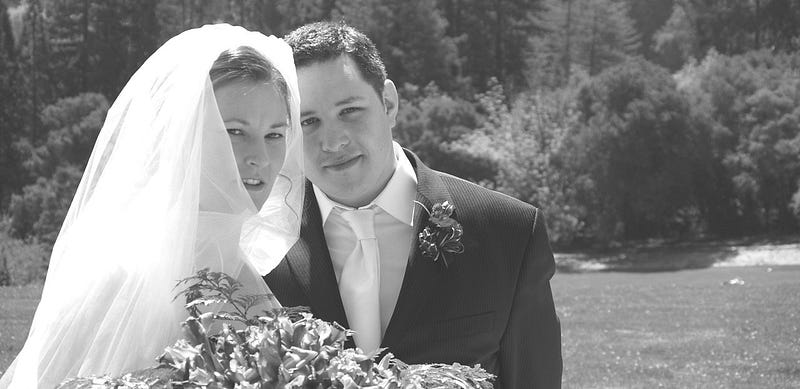
But it was different yesterday, when I found myself pouring over pictures of Sally’s wedding. There was a video clip of her father walking her down the “aisle” — a dirt path in a vineyard in Sonoma County — that I played four times before unhappiness overwhelmed.
Was it jealousy? Not exactly. You see, Sally used to be in love with my son.
I have a picture of the two of them going to prom in high school. She rocks a long black dress with big white polka dots and white gloves. He looks fantastic in a suit jacket and slacks. They pose in front of a backdrop of Paris. He has a red lipstick kiss on his cheek. She holds her fingers up in front of her mouth, miming “Oh!” His hands hold her slender waist as he leans back and flirts with the camera, vamping right along with her, compliantly playing his role.
It’s exactly the kind of photo Sally would compose: charming and funny and planned down to the last detail. Some attendees at her wedding took pictures of their place settings. Each one was unique. She wrote the name cards by hand and adorned them with photos she’d chosen to be personally relevant to each guest. Sally is the Scrapbooking Queen. She is the Anti-chaos.
Her high school crush on my son was a puppy love, sure, but I remember it fondly. Because back then, we had all kinds of hopes for Scott. He’d been hard to raise: stubborn and defiant, but also smart and handsome and unusually charming, awake to possibilities in the world around him, intensely alive. We hoped that growing older would smooth out his rough edges. We worried that it would not. Because mental illness runs in my family. My father was bipolar. Two cousins on my mom’s side — the same. An uncle died of alcoholism. There there were years when I had chronic panic attacks. And something about Scott’s behavior felt too familiar.
I remember lying in bed one afternoon when Sally’s mom came over to loan me self-help tapes for anxiety. We talked of Sally and Scott’s romance, and I admitted that I worried that something was wrong with my son. Just a year later, at age 18, Scott had his first psychotic break. And over the next 14 years, he’s taken us on a hell ride.
While Sally was vowing to love and cherish her sweet man in a creamy bridal dress on a bucolic farm in Sonoma, my son was struggling with security guards at a psychiatric hospital, breaking a window and getting a black eye in the course of refusing antipsychotic medication.
Trying to get help for him has been Kafkaesque. There are laws that protect his “right” to be mentally ill, allowing him to refuse medication and treatment and walk out of a hospital at any time, despite the fact that a common symptom of mental illness is not knowing that you’re mentally ill.
We’ve called the police to our home more than once, asking for help getting Scott to a hospital, only to be told that carrying his pee around in a bottle in his pocket, hiding in the crawl space over the garage, or ranting non-stop for four hours straight is “not a danger to himself or others,” so doesn’t meet the criteria for taking him to the hospital against his will.
Even when we do manage to get him hospitalized, they don’t keep him long enough to make a difference. Three days is typical. Rarely, that’s extended to 10. All across America, we’ve lost 96 percent of the psychiatric beds we had in the ‘50’s, so hospital personnel keep their psych patients churning to make room for the next person in line.
You might think a person like Scott is his family’s problem, not the hospital’s. And we’ve tried to help him. Believe me, we’ve tried. When living together became untenable, we lined up a room in a hotel in North Beach where he antagonized the manager, threatening lawsuits because he wasn’t allowed to let vagrants sleep on the floor in his room. When we bought him a small trailer in Belmont, he ripped out the built-in furniture and used it to create “artwork” in his driveway. His toilet got clogged, so he shoveled the shit into his shower. Three big, burly meth users moved in.
Scott was lying in a puddle of glass on the floor of that trailer, beaten bloody and semi-conscious, when he called to whisper, “Mom, I’m afraid I’m trying to get myself killed.”
Scott’s been homeless. Dirty. Pathetic. Aggressive. Beaten up. Broken. Afraid. We used to let him come into our house to use the shower or toilet, spend a night on the couch, or share a meal, even though sometimes he’d start yelling and refuse to stop or leave. Then his dad had a heart attack while Scott was yelling at me in another room, so I don’t let him into the house anymore. I meet him at a park, or a restaurant. I visit him in the hospital, or jail.
Even with his family’s support, Scott hasn’t been able to put any kind of life together in the 14 years since that first psychotic break. He doesn’t cooperate with doctors or take his medication as prescribed. He resists interventions. He imagines that we are conspiring against him, not trying to help.
Today, he isn’t speaking to me. He asked me to show up at a hearing at the hospital to tell the administration that he can take care of himself. But I didn’t, because he can’t.
Scott’s diagnosis is schizoaffective disorder. He also uses alcohol, marijuana, and crystal meth. Of course I want him to stop, but I also sympathize. Perhaps if I were homeless, without a place to pee, or sleep safely, or even sit down, and unable to separate enemies from friends — delusion from reality — I might use drugs, too. I might want some relief.
One time he let two muggers beat him senseless rather than hand over the $20 clutched tightly in his fist. That’s emblematic of his personality and his illness. He’s both a bad-ass and dangerously misdirected. He’d rather die than submit to authority — to anyone. But I’m not ready for that. I don’t want my son to die.
The period when we saw the most improvement in Scott was the year when he was conserved, meaning a public guardian made Scott’s decisions for him, requiring him to take medication and stay in a locked psychiatric hospital where he got therapy and got off street drugs. He was friendly when I came to visit. He introduced me to a new girlfriend with a self-conscious smile. The two of them participated in groups daily. And the family who loves him — his father, sister, brother and mom— all hoped that one day he’d return to us, come to Christmas celebrations, maybe wash dishes in our family cafe.
Then a judge who’d seen him for five minutes decided he was no longer gravely disabled and released him from conservatorship. An hour later, he was on the street with nothing — no doctor, medication, money, or support. That’s how our system works. One day you’re in a locked psychiatric ward with every need taken care of. The next, you’re on your own.
The judge was wrong. Scott needs what every floridly psychotic person you see on the street needs: to be taken into custody and given medication — whether they want it or not; to be given a safe place to sleep and a hot shower; to be coaxed back to reality with kindness and professional attention.
When I’m not stressing over my son and trying to line up housing, medication, and some kind of treatment, I give walking tours of San Francisco. A recent tourist from Israel said he wouldn’t be coming back anytime soon because when he walked down Market Street, he saw mentally ill homeless people everywhere he looked, stepped around junkies on the sidewalk shooting up heroin, smelled feces and urine on the street.
“Why aren’t you taking care of these people?” he asked me.
I said we were trying.
He said not hard enough.
And that’s the question I’ve been asking myself ever since. Why aren’t we taking care of the mentally ill and drug addicted people on our streets?
Our current mental health care system is brutal, misguided, and inhumane. Back in the day, people with a major mental illness could live in an asylum until they were stabilized. Then asylums were closed for “humanitarian” reasons. But it’s not humane to put a person with a major mental illness or serious drug addiction on the street.
The result is both upsetting and dangerous. And everyone is paying the price: the people who are mentally ill and abandoned; their families who can’t figure out what to do next; and those who have to walk by, turn their heads, and pretend they don’t see the suffering — or the garbage, used needles and human waste.
Yesterday, Scott called to say he hates me. He called me a bitch. But I know better. I know he wouldn’t say those things if he was on medication, had a place to sleep and a belly full of food. I remember how he looked in his suit jacket on prom night.
That’s why I cried when I saw the pictures of Sally’s wedding. That’s why I’m still crying now. It’s not that I wish Scott had married Sally. I cry because the kind of sweet, stable life that Sally represents is not an option for my mentally ill son. But it could be. It still could be. If only our nation would take care of our people.
Why aren’t we taking care of them?
For further reading…
My writing is free to readers who follow links from Twitter, Facebook, and LinkedIn, but if you’d like to read more, click here to join Medium for $5 a month and they’ll give me some of that money. (Yes!) For an email when I publish a new story, click here. Find more stories about mental health on this List. And for more of the good stuff, follow Fourth Wave, where we’re changing the world for the better, one story at a time. Got one of your own? Submit to the Wave!