
Saint John the Baptist’s Head
Christian and Muslim beliefs
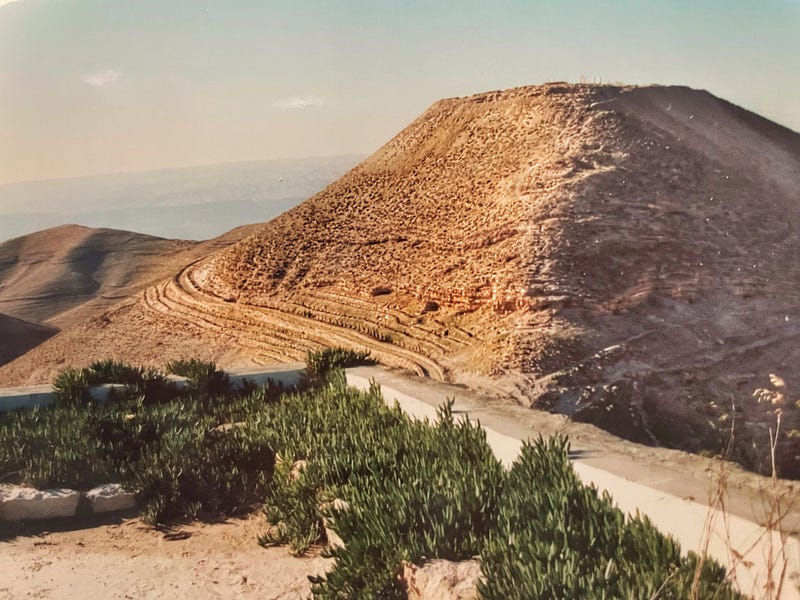
The hilltop in the photo is believed by Jewish-Roman historians to be the site of Tetrarch Herod Antipas’ fortress. It is located on the mouth of the Jordan River on the eastern side of the Dead Sea. It is near the Jordanian village of Mukawir about 45 km away from Madaba on the King’s Highway. (Source) When we lived and taught in Amman, Jordan, we traveled down this road often.
Tradition is that this is the site where John the Baptist had his head cut off.
John was born long after Zacharias and Elizabeth thought it was possible for them to still have a child. Mary visited Elizabeth while both were carrying their sons. John leaped with joy in recognition of Jesus in the womb.
John grew up in the hill country of the area. He lived in the desert, wore camel’s hair clothing, and ate locusts and honey. He preached to people in the area about repenting for sins. He talked about Jesus to the people that gathered to hear him speak. He baptized Jesus in the Jordan River when Jesus began his ministry.
After John criticized King Herod for marrying his brother’s wife, Herod imprisoned John in his fortress near the Dead Sea. “This condemnation would be his downfall as King Herod promised to grant a wish to his daughter. In revenge for John the Baptist’s condemnation of her mother’s scandalous marriage to Herod, she asked for John’s head. King Herod reluctantly obliged. John the Baptist died sometime between 33 and 36 AD.” (Source)
Where is John the Baptist’s Head? There are many beliefs and traditions. The one that fascinates me is that his head is buried in the Umayyad Mosque in Damascus, Syria. The mosque is beautiful. We visited it often on our trips to Damascus from Amman, Jordan.
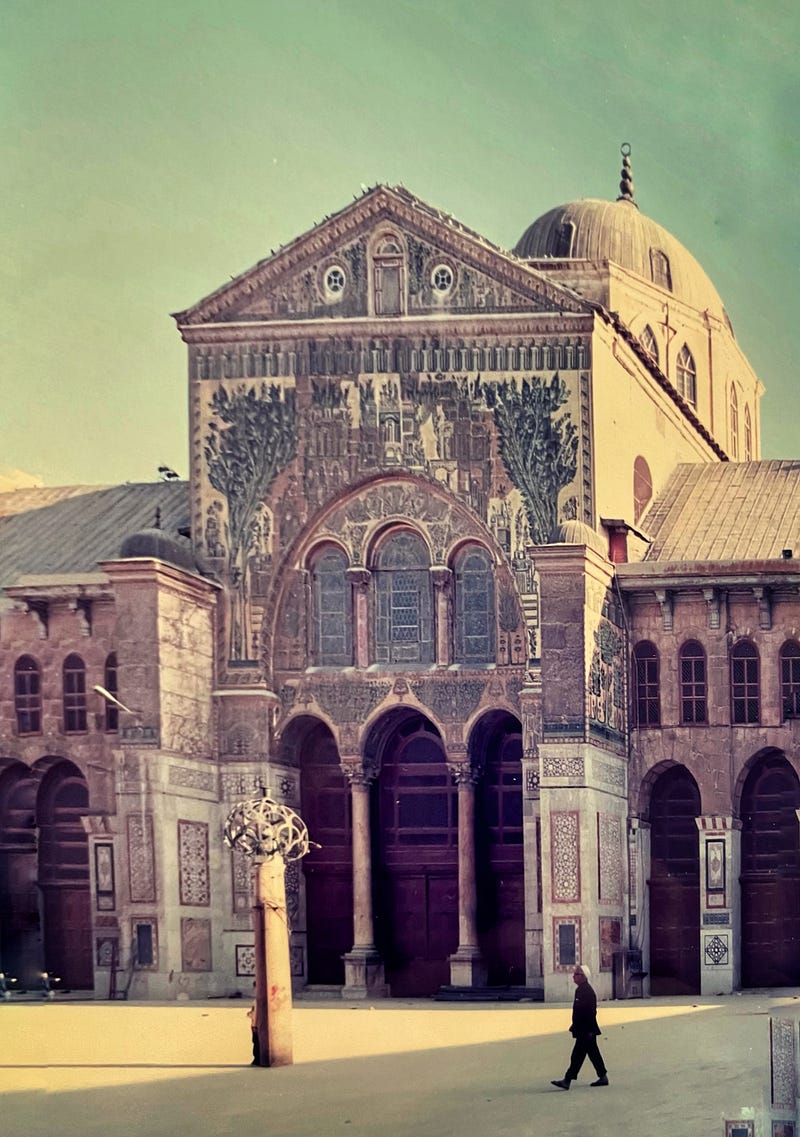
Throughout history, as the religious beliefs of the people in an area change, they often decide the best place for a new religious building is on the site of the previous religion. One of the earliest religious buildings on this site was an Aramean temple from about 3000 BCE. During the Roman era, a temple to Jupiter was built on the same site. In 391, the Temple of Jupiter was converted to a cathedral, Saint John the Christian. It was believed then that John the Baptist’s head was buried there. In the 6th century, the cathedral was dedicated to John the Baptist.
Christians and Muslims shared space within the old cathedral. In 706 the cathedral was demolished to begin construction of the Umayyad Mosque. “During the construction of the mosque, workers found a cave chapel which had a box containing the head of John the Baptist, known as Yahya ibn Zakariya by Muslims. Upon learning of that and examining it, al-Walid I ordered the head buried under a specific pillar in the mosque that was later inlaid with marble.” (source) This pillar is still present in the mosque today and is still believed to be where the head of John the Baptist is buried.
If you travel to Jordan or to Syria, try to visit both sites. History, traditions, and religions overlap and are fascinating to explore.


