
Sailing into Trouble
A memory of a nail-biting journey
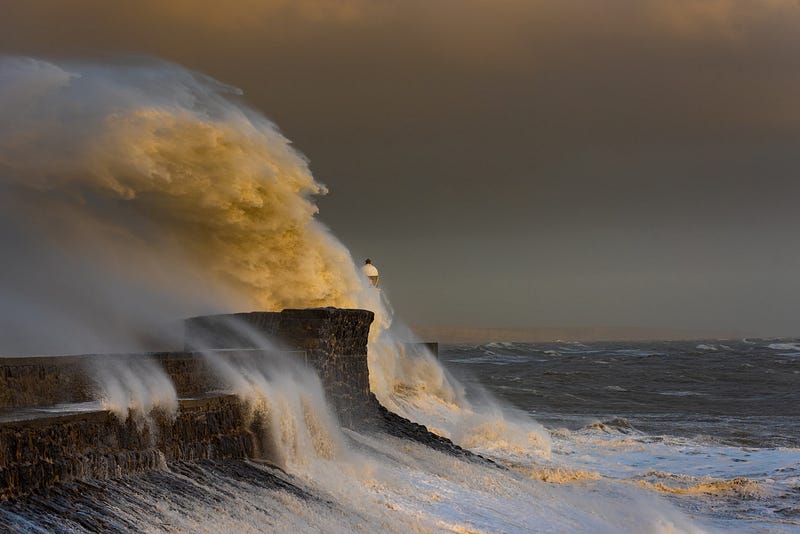
In my carefree younger days, I used to do a lot of offshore sailing. We Brits are islanders and seafarers. For a relatively small country, the British Isles have a long and varied coastline, and some of the largest, and wildest tides in the world.
It is essential to scrutinise thick books of tide tables and charts before setting out on even the briefest voyage or run the risk of ending up aground, on the rocks, or simply being carried backwards by the rush of the tide. And then there are the winds and the storms that build in force on the long journey across the Atlantic, then pick up their skirts and dance chaos on our western coasts.
One summer I signed up for a trip sailing a 35-foot yacht down the southern coast of Cornwall — the south-westerly tip of England — and then across the Irish Sea to the Republic of Ireland. We had a week to complete the journey and deliver the boat to a fresh crew that would meet us in Wexford.
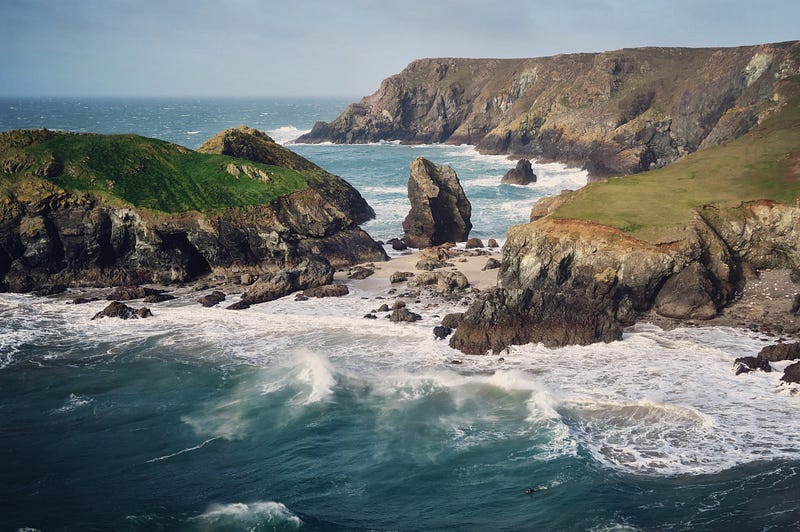
For the first few days, we pottered down the jagged Cornish coastline, exploring wooded estuaries and inlets, fishing for mackerel off the stern of the boat, and mooring up for the night in fishing villages shielded by ancient stone harbour walls.
I find sailing the perfect escapism. You get physically worn out, without breaking a sweat, from the constant strain of tensing and adjusting to stay upright on a bobbing, bouncing vessel. Cooking on a stove, or sleeping on a berth, canted over at a 45-degree angle is all-consuming. The endless recalculation of the combined impacts of tides, winds, speed, and drift on your course is mentally taxing. And confinement in a space smaller than my kitchen with five or six other people, sometimes for several days and nights, renders teamwork, collaboration and communication essential.
These elements come together to banish the concerns of daily life and create a sense of both literally and metaphorically floating free of the ties of landlocked normality. Sailing is an escape to a clear place of wide horizons away from phone signals, routines, and responsibilities, with no choice but to focus completely on the rhythm of the winds and the tides, the insistent demands of nature.
Our plan, on that trip to Ireland, was to spend the first half of the week exploring the Cornish coast, then make the dash across to Ireland and spend the rest of the week exploring the area around Wexford.
The weather gods, however, had different plans.
Nowadays medium-term weather forecasting has become far more accurate, detailed and accessible thanks to the internet. But back then we basically had one source of information on the incoming weather — the Shipping Forecast — that was, and still is, broadcast twice a day on BBC Radio.
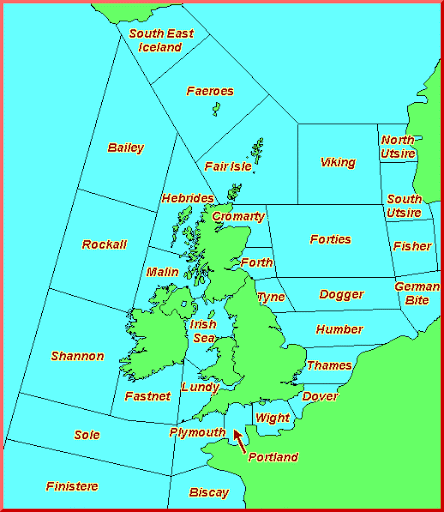
Five minutes long, the Shipping Forecast traces the course of the British coastline, conveying with mesmerising monotony the forecast of wind direction and speed, visibility, and air pressure for each of the 31 areas that our seas are divided into. It has been broadcast to seafarers, every day, since 1857.
Twice a day our crew would gather in silence around the chart table, pencils in hand, ready to copy out the forecast for the sea area in which we currently found ourselves — Plymouth — and those we were planning to head into — Lundy and Fastnet.
Early in that week, it began to become clear that we were sailing into trouble. Air pressure was dropping fast off the western coast of Ireland, sucking air into an accelerating swirling vortex. A major storm was building.
By the time we reached Land’s End — the furthest tip of Cornwall’s pointed toe — the storm was upon us. The calm, impersonal voice of the Shipping Forecast promised us turmoil, Gale Force winds were approaching: Force 8, 9, 10 and beyond.
We tried to wait out the storm. For two days we hunkered down in a harbour just to the east of Land’s End, and played a lot of scrabble, waiting for the winds to blow themselves out. But by Thursday we could wait no longer. The next crew would be waiting for us 150 miles away in Wexford. We were in possession of their holiday accommodation and transport; we couldn’t keep them waiting.
We divided our crew of six into three watches of two people each. It would take us at least 24 hours to cross the Irish Sea. We split the day into six watches of four hours. We would all rotate — four hours sailing the boat, four hours attempting to sleep, four hours cooking or otherwise helping out, then repeat. I’d been sailing about eight years by then so was appointed leader of one of the watches, with a young, inexperienced guy named Malcolm as my watch-mate. I wonder if he ever went sailing again after that trip.
We set off from our safe harbour at 5 am when the tide turned in our favour. Since we were sailing into the storm we couldn’t just plot a straight line, we would have to zigzag — or beat — into the wind, the sails winched in drum-tight, the boat tilted over at an improbably steep angle. The most exhilarating, and exhausting, point of sail.
We cleared the Lizard — the final speck of Cornwall — and tacked to the north, sailing, in our tiny boat, into towering, roaring seas. The battering, howling wind was a physical assault. We struggled to hear each other. Every part of the boat was creaking and straining. The waves were taller than the mast. As we crested each one and plummeted down into the next trough all we could see ahead and behind were looming mountains of green-black water.
Supposedly it was summer but there was no sign of it in the Irish Sea. We were all clad in full oil-skins, boots and hats, chilled by the wind and relentless drenching waves, our fingers shrivelling from the soaking saltwater. We were all hooked onto the boat by a line like a climber’s rope.
Malcolm and I took one watch in the middle of the day, one of us on the wheel, one on the ropes, braced against the bucking movement of the boat. We tried to steer the smoothest course we could through the crashing waves to allow our crewmates to grab some sleep down below. We strained to see ahead as we crossed a major international shipping lane, ploughed by cavernous container ships which would sink us without even noticing if we ran into their path.
After our watch, we fell, fully clothed and soaked, into one of the bunks on the uphill side of the boat. Wrapped in a damp sleeping bag, encased in a canvas lee cloth to stop us hurtling across the cabin, we slept. Turns out you can sleep through anything when you’re properly exhausted.
Malcolm and I came on watch again at 1 am. The storm was still raging. The night was terribly dark — the moon and stars were completely obscured by the ominous clouds. The only lights were the small red and green navigation lights on the bow and masthead of the boat. The compass, fixed on top of the wheel post, glowed an eerie luminous green.
That was one of the longest nights of my life. Four freezing, terrifying hours of darkness, gripping the wheel and battling the ocean one massive wave at a time.
I tried to sing to keep my spirits up. The only songs that I could remember the words to were either hymns learnt off by heart at school, or lyrics from childhood films like Mary Poppins or The Jungle Book. I belted out “The Bear Necessities” and “High on a Hill Stood a Lonely Goat Herd”, sometimes getting a mouthful of saltwater mid-note. At one point, I found myself desperately willing land to appear on the horizon, repetitively chanting a few lines from the hymn “Jerusalem”:
“And did those feet, in ancient times, walk upon England’s mountains green…. MOUNTAINS GREEN!!”
I’m a strong swimmer, have always been at ease in and on water. But that night, staring out at the angry seas, I was brutally aware that if I were to fall overboard for any reason that would be it, I would undoubtedly drown. No one would ever find me in these waves.
At around 4 am, with one hour of our watch to go, the first hint of dawn started to appear behind us. I was on the helm and scanned the water around us, yet again, looking for any dangers. I noticed a strange movement in the water, off to starboard. My eyes were accustomed to the patterns of the waves by then and this was a strange smooth hump, maybe four feet long, moving against the flow of the water. It vanished under the waves, but then there was another, and another, and another. Emerging, and sinking.
It was still dark. Was I beginning to imagine things in my exhaustion? I squinted into the wind and the dark and saw one of the humps leap out of the water and then dive back in. And then I understood.
We had been joined, at that hour before dawn when the human spirit is at its lowest ebb, by a pod of porpoises. They were swimming just off our stern, jumping and playing in the wave created by our bow. I counted at least twenty of them. In all the thousands of miles that I have sailed around the British Isles, I’d never seen a porpoise before or since that voyage.
They stayed with us through the rest of that watch. I may have been verging on delirium, but I felt strongly that they were the spirit of the sea, come to shepherd us to safety. Their presence — the only warm-blooded inhabitants of this section of open ocean — was soothing and reassuring.
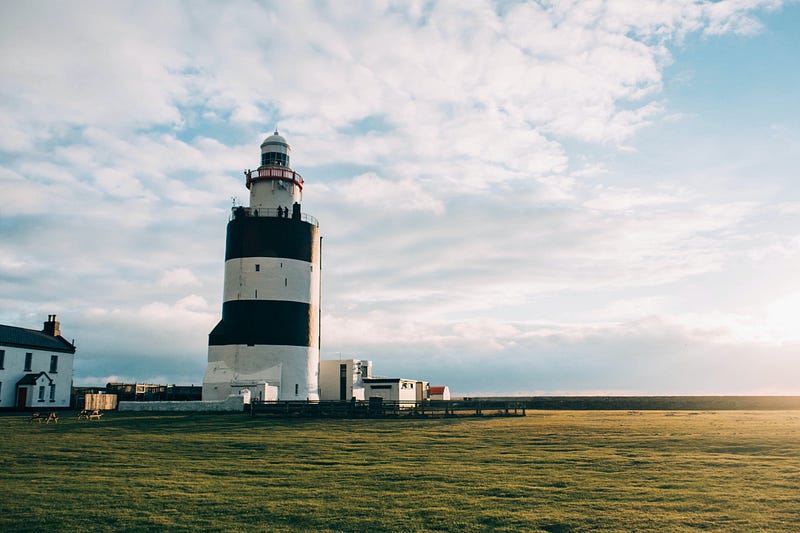
Around 5 am, we finally glimpsed the pulsing light of the Hook lighthouse, reportedly the oldest in the world, beckoning us towards safety. Shortly after that, as the sun cleared the horizon, our escort peeled off and vanished.
We limped into the port of Wexford later that morning and moored up against a fishing boat. Standing on dry land, the stone quay beneath our feet seemed to lurch and pitch. The next crew were astounded when we showed up and handed them the keys to the battered boat.
“We didn’t think you’d make it,” confessed the skipper, “We thought you’d have to turn back.”
We were due to fly out that night. In the meantime, we booked a room in a hotel so that we could all take turns in the shower washing off the encrusted salt. And then we slept, sprawled on the bed, the sofa and the floor, until it was time to head to the airport.
Flying high over that sea back to England, it looked no more threatening than a duck pond.
My thanks to Dennett for the prompt that caused me to dredge up this memory. The whole journey still feels like a hallucination.