
Sailboats and Swallows: Loss, Grief, and Meaning in NOMADLAND
For many of us, this film arrives just when we needed it.
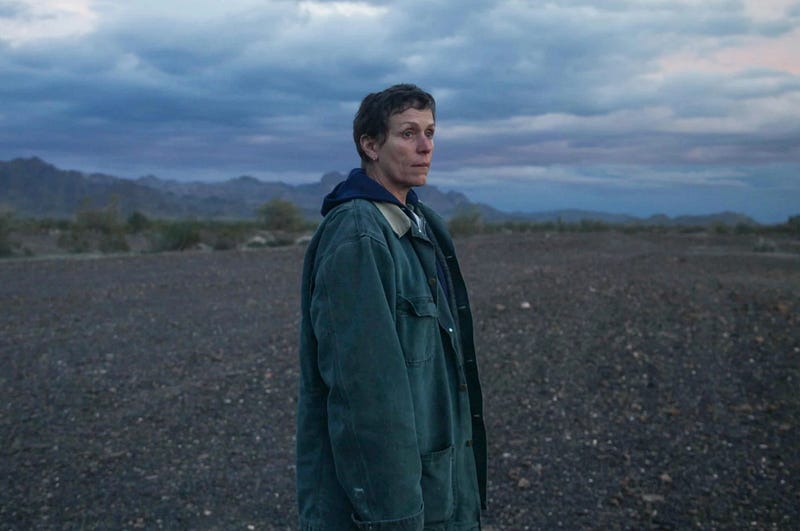
I just watched Nomadland.
And, well — wow.
I knew, from the moment the end credits started rolling, I had to write about it. It’s that kind of movie.
I’ll press on as if you’ve already seen it, so there are spoilers ahead. But first, some quick background on the film:
- Adapted from a nonfiction book titled Nomadland: Surviving America in the Twenty-First Century by Jessica Bruder
- Stars undisputed national treasure Frances McDormand as Fern, a woman who has lost everything, including her husband, and sets off in her van to explore the West
- Directed by Chloé Zhao, who also adapted the screenplay. It’s her third film; previous credits include Songs My Brothers Taught Me (2015) and The Rider (2017), both of which also focus on the modern American West
- Features a number of performers — almost all, in fact, except McDormand and David Strathairn, who plays Dave — who are real-life nomads rather than professional actors
I’ll be honest. I struggled with how to organize this little essay, because the movie is a lot of things. Its various layers will resonate with people differently. I’ll touch on a few of those layers here, although my reading of the film is far from universal — which, to clarify, I think is wonderful.
Perhaps foremost, it’s a potent indictment of American capitalism. (In light of recent news stories on labor rights, there’s a lot to say about how the movie depicts Amazon, which features prominently in the story. But I’m going to let someone else say it.) The film is set in 2011, in the still-unfolding fallout of the 2008 economic crash. The specter of financial catastrophe is present throughout the film but most unmissable in the first third or so.
Early on, there’s a scene in the van-dwellers’ camp where a large group sits around a campfire and shares with their peers the myriad, devastating ways corporate America has failed them. One line in particular, from nomad Merle, has stuck with me in a way that I just can’t shake:
“I worked for corporate America for twenty years. My friend Bill worked for the same company and he had liver failure. … He died … having never taken that sailboat he bought out of his driveway. He missed out on everything. He told me before he died, ‘Just don’t waste any time, Merle. Don’t waste any time.’ So I retired as soon as I could. I didn’t want my sailboat to be in my driveway when I died.”
She pauses, then adds:
“And it’s not. My sailboat is out here in the desert.”
Already, you can start to see how Nomadland begins with a defined, concrete concept — the damage wrought by American capitalism — and spirals outward to something bigger, something almost spiritual in scope. The film is more than a reflection of the economic times. It’s also a powerful exploration of mortality, loss, grief, and, perhaps most of all, what gives life meaning.
Without a doubt, this notion intersects with the film’s underlying economic themes. In America’s capitalism, after all, the value and meaning of our lives is intrinsically tied to our participation in the labor force. We use the phrase “earn a living” as if our mortal existence must be justified by our ability to provide labor. This culture is what gives rise to the nomads, many of whom are consciously rebelling against it.
But to me, at least, Nomadland’s message goes beyond that. The film starts by acknowledging that our capitalistic system isn’t enough to grant meaning to our lives, then asks: what is?
This question is addressed by a number of characters, sometimes with almost startling directness. One of them is Swankie, a 74-year-old nomad who has terminal cancer. She plans to take one last trip while she still can, explaining to Fern that she refused to consider spending her last days in a hospital. She reflects on the things she’s seen in her life — I’ll let Swankie speak for herself:
“Coming round a bend of a cliff and finding hundreds and hundreds of swallow nests on the wall of the cliff. And the swallows flying all around, reflecting in the water so it looks like I’m flying with the swallows. And little babies are hatching out. Eggshells are falling out of the nest and landing on the water right next to me, these little white shells. And…it was just so awesome, Fern! I felt I had done enough. My life was complete. I felt like if I were to die right then, it would be okay. How many people can say that?”
Later, Swankie sends Fern a video from her final trip. It’s all there, just as she described it — the cliffs, the swallows, the fragments of newly broken eggshells floating on the surface of the water. It’s just low-resolution, shaky cell phone footage. And it’s stunning. We’re witnessing what, for Swankie, made life worth living. Fern watches the video and, smiling, whispers: “You made it, Swankie.”
If the pursuit of experiencing beauty is Swankie’s answer to what makes a life fulfilling, other characters have their own answer. In a poignant scene late in the film, Bob Wells, the de facto leader of this group of nomads, reveals to Fern that he, like Fern herself, is driven by grief. He tells her that his son took his own life five years prior. “I realized I could honor him by helping people,” he says. “It gives me a reason to go through the day. Some days that’s all I’ve got.”
He tells her that the two of them are far from alone in their experience of loss. In fact, he points out that many in their nomad community are carrying grief. “Most of them don’t get over it, and that’s okay. That’s okay.”
But it’s not just that these folks have reached a quiet acceptance of the burden of grief. Instead, Bob suggests that there’s something about this lifestyle that makes the grief easier to bear. “One of the things I love most about this life is that there’s no final goodbye,” he tells Fern in the same conversation. “You know, I’ve met hundreds of people out here and I don’t ever say a final goodbye. I always just say, ‘I’ll see you down the road.’ And I do. And whether it’s a month, or a year, or sometimes years, I see them again. I can look down the road and I feel certain in my heart that I’ll see my son again.”
At this point, it’s worth noting that not everyone in Bob’s group of nomads is there by choice. Many of them are there because they have few or no other options: they can’t afford to live on their social security payouts, so they travel in search of seasonal work. Again, this underscores the various cracks in American society into which far too many people fall. But I don’t think that bleak financial reality in any way negates the point Bob is making here. If the van-dwellers are only van-dwellers because of society’s failures, then they are all the more deserving of what comfort and solace they can find in that life.
While Swankie and Bob are forthright in their conversations about life’s meaning, others address this central question in a more indirect way. We see Dave, for example, reassess his own answer over the course of the film. He appears, initially, to be a committed member of the traveling group. Then his son catches up to him in South Dakota.
He tells Dave that his wife is having a baby in a few weeks, and he wants Dave to come home with him. Dave does, but not before admitting in an emotional confession to Fern that he wasn’t an especially good father to his own child. In doing so, he draws a contrast between himself and Swankie. She, too, has a son, but they’re estranged and she has no interest in seeing him.
Later, Fern goes to visit Dave, his son and daughter-in-law, and his new grandkid. She receives a warm welcome from the family, but at first, she’s intensely awkward — especially with the baby. By now, we know that Fern has no children of her own. Maybe that’s why she finds it hard to square with what Dave’s new priorities are in life, or perhaps it’s that she’s uncomfortable reckoning with the fact that she doesn’t have the option to prioritize the same things.
Shortly after Fern arrives, she and Dave have an exchange:
Fern says, “You’ve got a flat.”
“Huh?” Dave replies.
“Your van. One of your tires is flat, Dave.”
“Oh. Okay. I haven’t noticed.”
“Because you’re staying?”
“Yeah…”
He goes on to explain the difficulty of life on the road. “Every time I say bye to them,” he tells Fern about their nomad friends, “I don’t know if I’m going to see them again. And most of the time, I never see them again. It’s fine at first…but a decade of that is something else.”
Dave’s words are a point-blank rejection of Bob Wells’ assertion that “whether it’s a month, or a year, or sometimes years, I see them again.” But does that make either of them wrong?
I don’t think so. I think this is a way to honor the diverse tapestry of human experience; it reflects that one truth lived authentically might not align with another person’s truth, but both are equally true and equally valid, as long as they are an honest reflection of the individual. Dave is living Dave’s life, as best as he can. Bob is living his life and Swankie is living hers. And all the while, Fern is learning how to live this new chapter of her own life.
Dave invites Fern to stay with him. She seems to consider it, but in the end, she refuses. This house, this family, is Dave’s answer. It’s not hers. She moves on.
The film was shot in 2018, and after doing the festival circuit in 2020, it was made available on Hulu on February 19, 2021. Its wide release happens to coincide with a moment when so many of us are grappling with loss. Personal grief has defined the past year for hundreds of thousands of Americans. And hardly any of us, I think, are untouched by the societal grief that has saturated our collective universe since roughly February of 2020.
In between watching the death tolls rise and losing sleep worrying about the health of my loved ones, I know that I’ve certainly thought more about my own mortality in the past year than I have before. And it’s brought me to ask the same question that we see the characters in this film stare down, over and over again: what does it mean to have a well-lived life?
Rather than imposing a singular answer, Nomadland offers us a beautifully inconsistent kaleidoscope of possibilities. For Swankie, a well-lived life means seeking amazement and wonder in the beauty of nature. For Bob Wells, it’s about fostering community and being of service to others. For Dave, it’s about belonging and being present in a family that will be his legacy.
That, to me, is the ultimate message of the film: there is no one correct response to the question it poses. The key is that once you decide what gives life meaning, you have to live your answer.