
Sadness has Secret Superpowers that No Other Emotion Does
How you can apply the evolutionary benefits that scientists believe sadness provides.
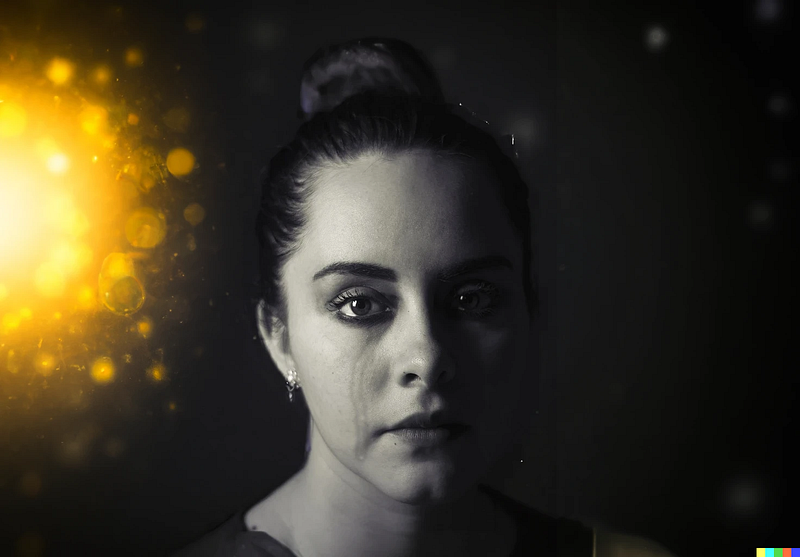
When I was six years old, I remember slipping on a step and skinning my knee. As the tears threatened to fall down my face, I heard my father’s stern voice, “Don’t cry.”
To this day, I recall the physical sensation of gulping the tears back down.
My father was entertaining some friends at the time and the unsaid message was clear, “We do not express sadness in front of other people.”
What I didn’t realize until many decades later was that I had also internalized the implicit message that sadness is bad and that we should avoid feeling it at all costs.
This message isn’t unique to my father, of course. Every day, we hear parents telling their children, “Don’t be sad,” or “Don’t cry” when it would be better to say, “It’s normal to feel sad” or “It’s okay to cry.”
Fueled by this message from both my father and the wider society, I spent my youth constantly chasing pleasure and suppressing or distracting my way out of any inkling of sadness. I thought I had found the answer to life. All pleasure, no pain.
But there was a shallowness to my experiences — especially when it came to romantic relationships. I was incapable of vulnerability because I was terrified of sadness.
I had initially thought that my problem was my inability to be vulnerable. So, I dove headlong into the next relationship and threw the doors to my heart wide open. But it was the wrong person for the wrong reasons.
When it ended, I felt an intense, almost drowning wave of sadness. I realized that until I learned to swim in sadness, I was always going to be afraid of the ocean of intimacy that existed out there.
So, for the first time in my life — I was determined to confront the sadness. Instead of trying to change my thoughts, I simply observed them. Instead of trying to suppress, distract, or push out my sadness as quickly as possible, I was going to sit with it and allow my body to feel it.
Becoming Friends With Sadness
To my surprise, my sadness did move through my body and leave on its own. The feelings would rise and peak but eventually pass. Like a toddler tiring from a tantrum, it quieted down without any active intervention from me. More importantly, it felt like if I allowed its full expression, none of the sadness lingered. All of it was gone. Completely.
From that moment on, each and every relationship I built was deeper, more meaningful, and more intimate. Embracing sadness finally gave me the freedom to love as deeply as I wanted.
The experience was so transformational that I came to realize that sadness must have a purpose. There must be a reason it is one of the seven universal emotions that everyone experiences. It turns out that I was right.
None other than Charles Darwin himself had hypothesized that sadness must have an evolutionarily adaptive function. In fact, as I dug deeper into the research, I found that sadness has multiple superpowers that other emotions don’t.
Evolutionary Adaptive Benefits of Sadness
Two major clues to the importance of sadness as an evolutionary adaptation are that there are more situations that lead to sadness than to any other emotion and that sadness is the most intensely experienced emotion. It makes sense when you consider the proposed benefits of sadness such as the ones summarized below:
Sadness fosters connection and empathy
One of the first things I noticed when I was sitting with sadness was how much it deepened all the other relationships in my life.
Talking about my sadness allowed people to show up for me. Expressing my vulnerability signaled that I trusted them and forged a stronger bond. More importantly, knowing that I was sad, people went out of their way to check in, spend time with me, and demonstrate support in any way they could far more than they ever did when I was happy.
This ability of sadness to foster connection and elicit empathy is in fact what Charles Darwin suggested is the evolutionary adaptation of sadness. He theorized that sadness is a communication tool that allows us to signal distress and receive the support of others or even a whole tribe in order to survive a traumatic event.
Sadness gives us information on things that harm us
Scientists postulate that in the same way that physical pain alerts us that something is causing us harm, sadness is sometimes a psychological sign that something is bad for us.
This makes sense when you think about it. An abusive partner, a toxic friend, and a job that doesn’t align with our values are all things that make us sad. Once the damaging external stimuli go away, sadness will also eventually dissipate. There is also no instance where something that is psychologically damaging occurs and sadness does not follow. The two go hand-in-hand.
Sadness improves prioritization and problem-solving skills
A common consequence of sadness is that attention to the outside world is reduced. We withdraw socially and reduce our investment in non-essential activities. Psychiatrists suggest that we do this as a form of energy conservation. It allows us to redirect the energy inward to create more self-awareness and increase problem-solving.
Psychologists have even been able to demonstrate that sad people are better at using more data-driven strategies while happy people apply more theory-driven strategies. So, in certain situations, sadness may enable you to make more objective and fact-based decisions.
Sadness fuels motivation
When I was actively avoiding sadness, I realized that my motivation for certain aspects of growth was limited. For example, although I had always wanted to be better at mindfulness, when I was generally happy — I was fairly complacent at doing it.
However, when I was deeply sad, I had an intense motivation to understand mindfulness which promised to allow me to observe my feelings. In one month of sadness, I cultivated a greater capacity for mindfulness than years of effort when I was happy.
Psychiatrists believe that sadness motivates people to change to both escape the negative state, as well as to avoid being in that negative state in the first place. It makes sense that the sadder you are, the more motivated you are to change something. While the happier you are, the more likely you are to want to stay in that state.
Now that you know, the next time you are sad, you can take advantage of the adaptive benefits of sadness. Here’s how:
Disclaimer: The material contained in this article is for informational purposes only. No part of the text is intended to be a substitute for professional medical and psychiatric advice, diagnosis, or treatment. Always seek the advice of a qualified mental health professional before undertaking any action relating to the information you have read in this article.
How to Leverage the Secret Superpowers of Sadness
The main reason that many of us are unable to tap into the superpowers of sadness is simply that we don’t allow ourselves to. The key word here is surrender. Here are some actionable ways to surrender to sadness:
1. Allow connection
We often suppress sadness because we are afraid of appearing weak or being a burden to our friends. But sadness often devolves into depression when we suppress the opportunity for connection.
When you feel the familiar urge to hide your sadness, remind yourself that decades of research show that expressing sadness elicits empathy and bonding more often than not. So, go ahead, reach out, and allow yourself to be supported.
2. Pay attention to what sadness is trying to tell you
Because sadness rarely results in a broken bone or continuous bleeding, we tend to ignore the information it is giving us — to our own detriment. After all, psychological pain can be just as damaging as physical pain.
To elicit the information that sadness can provide, take a pen and paper and do an audit of the recent times in your life when you have felt sad. Then identify if there are common events or people. If there is a pattern to your sadness, it may be time to cut ties with that activity or person.
3. Lean into self-awareness
Scientists have also observed that sadness often motivates people to self-reflect and evaluate their feelings and thoughts about the event. This is believed to be a way to heal and recover from loss. Often this also leads to the person investing time into understanding what is meaningful to them and refocusing their energies.
You can tap into this increased self-focus when you are sad to better understand how these events occurred, the role you may have played in it, and the things you can do to mitigate the situation in the future. More importantly, you can use sadness to understand your own patterns and preferences. Journaling can be a highly effective way to explore and document the insights from this phase.
4. Tap into growth
When you are sad, you will be far more motivated to develop tools to cope with your sadness or to change your existing situation. This is a powerful catalyst that you can take advantage of.
Some of the ways to leverage sadness include participating in novel activities (e.g., dance classes, traveling, etc.), learning new techniques (e.g., meditation, exercise, journaling), or setting new goals (e.g., building a stronger community). Remind yourself that you can start today to be more emotionally resilient for the future and use that to fuel growth.
5. Redirect it to a creative expression
Something I’ve known for a long time is that I often create far more beautiful songs on the piano when I am sad. I’m not alone, scientists have long studied a link between sadness and creativity. There are also many examples of artists who have channeled their sorrow into creative masterpieces. One such example is the singer Adele, whose album “21” is an expression of her heartbreak and depression following a breakup.
The next time you are sad, find a medium that works for you — write, sing, play music, paint. It doesn’t really matter what you do — just create and let the pain transform something mundane into something profound.
Takeaway — Sadness Makes Your Life Richer
I’ve always been a voracious reader. When I was 11 years old, I heard of the classic book, “The Prophet” by Kahlil Gibran. At the time, ebooks did not exist and in the relatively small city that I grew up in, book options were limited.
I had a copy special-ordered, and it took 8 weeks to arrive. I remember my excitement when the book arrived, followed by my abject disappointment very soon after. I didn’t get it at all. The book sucked. It talked about everyday things that seemed obvious and mundane. I set it aside and promptly forgot about it.
Sixteen years later, I was at work one day after a breakup. Trying to hide the stream of tears flowing from my eyes, I ducked into a bookstore where a book with a beautiful velvet-bound cover caught my eye.
I picked it up and read the page that the bookmark ribbon happened to fall on. It was the most profound poem I had ever read up to that point. I felt as if it spoke directly to my experience, and it was written just for me. I remember an immense feeling of awe for the experience I was having.
I finally flipped back to the cover and saw that the book title was, “The Prophet.”
At that moment, I understood that the only thing that transformed the words that my 11-year-old self considered utterly boring into something so profound and beautiful — was the painful experience I had just endured.
The poem was called, “On Joy and Sorrow” and I could finally experience it fully because I had now experienced deep sorrow.
It made me see that sometimes, sadness can make the world more meaningful, richer, and more textured. That you can have the exact same experience as someone else or even your past self and sadness can transform it into something completely different, and in many ways — better.
“Sadness gives depth. Happiness gives height. Sadness gives roots. Happiness gives branches. Both are needed, and the higher a tree goes, the deeper it goes, simultaneously. It is always in proportion. That’s its balance.” — Osho
If you are interested in reading more about methods to create a deeper connection with yourself and others, subscribe to my mailing list to get it in your inbox.


