
-S.D.R.- From commercial use to Piracy and Satellite data harvesting!
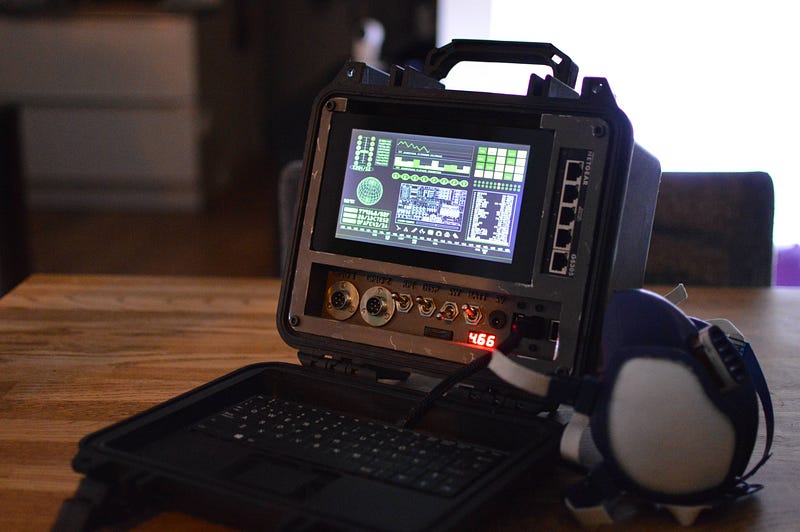
S.D.R.(Software Defined Radio):
Transforms radio communication by replacing analog hardware with software on computers or embedded systems. This enables flexible processing of signals, accommodating diverse radio protocols solely through software configurations. SDRs are crucial for military and cellular services, swiftly adapting to evolving radio protocols. Proponents foresee SDRs becoming the dominant technology in radio communications, alongside software-defined antennas, fostering innovation in cognitive radio technologies.
A brief history
S.D.R. traces its origins back to the 1970s where it was still under research concepts. Two decades later, in the 1990s S.D.R. gained momentum, driven by advancements in digital processing and computing. In 1984, Dr. Joseph Mitola III proposed the idea of software radios, where most signal capturing and processing functions could be executed via software under the same system. The late 1990s witnessed initiatives like the Joint Tactical Radio System (JTRS), aiming to develop software-defined radios for military use, fostering interoperability across platforms.
Commercially, S.D.R. gained traction in the early 2000s, with companies introducing products for diverse applications. Probably the most common use of S.D.R. that you have heard are USB tuner devices, used in old TVs for channel coverage since they weren't manufactured with a modern built-in DVB decoder for digital signals. Talking about decoders, yes, they are slightly a relevant of S.D.R. operating on fixed and predetermined frequencies, focusing on specific broadcast standards and formats.
Technical Info:
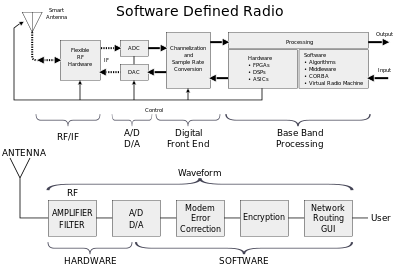

Just because I’m kind, I will spare you the boring technical info if you are not interested and quickly summarize them for you. So, in essence, S.D.R. fundamentally transforms radio communication from analog signals to digital signals thus shifting signal processing tasks from hardware to software, offering unprecedented flexibility, adaptability, and efficiency in radio system design and operation.
BUT, if you are interested here are the key principles in short:
- Signal Processing in Software: S.D.R. systems leverage digital signal processing (D.S.P.) techniques to manipulate radio signals. Instead of relying on analog components like mixers and filters, S.D.R. processes signals entirely through software algorithms executed on digital signal processors or general-purpose CPUs.
- Sampling: Typically involves sampling the radio frequency (RF) signal using an analog-to-digital converter (ADC). This conversion process transforms the continuous analog RF signal into a discrete digital signal that can be processed by digital circuits.
- Flexibility and Reconfigurability: S.D.R. offers unparalleled flexibility and reconfigurability compared to traditional, analog radios. By implementing signal processing tasks in software, they can easily adapt to different communication standards, protocols, frequencies, and modulation schemes without requiring hardware modifications.
- Direct Sampling: Some S.D.R. architectures employ direct sampling, where the RF signal is directly digitized without intermediate frequency (IF) conversion. This approach simplifies the hardware architecture and enables wideband operation but may require specialized ADCs with high sampling rates and dynamic range.
- Digital Filters and Signal Conditioning: Utilizes digital filters and signal conditioning techniques to manipulate and enhance the received signals. These digital processing blocks replace their analog counterparts, offering precise control and flexibility in signal processing tasks.
- Dynamic Spectrum Usage: One of its key advantages is its ability to dynamically allocate and utilize spectrum resources. S.D.R. systems can adaptively adjust their operating parameters and frequency bands based on changing environmental conditions and communication requirements, optimizing spectral efficiency.
Piracy
Any system created by the mind of man can be hacked by the mind of man. -Stephen King

Soon enough S.D.R found it self in the HAM(informal name amateur radio operator) community, providing enthusiasts with versatile tools for exploring and experimenting with radio communication. It allows amateur radio operators, to receive and transmit signals across a wide range of frequencies using flexible software-defined hardware. What I didn’t ,mention until now is the fact that S.D.R devices/modules cover a great range of frequencies(many bands) without any significant modification. Thus letting operators experiment on multiple bands both by receiving signals but also transmitting. Yes, you can obviously transmit using S.D.R. on regular frequencies either TV bands, VHF/UHF bands and even FM bands that are normally vested by radio stations. Obviously such action is ILLEGAL(in the vast majority of countries, check your local law regulations first)…Why are you interested?! In other words by exploiting the power of S.D.R, operators use devices in order to ‘step’ on frequencies that are already in use by someone else and transmit their own signals. The small detail that makes it different than traditional radio piracy is the fact that you can broadcast on multiple frequencies with the same device meaning that you can transmit sound or even images without having to dive in too deep into hardware modifications. For educational purposes I will provide some examples of such devices used for these purposes like RTL-SDR, HackRF One, AdamPluto EVEN THOUGH THEY ARE MANUFACTURED FOR TESTING PURPOSES ONLY AND THIS IS WHAT THEY SHOULD BE USED FOR!
Satellite Imagery
Following the same path and used by HAM operators but in a legal way they receive signals transmitted by satellites, including those used for remote sensing and Earth observation. These signals typically operate in various frequency bands, such as L-band or S-band, depending on the satellite and its mission. How it works: Weather satellites like NOAA’s POES and Meteosat utilize frequencies in the VHF/UHF range to broadcast imagery and meteorological data. Remote sensing satellites such as Landsat and Sentinel series operate in different bands like X-band and S-band for transmitting high-resolution imagery and environmental data. Software-defined radios (S.D.R.s) receive these signals using specialized antennas tuned to the satellite’s frequency. Once received, the data is decoded using appropriate software, such as GNU Radio, SDR++ or custom scripts. This software demodulates the signal, extracts the encoded information, and processes it into usable data, which could be satellite imagery, telemetry, or other scientific measurements. Through this process, enthusiasts and researchers access valuable satellite data for various applications, from weather monitoring to environmental research.

Conclusion
Software-defined radio (S.D.R.) offers vast potential for exploration and innovation in various fields. However, users must operate within legal boundaries and prioritize safety to avoid interference with licensed communication services. By responsibly leveraging S.D.R. technology, enthusiasts can continue to push the boundaries of radio communication while ensuring compliance and safety.